Bitcoin Retreats Toward $90K as Early-Week Rally Fades
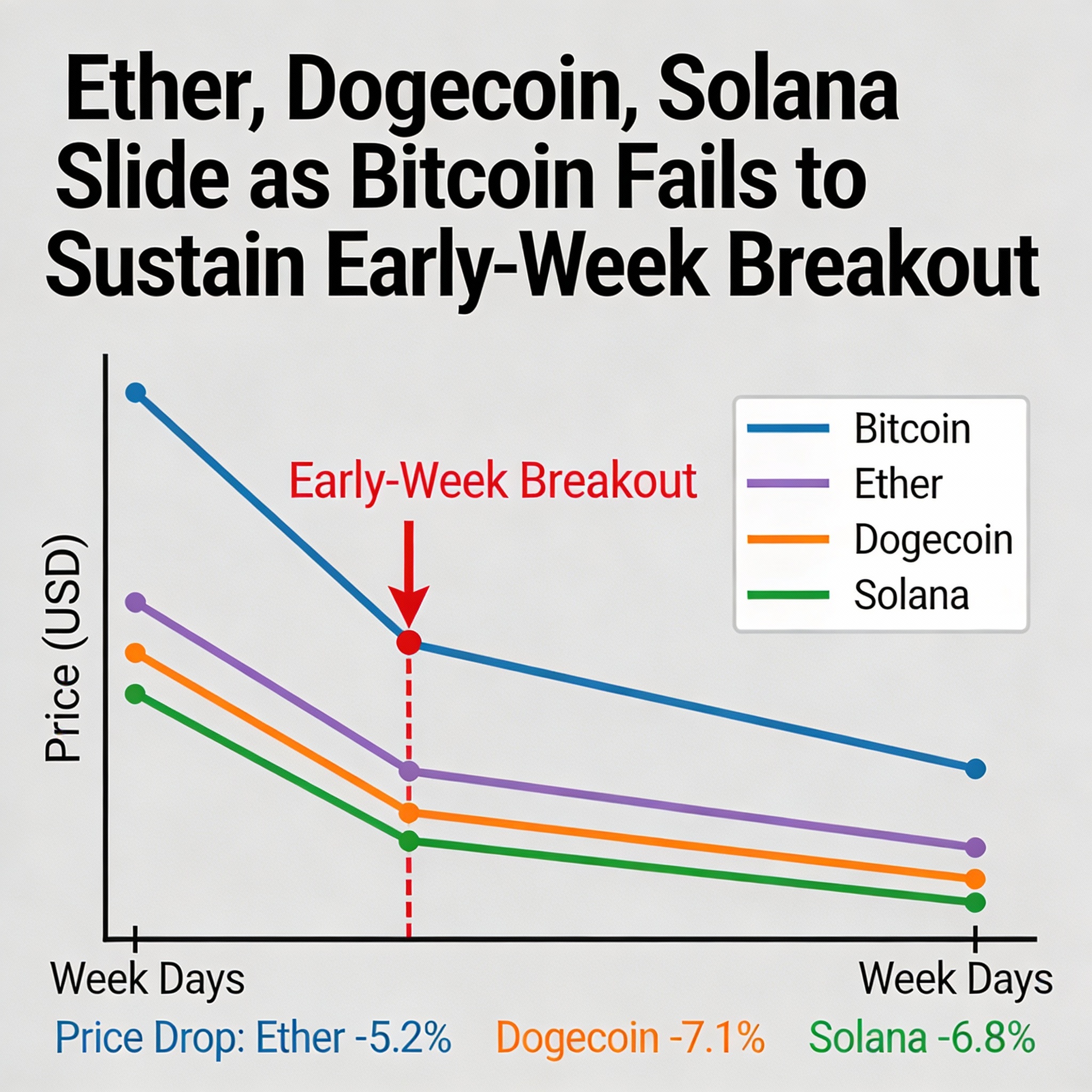
Bitcoin (BTC) fell toward $90,000 on Thursday, giving back most of Tuesday’s rebound despite the Federal Reserve’s expected rate cut and resumption of Treasury purchases. BTC had briefly surged above $94,500 earlier this week, triggering a minor short squeeze, but the move failed to breach the resistance that has capped price for the past three weeks.
Crypto markets broadly extended losses amid heightened volatility, with over $514 million in leveraged positions liquidated across derivatives venues in 24 hours. BTC traded near $90,250, down 2.4%, while Ether (ETH) fell 3.4% to $3,208. Solana (SOL) slid 5.8% to $133.84, and Dogecoin (DOGE) dropped 5.5% to $0.139. Seven-day losses were widespread, including XRP (-8.6%), ADA (-7.2%), and BNB (-5.9%), according to CoinGecko.
The pullback returned BTC to the middle of its month-long range, where thin liquidity and concentrated liquidation clusters continue to influence price swings. “We’ve seen higher local highs and lows since 21 November,” said Alex Kuptsikevich, senior market analyst at FxPro. “However, for sustained capitalization growth, market cap would need to surpass $3.32 trillion,” roughly 6% above current levels. The global crypto market cap currently sits near $3.16 trillion.
Leverage contributed to the decline, with CoinGlass reporting $376 million in long liquidations—almost triple the $138 million in shorts—as BTC slipped below its short-term trend line.
Macro conditions offered little support. While the Fed cut rates, it projected fewer reductions over the next two years, highlighting internal divisions. QCP Capital expects BTC to trade within a wider $84,000–$100,000 range through year-end, while Bloomberg Intelligence strategist Mike McGlone cautioned that a “Santa Claus rally” may not materialize.
Traders are closely watching the $90,000–$91,000 support zone. A decisive break lower could test the bottom of the current range, while stabilization may set the stage for another attempt at $94,000 resistance as markets digest post-Fed conditions.