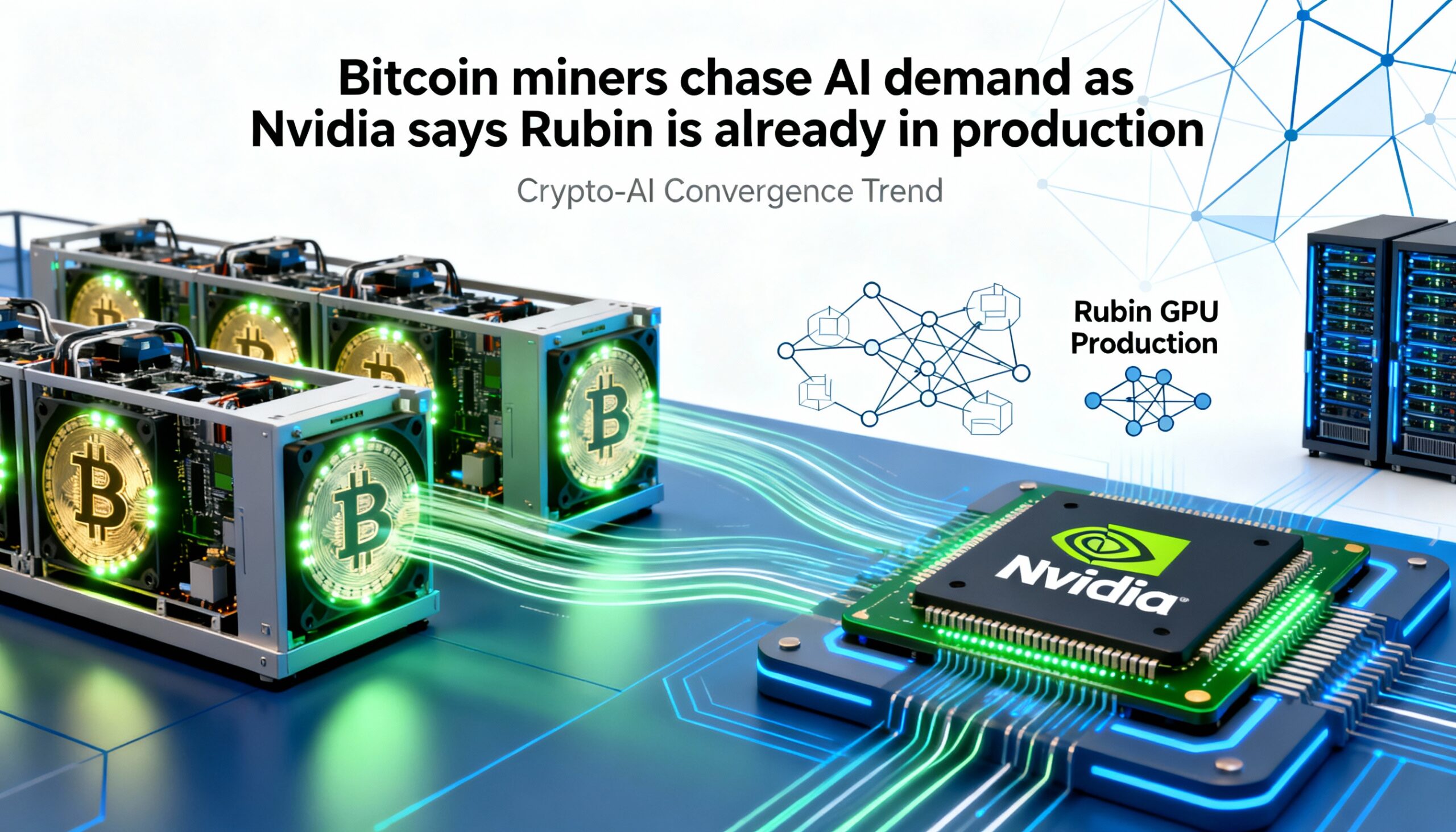
Bitcoin miners that can successfully reposition as infrastructure providers are likely to benefit from the AI investment cycle, while those tied to pure mining economics may face increasing strain as 2026 approaches.
At the CES technology show in Las Vegas, Nvidia Chief Executive Jensen Huang said the company’s next-generation Vera Rubin platform is already in full production. He said the system delivers about five times the artificial-intelligence computing power of Nvidia’s previous architecture.
Rubin, expected to be released later this year, is aimed at AI inference — the fastest-growing segment of the market focused on generating outputs from trained models. Huang said Nvidia’s flagship Rubin server will include 72 graphics processing units and 36 central processors, and can be scaled into larger “pods” containing more than 1,000 chips.
Efficiency featured prominently in Nvidia’s presentation. Huang said Rubin could improve the efficiency of generating AI “tokens,” the core units produced by large language models, by roughly tenfold. Those gains come despite only a 1.6-times increase in transistor count, aided by a proprietary data format Nvidia hopes will gain broader adoption.
Huang framed AI development as an infrastructure arms race, where faster processing shortens time to breakthroughs and forces competitors to spend heavily on computing hardware, networking and storage.
Impact on the mining sector
That same arms race is reshaping parts of the crypto industry. Bitcoin miners are increasingly pitching themselves as energy and data-center operators rather than pure crypto plays, emphasizing long-term power contracts, cooling capacity and existing facilities to AI customers.
For miners with access to cheap power and established sites, hosting AI workloads can offer more stable revenues than bitcoin mining during cyclical downturns. But demand from hyperscalers, cloud providers and AI startups is intensifying competition for premium data-center locations.
Higher rents, rising equipment costs and tougher financing conditions are raising barriers, particularly for smaller operators. The result is a growing divide: miners that resemble infrastructure companies may thrive, while those reliant on mining margins alone could struggle heading into 2026.
Nvidia also highlighted new networking switches based on co-packaged optics, a technology essential for linking thousands of machines into unified systems. The company said CoreWeave will be among the first customers for Rubin systems, with Microsoft, Oracle, Amazon and Alphabet also expected to adopt the platform.