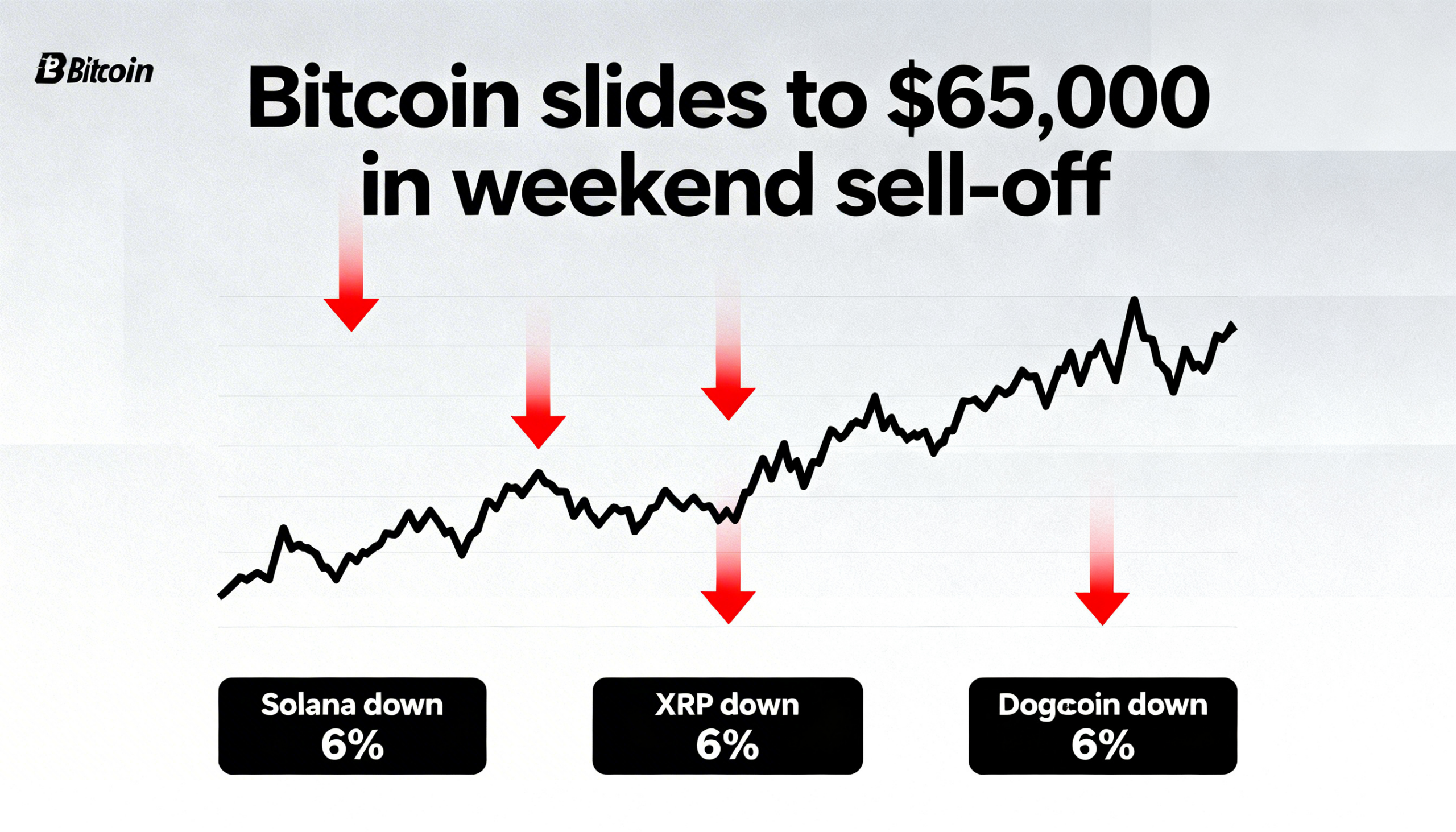
Bitcoin’s rebound toward $70,000 proved short-lived, with the broader pullback in equities and renewed inflation worries dragging crypto prices lower into the weekend.
Bitcoin slipped to $65,735 during early Asian trading on Saturday, marking a 3% decline over 24 hours and nearly 3% for the week. The midweek surge that briefly pushed prices close to $70,000 has now surrendered more than half of its gains as risk appetite faded during Thursday and Friday’s U.S. sessions.
Losses were steeper across major altcoins. Solana tumbled 6.7%, Ethereum fell 6.2%, Dogecoin dropped 5.1%, and XRP declined 4%. The downturn erased the week’s earlier altcoin strength, pushing most large-cap tokens back into negative territory. BNB held up relatively well, sliding about 2.5%.
The weakness coincided with a softer finish in traditional markets. On Friday, the S&P 500 closed 0.4% lower, the Nasdaq-100 lost 0.3%, and the Dow Jones Industrial Average fell 1.1%. Shares of Nvidia extended their post-earnings retreat, declining another 4.2%.
Adding to the cautious tone, producer prices rose 0.5%—hotter than expected—reinforcing concerns that the Federal Reserve may delay interest-rate cuts. Layoffs announced by Block, Inc. also amplified unease about broader economic conditions and the labor-market impact of accelerating AI adoption.
As is often the case, crypto mirrored equity losses but with greater intensity. A modest pullback in stock indexes translated into a sharper decline in digital assets, as leverage built during Wednesday’s rally was flushed out during the reversal.
The retreat comes despite solid institutional inflows earlier in the week. U.S. spot bitcoin ETFs absorbed $1.1 billion over three days, setting up what had been shaping into one of their strongest weekly performances in months. Still, ETF demand has not been sufficient to offset macro-driven headwinds.
“Focusing too much on short-term volatility misses the bigger picture,” said Dom Harz, co-founder of bitcoin finance firm BOB, noting that market swings remain typical for the asset class, even as the composition of capital entering the market evolves.
Meanwhile, data from CryptoQuant shows Tether reserves on exchanges have fallen from $60 billion to $51.1 billion over the past two months. The firm warned that a drop below the $50 billion mark could increase the risk of an accelerated sell-off.
Shares of Strategy, known for its debt-funded bitcoin buying strategy, have also drawn heavy short interest as investors question the sustainability of its approach.
On the Ethereum front, selling pressure has intensified among some large holders, with digital asset firm ETHZilla halting its ether accumulation strategy and pivoting toward tokenized real-world assets.
With bitcoin back in the middle of the $60,000–$70,000 trading range that has defined price action since early February, the latest failed breakout underscores resistance near $70,000. The key question heading into March is whether support around $60,000 can continue to hold