


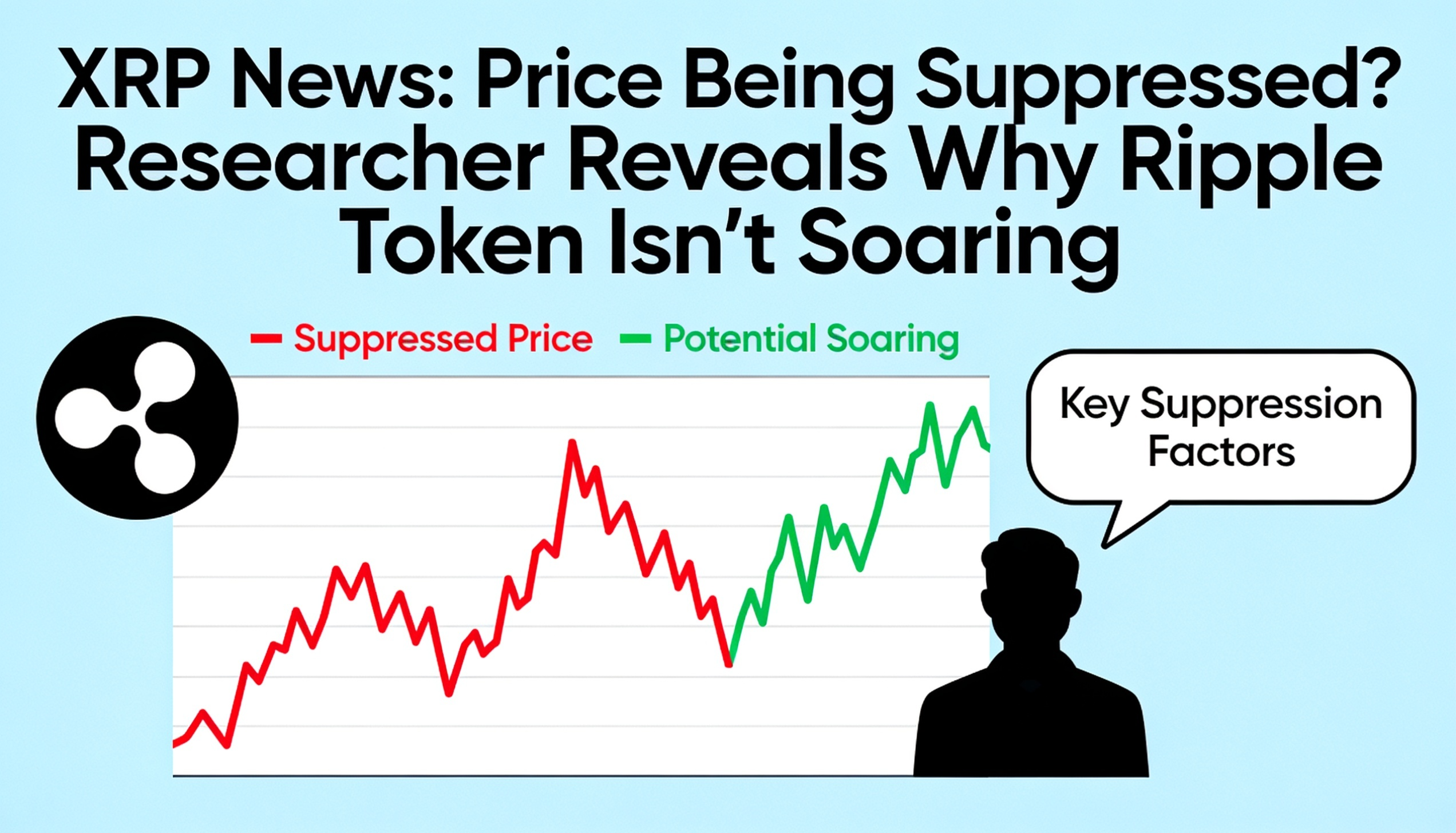
A debate over XRP’s muted price performance has resurfaced after Apex Crypto researcher Jesse suggested that the token may be facing intentional downward pressure. His argument centers on a 2021 Citibank document that originally used the term “Regulated Internet of Value” before it was later revised to “Regulated Liability Network.”
According to Jesse, the change was more than a simple rebranding exercise. He argues that the original terminology closely reflected Ripple’s long-standing Internet of Value vision, making the connection to the company too apparent. The subsequent revision, he claims, distanced the concept from Ripple while preserving the same underlying framework.
The theory has gained attention among XRP supporters, many of whom continue to question why the token has failed to deliver outsized gains despite Ripple’s steady expansion into institutional finance and cross-border payments. Given Ripple’s partnerships, enterprise adoption efforts, and the ambitions of the Interledger Protocol, some investors view XRP’s relatively flat long-term performance as difficult to reconcile.
Citibank’s Language Shift Draws Scrutiny
Jesse’s argument begins with Citibank’s use of the phrase “Regulated Internet of Value” in a 2021 paper. He contends that the concept closely mirrored Ripple’s own vision of seamlessly transferring value across financial networks. When Citibank later adopted the term “Regulated Liability Network,” Jesse interpreted the move as an effort to remove an obvious association with Ripple.
The discussion extends beyond terminology. Tony McLaughlin, one of the key figures behind the Regulated Liability Network initiative, has described the project as a shared-ledger framework for tokenized bank deposits. Many observers have noted similarities between that model and the type of interconnected financial infrastructure Ripple has promoted for more than a decade.
At the same time, global institutions are increasingly exploring unified settlement systems. The Bank for International Settlements has outlined ledger-based architectures that could connect multiple forms of money and financial assets within a single framework, potentially transforming the way cross-border transactions are processed. Such proposals have fueled speculation about whether Ripple’s technology could eventually play a role in next-generation financial networks.
Based on this line of thinking, Jesse argues that institutions would have little interest in supporting a highly volatile settlement asset. If XRP were positioned as a foundational layer within future payment infrastructure, stability could be viewed as more valuable than rapid price appreciation.
Ripple Maintains There Is No Evidence of Manipulation
While the theory has generated discussion, it remains largely speculative. Ripple executives have consistently dismissed suggestions that XRP’s price is being controlled or artificially constrained. CEO Brad Garlinghouse has previously stated that the asset’s substantial daily trading volume makes manipulation by any single participant highly unlikely. Likewise, CTO David Schwartz has argued that XRP’s market behavior is broadly consistent with that of other major altcoins.
Regulatory findings also offer little support for suppression claims. Before launching its enforcement action against Ripple in 2020, the SEC conducted an investigation spanning roughly 18 months and did not accuse the company of manipulating XRP’s market price.
As a result, Jesse’s case rests primarily on interpretations of public documents and perceived institutional connections rather than direct evidence such as trading records, internal communications, or regulatory disclosures.
Whether the theory holds merit remains an open question. Nevertheless, the discussion highlights a broader issue that continues to intrigue market participants: the apparent disconnect between Ripple’s institutional progress and XRP’s inability to sustain the type of price growth many investors once expected.

















































Leave a Reply