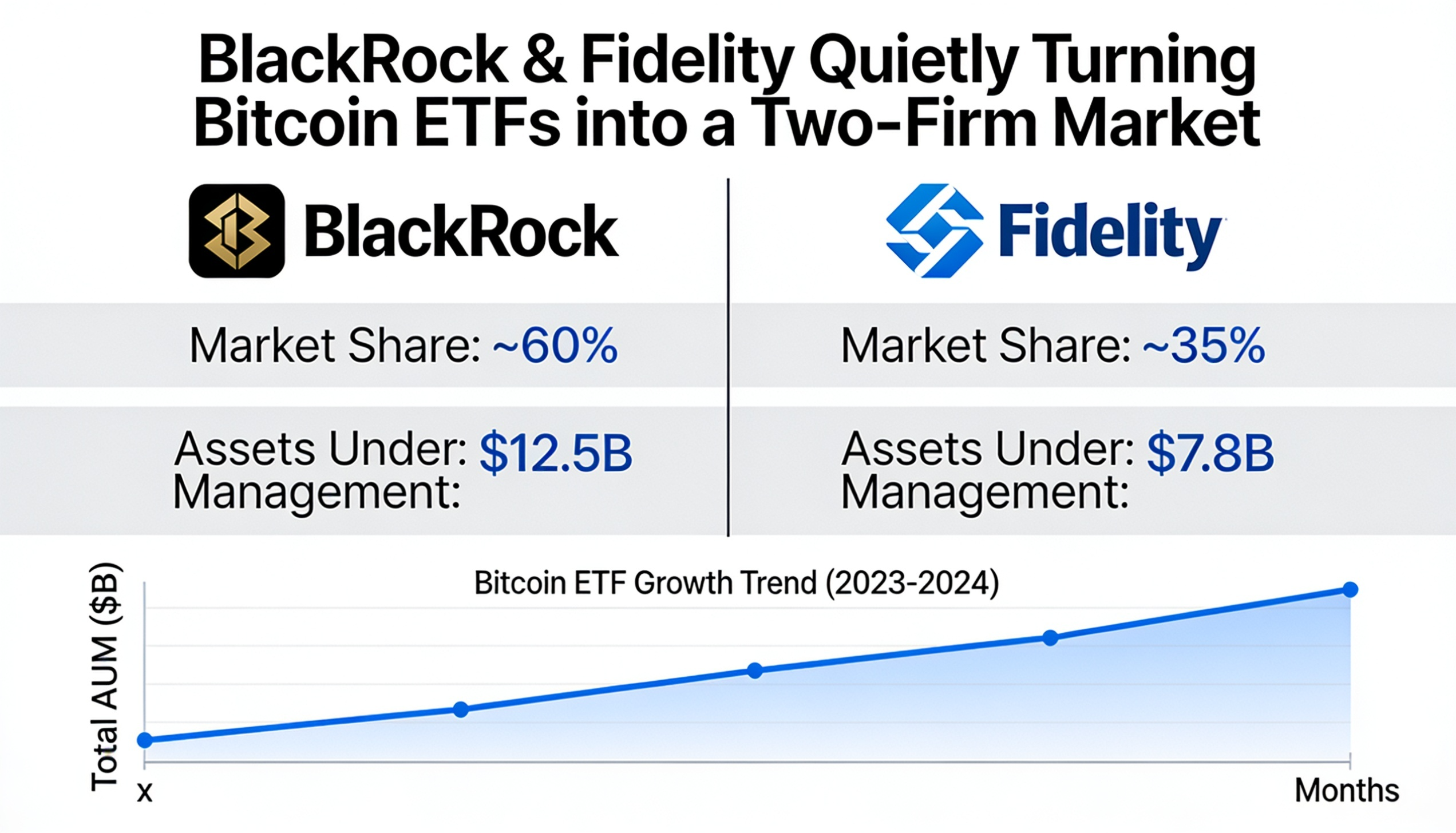
BlackRock’s IBIT and Fidelity’s FBTC are now capturing the overwhelming majority of new inflows into bitcoin ETFs, while smaller funds are steadily losing relevance as institutional investors concentrate capital in the largest, most liquid products.
When U.S. spot bitcoin ETFs launched in January 2024, the market featured more than a dozen issuers, including BlackRock, Fidelity, Ark Invest, Bitwise, VanEck, and Franklin Templeton, creating expectations of intense competition across the sector.
Eighteen months later, that competitive field has largely narrowed into a two-player dominance.
Flow data shows IBIT and FBTC consistently account for most major inflow days, while smaller ETFs increasingly play only a marginal role in shaping overall market direction.
The pattern has been consistent throughout 2026.
On January 14, for example, total inflows reached $840.6 million, with IBIT contributing $648.4 million and FBTC adding $125.4 million—together representing more than 90% of flows. A similar concentration appeared on April 17, when the two funds accounted for roughly two-thirds of $663.9 million in inflows.
Even during weaker sessions, the same dynamic holds. On May 1, IBIT and FBTC together made up nearly $500 million of $629.8 million in total inflows.
Although year-to-date data shows occasional exceptions—such as stronger inflows into Grayscale’s Bitcoin Mini Trust compared with IBIT—the broader trend remains clear: BlackRock and Fidelity continue to absorb the majority of new capital entering spot bitcoin ETFs.
This consolidation has taken shape during a challenging year for crypto markets, with bitcoin down roughly 29% year-to-date and ETF flows swinging between inflows and sharp redemptions. Periodic selloffs in mid-May and early June highlight a shift away from earlier patterns where dips were consistently bought.
Still, allocation decisions are increasingly driven by scale, liquidity, and institutional trust.
BlackRock has emerged as the primary beneficiary.
IBIT has become the flagship product in the bitcoin ETF space, frequently leading inflows and showing relative resilience during market stress. On several days of broad outflows, it either remained positive or experienced smaller redemptions than competitors.
This reflects the profile of ETF buyers, which includes financial advisers, RIAs, hedge funds, family offices, and pension consultants—investors who prioritize execution quality, liquidity, and issuer credibility alongside exposure.
With over $10 trillion in assets under management and a vast global distribution network, BlackRock holds a structural advantage, while Fidelity benefits from its strong position in both retail brokerage and institutional investing.
As a result, IBIT and FBTC are increasingly viewed as default vehicles for bitcoin exposure.
By contrast, smaller issuers are struggling to maintain meaningful traction.
Funds from firms such as Franklin Templeton, VanEck, Valkyrie, and WisdomTree typically see modest daily flows that have limited impact on overall market direction.
Even earlier competitors like Bitwise and Ark have shifted into secondary roles, underscoring how quickly leadership in the sector has consolidated.
During volatile market periods, the concentration becomes even more pronounced: the net direction of ETF flows is effectively determined by IBIT and FBTC alone, often deciding whether the entire category ends the day in net inflow or outflow.
Overall, the data points to a market structure evolving from broad competition into a winner-take-most model, where scale, liquidity, and distribution increasingly define success.