FlightAware Withdraws Kalshi Lawsuit as Flight-Betting Market Sees Little Demand
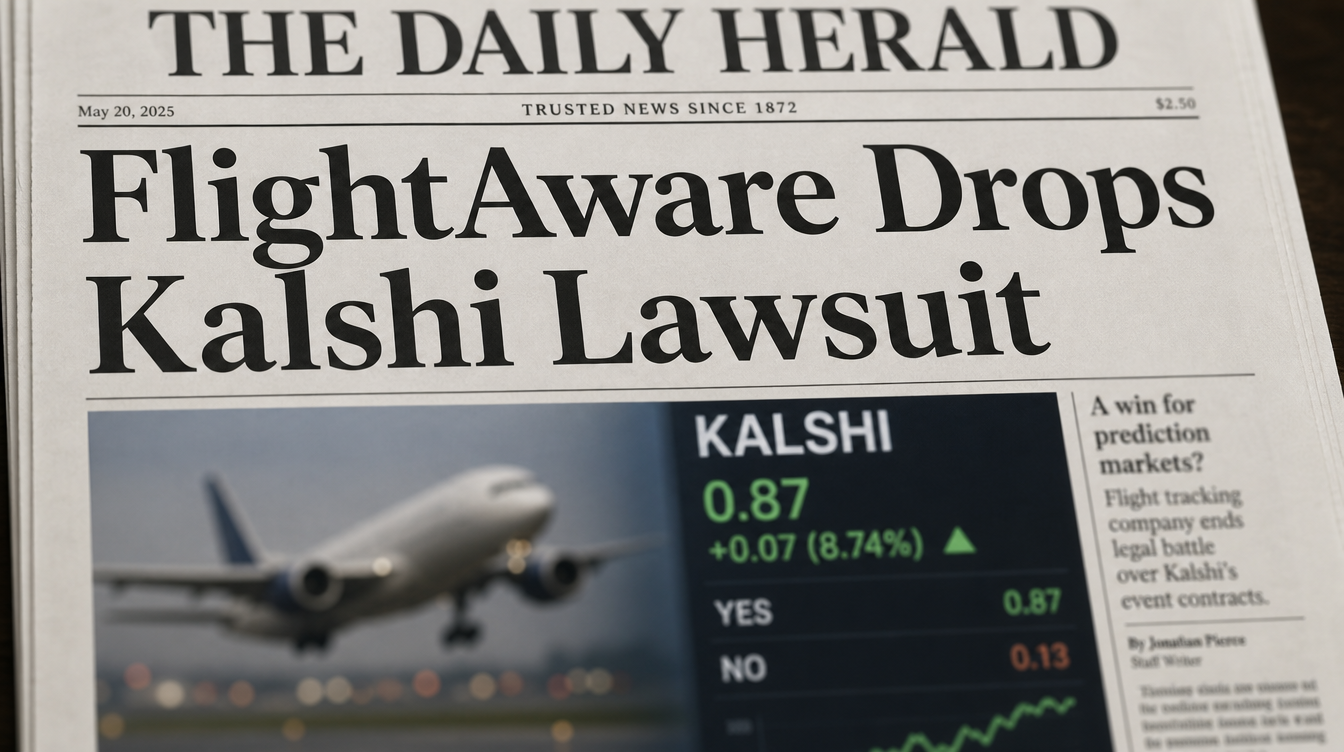
FlightAware has dropped its lawsuit against prediction-market operator Kalshi, withdrawing the case just one day after filing it in a New York federal court. The flight-tracking company dismissed the action voluntarily and without prejudice, while offering no explanation for the decision.
Because the case was dismissed without prejudice, FlightAware could potentially bring the claims again at a later date. The withdrawal also came as Kalshi’s flight-cancellation contracts appeared to attract very limited trading activity.
FlightAware filed the dismissal notice in the U.S. District Court for the Southern District of New York but did not disclose why it decided to end the case so quickly.
One possible explanation is a combination of negative reactions on social media and weak demand for Kalshi’s aviation-related prediction markets.
Kalshi’s Flight Contracts See Minimal Activity
Kalshi previously paused its flight-cancellation contracts after users on social media raised concerns that individuals could deliberately interfere with flights and profit from the resulting prediction-market payouts, according to a Fortune report published in July.
Available trading figures also suggest the market struggled to attract participants. The U.S. flight-cancellation contract scheduled to run through Aug. 14 had recorded only 31,412 contracts traded, generating approximately $1,842 in total volume. Open interest stood at about 1,120 contracts.
Those numbers are tiny compared with Kalshi’s overall activity. The platform has recorded roughly $148 billion in trading volume this year, according to its own data.
The dismissal notice does not clarify whether FlightAware and Kalshi reached an agreement or whether Kalshi changed the markets or the data source used to settle its contracts.
Neither company immediately provided a response to requests for comment.
FlightAware Challenged Kalshi’s Use of Its Data
FlightAware had accused Kalshi of using its flight information and trademark without authorization to support contracts tied to airline cancellations.
The company sought financial damages and an injunction against markets that allowed users to speculate on cancellation rates across the U.S. or at individual airports.
Kalshi disputed the allegations, maintaining that it had not breached FlightAware’s licensing rights or infringed its trademark. The prediction-market operator argued that references to FlightAware represented nominative fair use.
The original complaint also stated that Kalshi had identified U.S. Department of Transportation flight data as another potential source for determining contract outcomes.
Case Ends Before Kalshi Files a Response
FlightAware withdrew the lawsuit before Kalshi submitted an answer or filed a motion for summary judgment. That timing allowed FlightAware to dismiss the action on its own under Federal Rule of Civil Procedure 41.
Kalshi launched its nationwide and airport-specific flight-cancellation contracts on July 14, the same day it submitted a filing to the Commodity Futures Trading Commission seeking approval to list the event contracts.
The products allowed traders to take positions on the percentage of scheduled flights expected to be canceled over a defined period.
FlightAware’s withdrawal followed a separate development involving Kalshi and the CFTC. One day earlier, the regulator announced that Kalshi had been ordered to continue operating in New York amid an ongoing dispute with the state.
Kalshi and other prediction-market companies are also dealing with lawsuits in Wisconsin and Nevada. FlightAware’s case was somewhat different because it focused on whether a prediction platform could use another company’s data and trademark to settle contracts without entering into a commercial licensing agreement.
For now, FlightAware has ended the legal dispute, although the dismissal without prejudice means the company has not permanently surrendered its ability to pursue the claims.