SEC-CFTC Crypto Roadmap Advances as CLARITY Act Remains Stalled
The SEC and CFTC are developing a clearer framework for digital-asset oversight while Congress continues to face obstacles in advancing the long-awaited CLARITY Act.
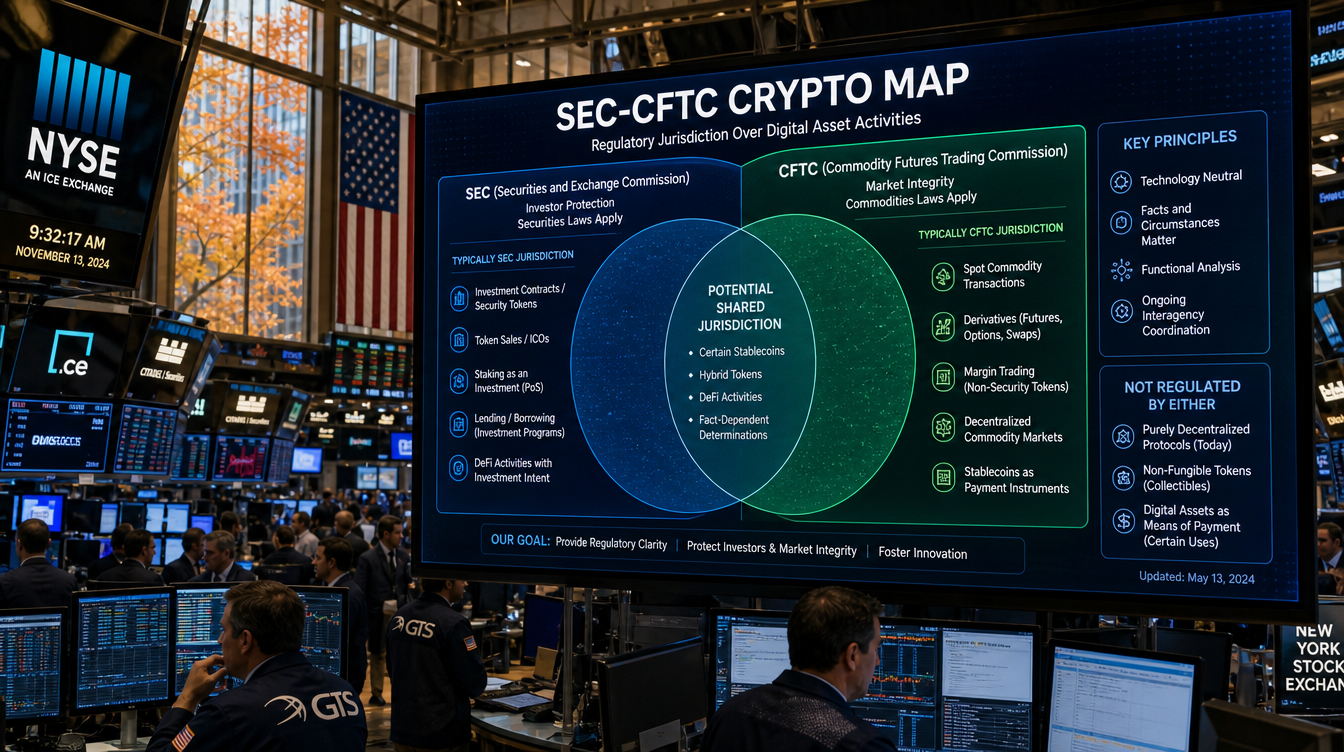
The two agencies recently issued joint guidance dividing digital assets into five categories: digital commodities, digital collectibles, digital tools, stablecoins and digital securities.
The classification provides exchanges, token issuers and traders with a clearer indication of how different crypto assets could be treated under U.S. regulations. However, the framework is based on agency interpretation rather than legislation, so it does not carry the same permanence as rules approved by Congress.
The announcement comes as crypto investors await the latest U.S. CPI figures. Bitcoin remains near $64,000, and the inflation data could influence whether BTC continues moving sideways or breaks out of its current trading range.
New Classification System Fills a Regulatory Gap
The SEC-CFTC framework generally places digital commodities, collectibles, tools and stablecoins outside securities regulation. Digital securities, meanwhile, remain the asset class most clearly subject to SEC oversight.
The SEC has also retained the ability to assert jurisdiction over specific assets that may otherwise be considered nonsecurities, depending on their individual circumstances. This leaves some uncertainty despite the new classification system.
The unresolved jurisdictional questions are among the reasons Congress has been pursuing the CLARITY Act. The legislation aims to create clearer statutory boundaries between the SEC and CFTC, while the latest guidance provides a temporary framework until lawmakers reach an agreement.
Ian Katz, managing partner at Capital Alpha, said regulators are continuing to act rather than putting their efforts on hold while Congress works through the legislation. The slow pace of formal policymaking makes regulatory action necessary in the meantime.
SEC Chair Paul Atkins has also defended the approach, describing the framework at the DC Blockchain Summit as an overdue move toward greater certainty for the digital-asset sector.
Atkins has outlined additional proposals that could include exemptions for startups and fundraising activities, as well as a safe harbor for crypto assets that eventually move beyond securities treatment. Making such measures permanent would require legislative action.
Senate Disagreements Continue to Delay CLARITY Act
Although the House approved the CLARITY Act last July, the bill has struggled to make similar progress in the Senate.
The Senate Agriculture Committee has advanced its portion without Democratic votes, while the Banking Committee has encountered separate challenges, including the loss of support from Coinbase.
Stablecoin rewards remain a major source of disagreement. Banking groups have pushed for stricter limitations, while crypto companies argue that excessive restrictions could make digital assets less competitive.
President Trump has criticized banks over their position on the GENIUS Act and has called for faster progress on crypto market-structure legislation.
Senators Angela Alsobrooks and Thom Tillis have reportedly reached a bipartisan understanding on stablecoin rewards, although the specific terms have not been fully disclosed.
David Carlisle of Elliptic said the joint SEC-CFTC guidance offers the crypto industry some additional certainty while lawmakers continue negotiating the legislation.
The Road Ahead for Crypto Regulation
Passing the CLARITY Act would still require several stages even if the Senate advances its version. The Banking Committee bill would have to be reconciled with the Agriculture Committee’s proposal, followed by an effort to secure the 60 votes needed in the Senate.
The resulting legislation would then have to be reconciled with the House-approved CLARITY Act before reaching the president.
With the midterm elections approaching, lawmakers have a shrinking window to complete the process, potentially increasing pressure for a compromise.
Sen. Bernie Moreno has warned that if the CLARITY Act does not pass by May, comprehensive digital-asset legislation could remain out of reach for an extended period.
For market participants, the difference between regulatory guidance and federal law remains significant. Agency interpretations can be modified or withdrawn by future regulators without congressional approval, while legislation offers a more stable and lasting framework.
The SEC-CFTC initiative therefore provides useful near-term clarity, but it does not resolve the broader legislative debate. Until Congress establishes permanent market-structure rules, regulatory uncertainty will continue to influence crypto businesses, institutional participation and digital-asset markets.