SEC-CFTC Crypto Rules Move Ahead as CLARITY Act Hits Roadblocks
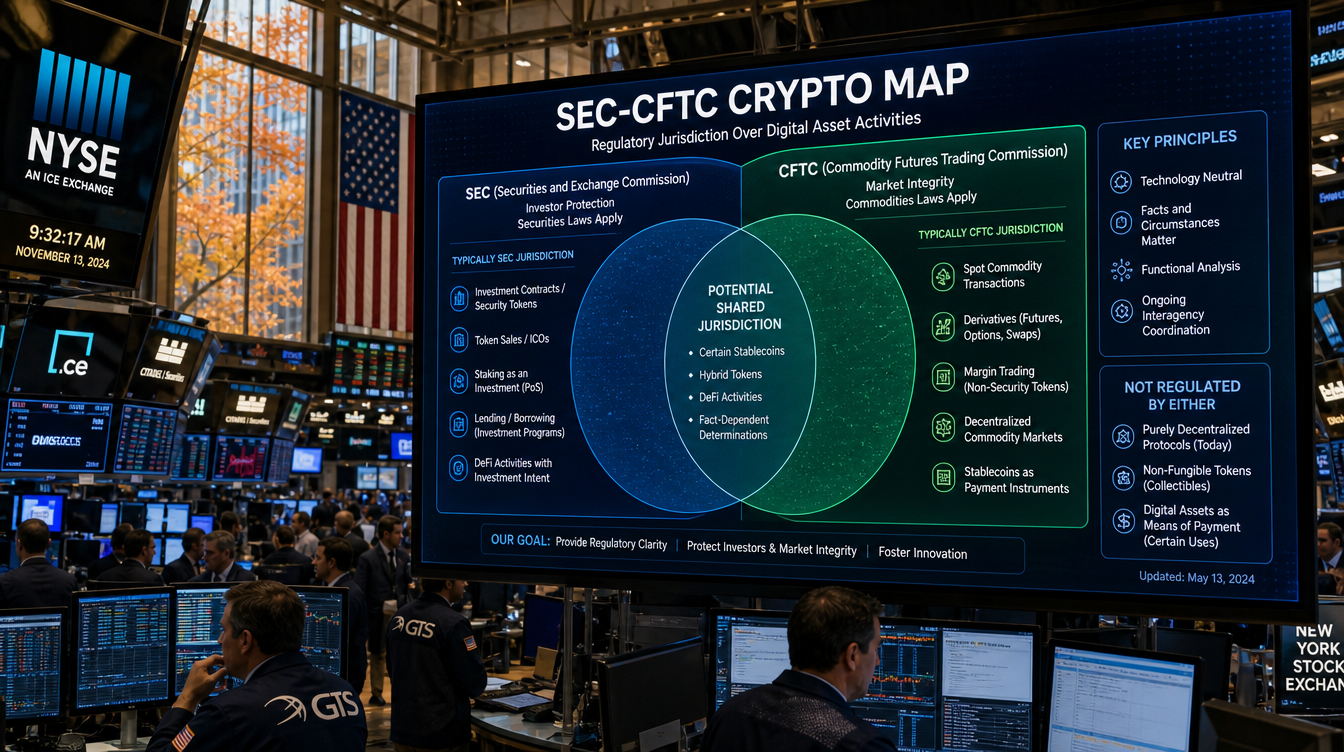
The SEC and CFTC have taken another step toward defining U.S. crypto oversight by issuing joint guidance that places digital assets into five categories: digital commodities, digital collectibles, digital tools, stablecoins and digital securities.
The framework indicates that regulators are moving forward with their own approach to crypto classification rather than waiting for the Senate to resolve the stalled CLARITY Act.
For crypto exchanges, token issuers and traders, the guidance provides a clearer picture of how regulators may view different types of digital assets. However, it remains an agency interpretation rather than a law passed by Congress, meaning its long-term authority is less certain.
The development comes as crypto traders await the latest CPI report, with Bitcoin hovering around $64,000. New inflation data could determine whether BTC breaks out of its recent consolidation range.
SEC and CFTC Create Interim Crypto Taxonomy
The joint framework generally places digital commodities, digital collectibles, digital tools and stablecoins outside securities regulation. Digital securities remain the category most directly subject to SEC oversight.
The SEC, however, has retained the ability to exercise jurisdiction over individual assets that may otherwise be considered nonsecurities under certain circumstances. That qualification leaves some uncertainty in the regulatory landscape.
The ambiguity is significant because a comprehensive market-structure law would provide statutory definitions and clearer boundaries between the SEC and CFTC. Until Congress acts, the new framework effectively serves as an interim solution.
Ian Katz, managing partner at Capital Alpha, said regulators are attempting to make progress rather than halt their work while waiting for lawmakers. He noted that the slow pace of formal legislation makes continued regulatory action necessary.
SEC Chair Paul Atkins expressed a similar view at the DC Blockchain Summit, presenting the guidance as a long-awaited development.
Atkins has also discussed a broader framework that could include exemptions for startups and fundraising, as well as a safe harbor for crypto assets that eventually move beyond securities classification.
Stablecoins Remain a Major Senate Dispute
The House passed the CLARITY Act last July, but the legislation has encountered significant resistance in the Senate.
The Agriculture Committee has advanced its portion without Democratic backing, while the Banking Committee has faced additional complications, including the withdrawal of Coinbase’s support.
Stablecoin rewards are among the most contentious issues. Banks favor stricter limits on reward-bearing stablecoins, while crypto companies argue that such restrictions could weaken their ability to compete.
President Trump has criticized banks over their handling of the GENIUS Act and has called for lawmakers to move quickly on crypto market-structure legislation.
Senators Angela Alsobrooks and Thom Tillis have reportedly reached a bipartisan understanding on stablecoin rewards, although the specific terms of the agreement remain unclear.
David Carlisle of Elliptic said the SEC-CFTC interpretation provides some welcome clarity for the market while Congress continues to debate the legislation.
The Legislative Clock Is Still Ticking
Even if the Senate Banking Committee advances its version of the legislation, lawmakers would still need to reconcile it with the Agriculture Committee’s bill. The resulting measure would then need to pass the Senate’s 60-vote threshold and be reconciled with the CLARITY Act already approved by the House.
The process could become increasingly difficult as the midterm election cycle approaches and congressional attention shifts toward campaigning.
Sen. Bernie Moreno has emphasized the time pressure, warning that failure to pass the CLARITY Act by May could leave the digital-asset industry without major new legislation for an extended period.
For crypto markets, the distinction between regulatory guidance and federal law is particularly important. An SEC interpretation can potentially be changed or withdrawn by a future commission, whereas statutory requirements generally provide a more durable regulatory foundation.
That difference could continue influencing institutional participation and capital flows. Until Congress establishes a permanent market-structure framework, the SEC-CFTC guidance may provide direction, but it is unlikely to eliminate regulatory uncertainty entirely.