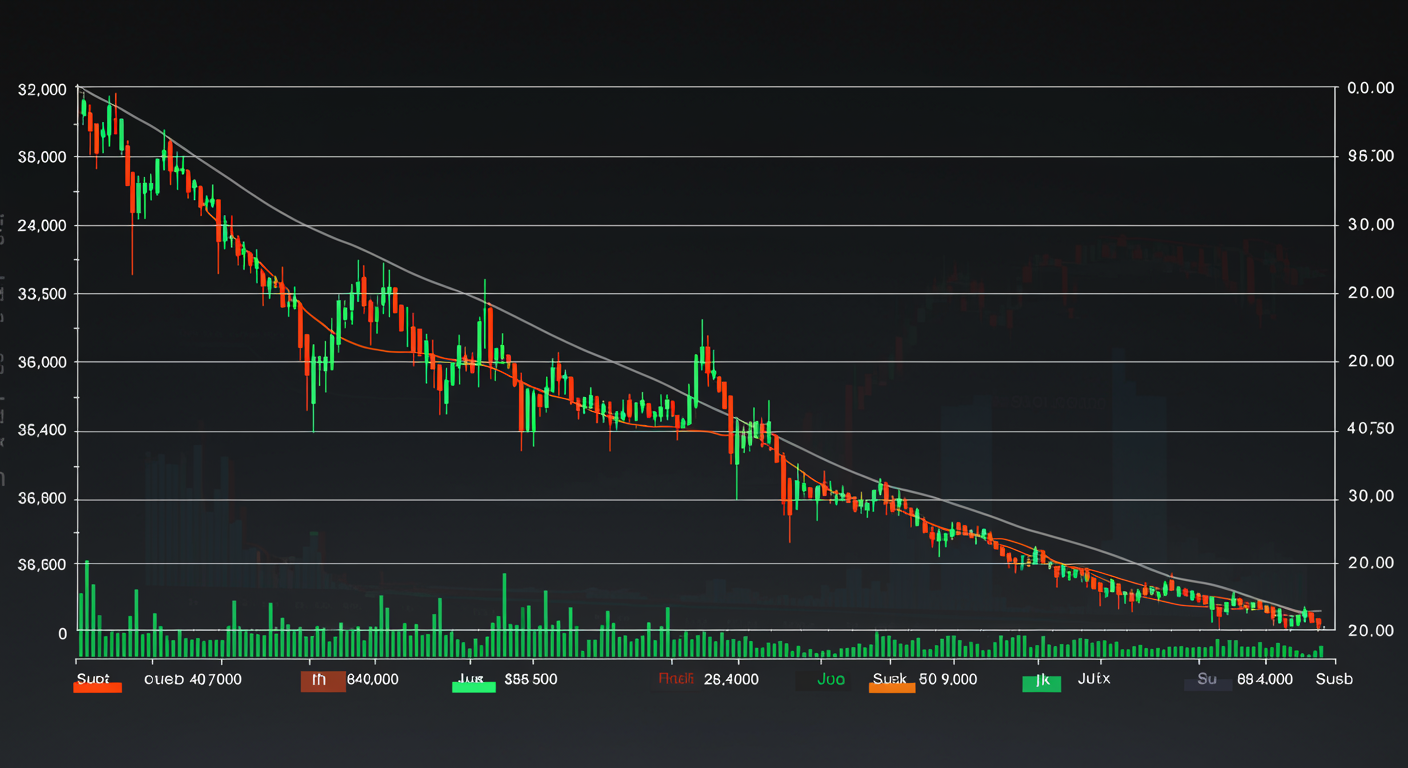
Bitcoin’s slip below $68,000 is emerging as a critical fault line, with options market positioning increasing the risk of a deeper, momentum-driven sell-off.
The latest decline comes as geopolitical tensions resurface, following President Donald Trump’s renewed hardline stance on Iran. Bitcoin has fallen roughly 2% over the past 24 hours to around $67,000. While the move may appear modest, underlying derivatives dynamics point to a more fragile setup.
The pressure is building in the Deribit options market, where traders have been активно accumulating downside protection. A heavy concentration of put options now sits just below current levels, spanning from $68,000 down to the mid-$50,000 range—reflecting caution amid macro uncertainty and lingering bearish sentiment.
This positioning has created a “negative gamma” zone, a condition where market makers—who are on the opposite side of these trades—must hedge in ways that amplify price moves. In a falling market, that typically means selling into weakness, accelerating declines.
Glassnode data shows dealer gamma exposure is largely negative between $68,000 and $50,000. In effect, dealers are short puts, meaning they face increasing losses as prices fall and are likely to hedge by shorting bitcoin, adding further downside pressure.
This dynamic can create a feedback loop: lower prices trigger more hedging, which pushes prices down even further. Such setups have historically intensified both rallies and drawdowns, but in the current context, the bias is clearly to the downside.
That makes the breach of $68,000 particularly significant. It not only signals technical weakness but also opens the door to a range where forced selling could accelerate.
According to Glassnode, negative gamma is building just below current levels, extending from $68,000 into the high-$50,000s. A move into this zone could lead to “accelerated selling,” with the potential for a sharper repricing toward $60,000—a level last seen during the February sell-off.
Thin liquidity may further amplify the risk. Following the March 27 options expiry, market depth has declined and is expected to remain subdued through the Easter holiday period, limiting the market’s ability to absorb additional selling pressure.
If this feedback loop fully takes hold, bitcoin could extend its decline well below $60,000.
While recent price action has been influenced by geopolitical headlines, the current setup highlights how internal market mechanics can shape outcomes. Holding above $68,000 could help stabilize conditions, but a sustained move lower risks triggering a cascade of selling that turns a routine pullback into a much deeper correction.