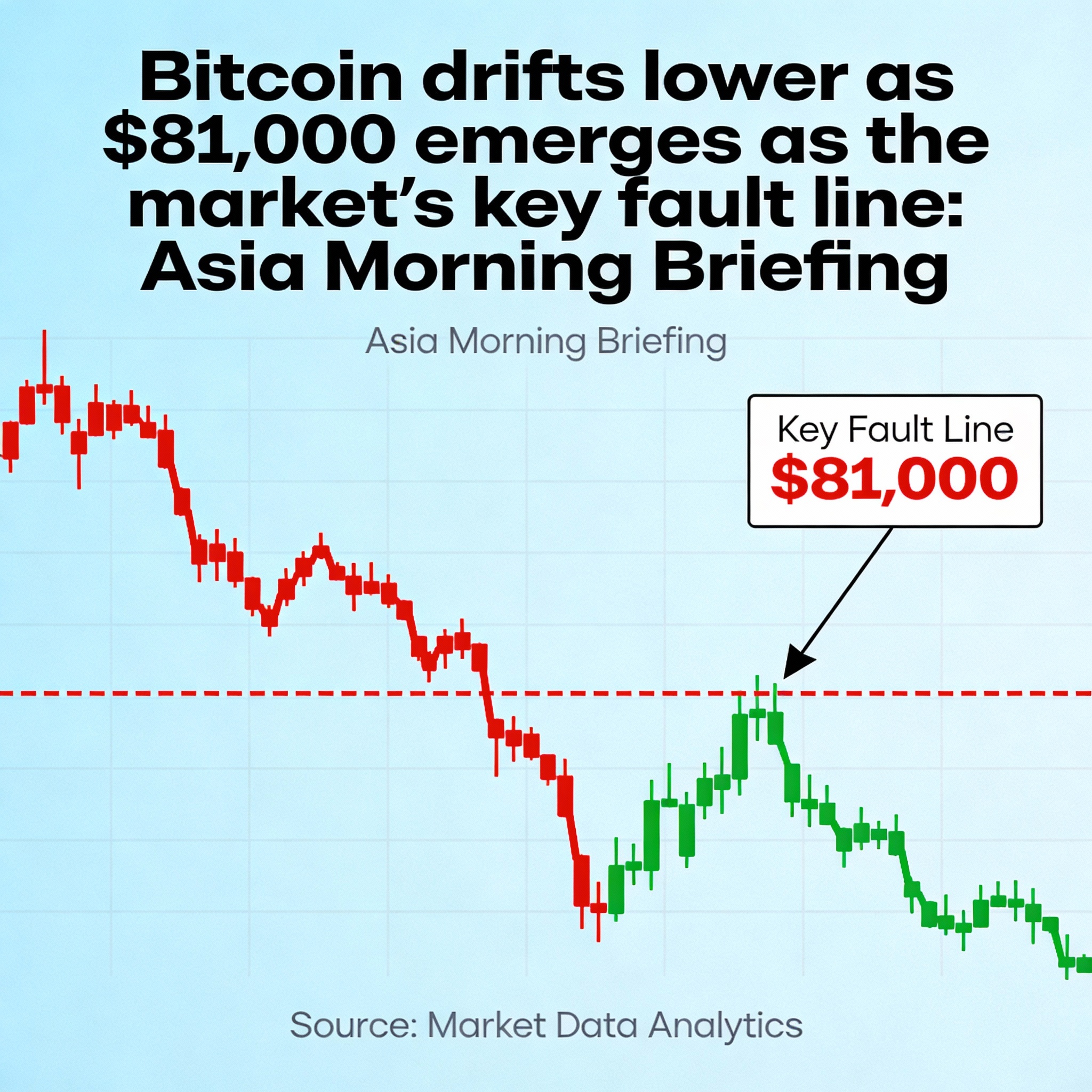
Glassnode has pinpointed bitcoin’s True Market Mean at around $81,300 as a pivotal level that separates gradual, time-driven drawdowns from more aggressive losses. In the post-October market environment, this threshold has gained additional significance.
The importance of this level extends beyond bitcoin itself. Over the past 90 days, especially since the October 10 flash crash, large-cap crypto assets have remained tightly correlated with bitcoin, cementing its role as the market’s central anchor.
A sustained dip below the True Market Mean could have far-reaching effects. Historical Glassnode data shows that when bitcoin remains below this level for extended periods, selling pressure tends to spread more broadly across the crypto market.
Currently, large-cap assets are still closely linked to bitcoin, while high-beta tokens have already experienced steep declines. A move below $81,300 could therefore pull weakness back into the market’s core. This isn’t merely a prediction of a breakdown but rather a guide to where market equilibrium currently sits.
As long as bitcoin holds above the True Market Mean, losses are likely to remain uneven and selective. However, if $81,300 fails to hold and does not recover, historical trends suggest selling pressure could extend beyond smaller tokens. In a post-October market characterized by thin liquidity and tight large-cap correlations, such a scenario could mark a shift from a slow, grinding drawdown to a more synchronized market reset.
Market Movement
BTC: Bitcoin traded near $86,400, down about 1% on the day and roughly 6.5% over the past week as the pullback continued.
ETH: Ether hovered around $2,830, down 3.6% in the past 24 hours and about 15% over the week, underperforming bitcoin amid broader market weakness.
Gold: Gold has continued its rally in 2025, surpassing $4,300 an ounce after doubling over the past two years. Central bank buying, geopolitical tensions, U.S. fiscal concerns, and a growing investor base have led major banks to forecast prices approaching $5,000 in 2026.