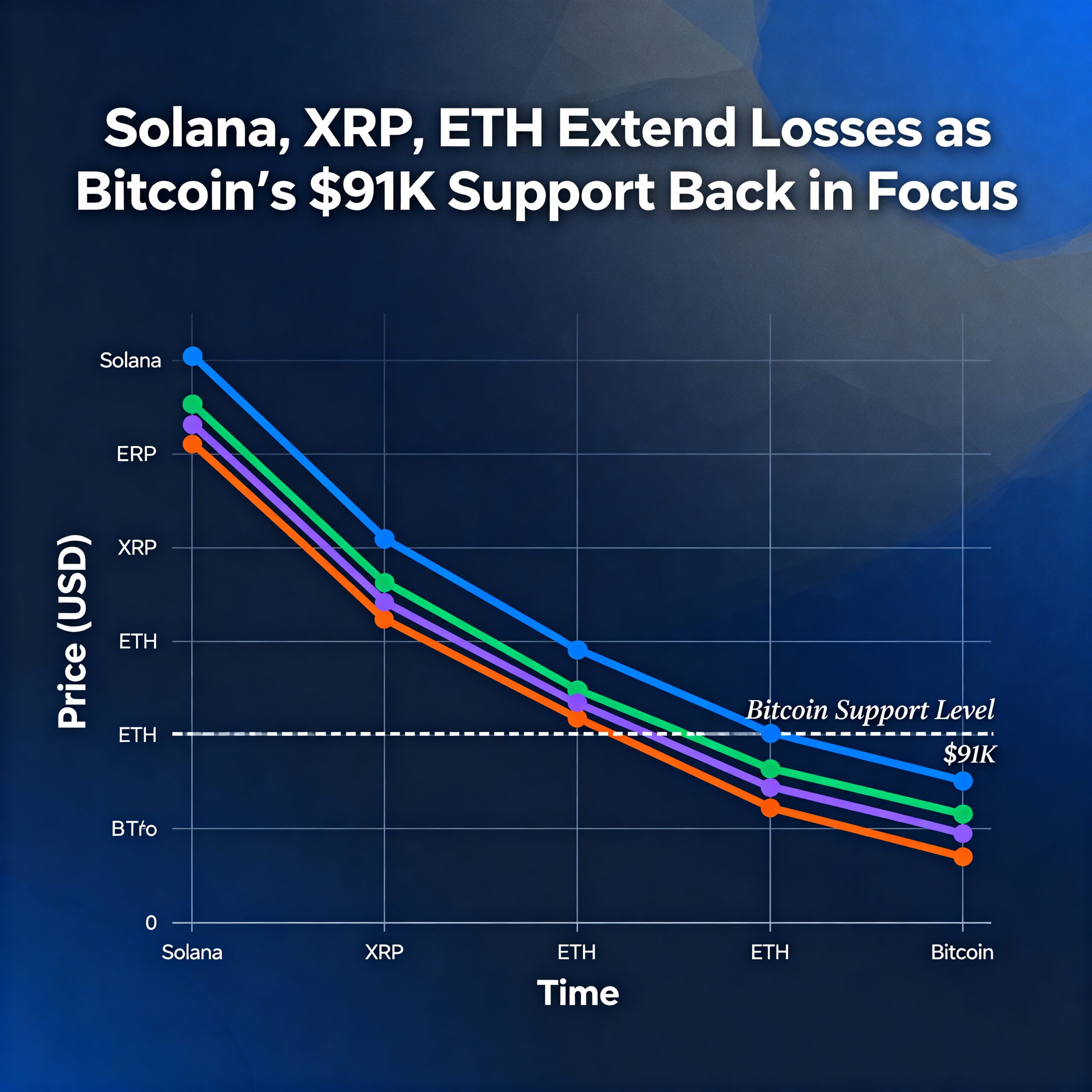
Bitcoin held near $92,000 on Friday as another failed attempt to clear the $93,000 barrier kept the market locked in the same narrow, indecisive range that has defined the past several sessions. The broader structure remains unbroken: sellers continue to defend the mid-$93,000s, buyers absorb dips around $91,000, and neither side has been able to force a decisive move.
On the one-month timeframe, BTC is still trending within a descending channel that began after early November’s peak. The latest bounce topped out near $93,500, forming yet another lower high and signaling that the corrective phase is still intact. Momentum remains weak, and the quick fade of intraday rallies underscores the lack of depth in upper-range liquidity. A break below $91,000 would open the door to $90,000–$90,500, while bulls need to reclaim $93,200 to flip the short-term trend.
Altcoins offered mixed signals into the weekend. Ethereum hovered around $3,150 after mild losses. Solana dropped about 4%, XRP nearly 5%, and Cardano slipped roughly 2%. Despite the uneven performance, total crypto market capitalization added about 1%, climbing to $3.2 trillion and extending the slow rebound that began two weeks ago following a prolonged seven-week decline. Over the past week, ETH has been the standout among major assets with gains exceeding 5%, while zcash also posted a strong session.
ETF flows highlighted a clear rotation. Spot bitcoin ETFs saw $14.9 million in net outflows, whereas ether ETFs pulled in $140.2 million, signaling fresh capital shifting toward the Ethereum ecosystem. Liquidation patterns echoed the divide: BTC recorded roughly $45 million in long liquidations and $50.7 million in shorts, but ETH saw a surge of $103 million in short-side liquidations, indicating that traders betting against ether were caught off-side as volatility picked up.
Macroeconomic data added to the cautious tone. U.S. ADP payrolls declined by 32,000 in November, a sharp miss versus expectations and a sign the labor market is cooling faster than anticipated. Wage growth slowed further, and futures markets now assign close to a 90% probability of a December rate cut. The dollar index swung sharply as traders repositioned around interest-rate expectations, while broader risk markets experienced a bump in volatility.
FxPro analyst Alex Kuptsikevich noted that bitcoin’s brief interaction with $94,000 met moderate resistance and suggested that sellers may not become more aggressive until the price challenges the $98,000–$100,000 area. The market’s behavior at those higher levels, he said, will help determine whether BTC is carving out a sustainable recovery or simply retracing within a corrective structure.
Analysts at Bitunix described the current environment as a macro-driven turning-point phase layered with internal capital rotation, pointing to ETF flows and uneven liquidation data as signs of divergence in market appetite. They expect the ongoing choppy, range-bound conditions to persist until bitcoin either holds convincingly above $93,000 or loses the $90,500 region.
Institutional developments added a modest lift to sentiment. Vanguard opened crypto ETF trading to clients earlier this week. Bank of America told its institutional customers that a 1%–4% portfolio allocation to digital assets may be appropriate. Meanwhile, the CME introduced a VIX-style implied volatility index for bitcoin futures, with versions tracking ether, solana, and XRP set to launch soon.