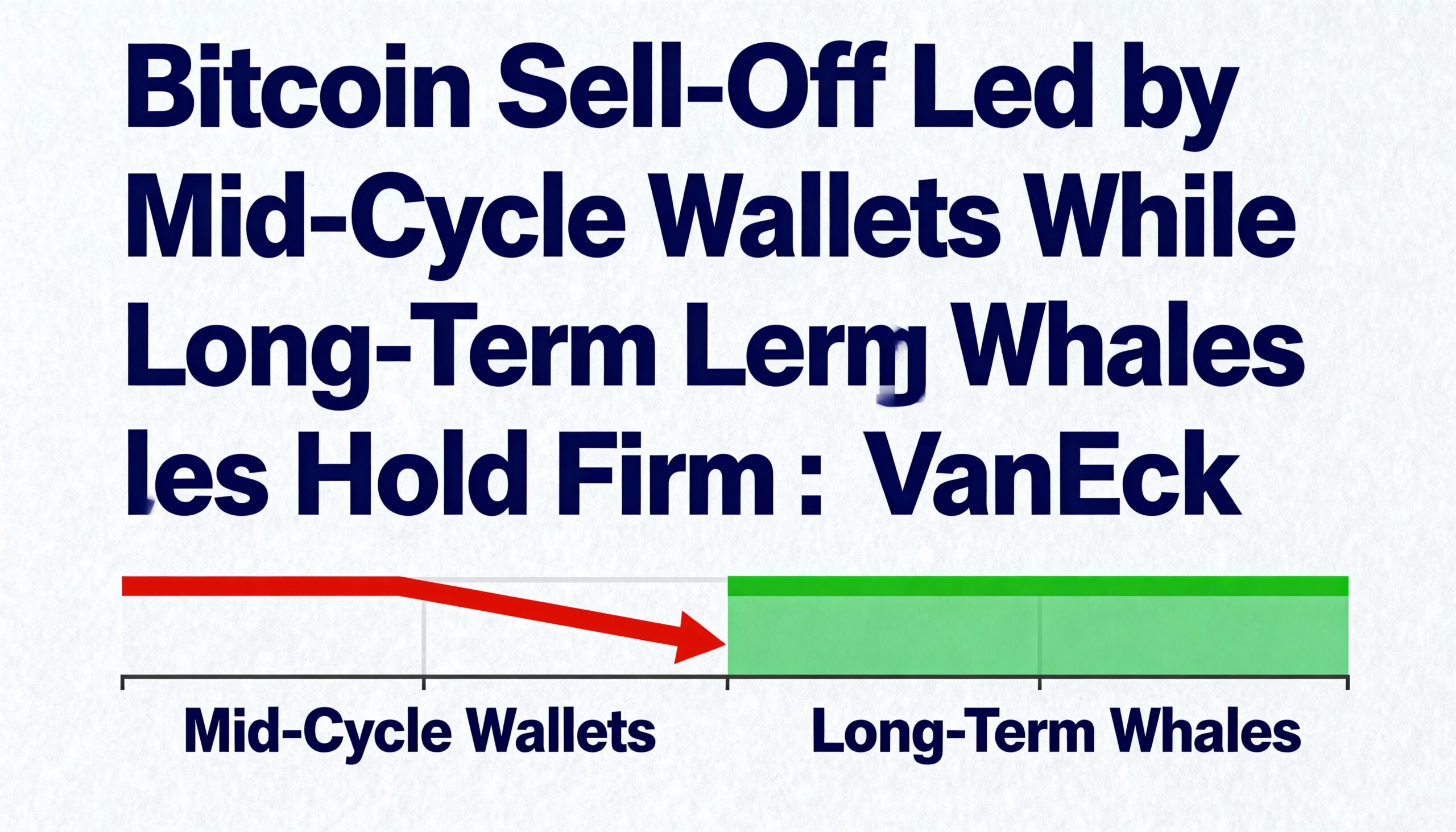
VanEck’s “Mid-November 2025 Bitcoin ChainCheck” report finds that Bitcoin’s recent decline is being fueled primarily by mid-cycle holders, while long-term whales remain largely stable.
The report highlights that wallets holding coins moved within the last five years are responsible for the bulk of selling, whereas coins untouched for over five years continue to accumulate. Over the past two years, roughly 278,000 BTC have been added to this long-term cohort, signaling enduring confidence among older holders.
Bitcoin recently traded near multi-month lows at $86,696 (9:15 p.m. UTC Thursday), down 3.2% over 24 hours and about 31% below its October 6 all-time high of $126,080, according to CoinGecko. Analysts have linked the broader decline to forced liquidations, distribution from long-term holders, and heightened volatility in offshore derivatives markets.
Nic Puckrin, CEO of Coin Bureau, told Euronews that key factors driving the sell-off include long-term selling by “OG” holders, economic uncertainty, and a mass deleveraging event on October 10. “Older, large-balance holders have been selling for several weeks, flooding the market with supply,” he said.
Carol Alexander, finance professor at the University of Sussex, noted that offshore trading activity also contributes to price swings. Professional traders often deploy order-book strategies such as “spoofing” or “laddering,” which are designed to move prices quickly, she explained.
VanEck’s data shows the 3–5 year coin cohort has declined 32% over the past two years as coins changed addresses—a trend tied to turnover among mid-cycle traders rather than capitulation by decade-long holders.
The report also indicates a reset in speculative positioning. Open interest in Bitcoin perpetual futures has dropped 20% in BTC terms and 32% in USD terms since October 9, with funding rates falling to levels consistent with previous “washed-out” periods. Meanwhile, smaller wallets holding 100–1,000 BTC have increased balances by 9% over six months and 23% over the past year, even as the largest whales trimmed positions.
According to VanEck, the combination of long-term holder stability, mid-cycle rotation, and futures-market capitulation has placed Bitcoin in a “reset” state—a condition that historically precedes tactical rebounds.