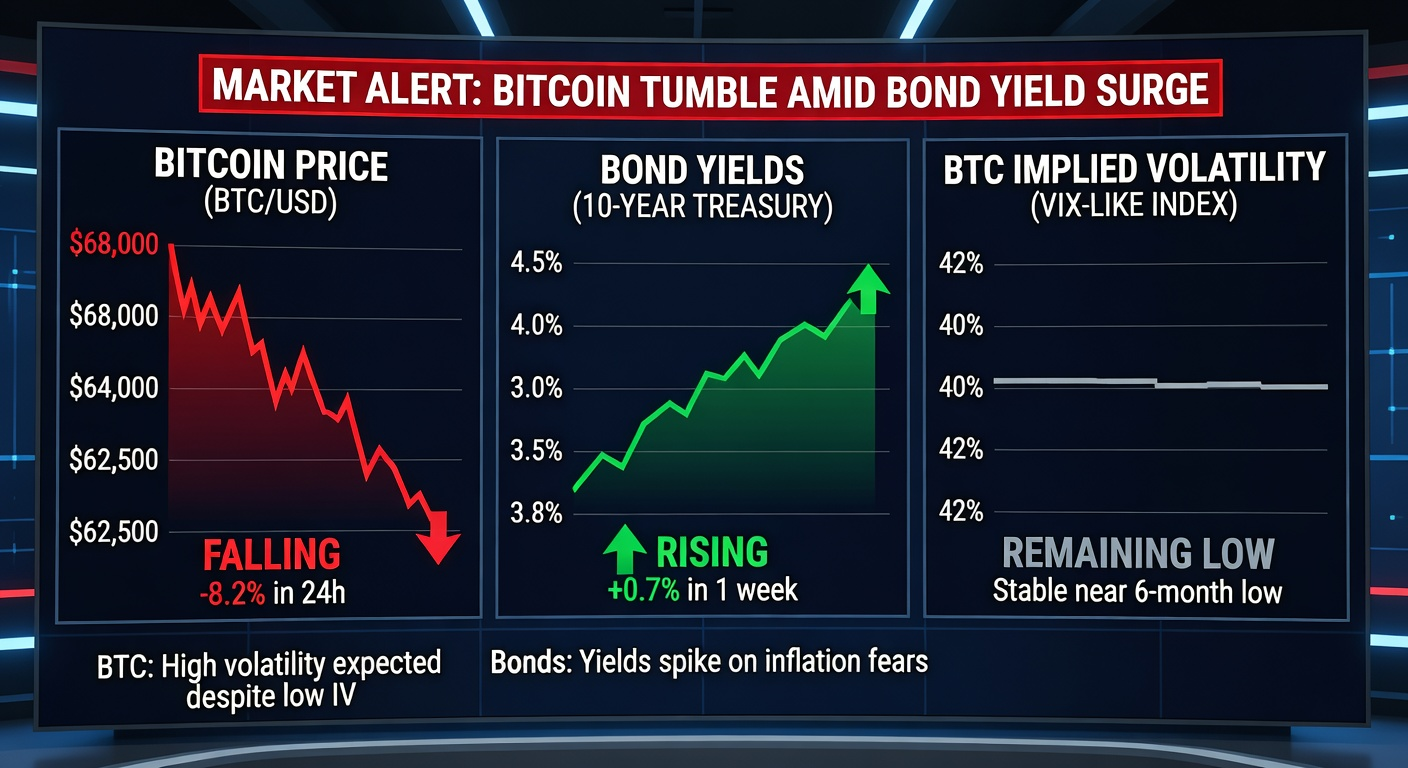
Bitcoin’s implied volatility remains surprisingly subdued even as prices weaken and macro conditions tighten, prompting some derivatives traders to view the market as mispricing future swings.
Bitcoin BTC $77,249.23 has fallen in recent days, slipping from about $82,000 to $77,000 since May 15. The decline has come alongside rising U.S. Treasury yields, a combination that typically signals growing macro uncertainty. Yet Bitcoin’s options market has not responded with higher volatility pricing.
Instead, implied volatility—a forward-looking measure of expected price fluctuations—has stayed relatively stable. That disconnect is attracting attention from options traders who see potential for a volatility repricing.
The roughly 6% drop in Bitcoin has coincided with significant outflows from spot Bitcoin ETFs and firmer U.S. Treasury yields. At the same time, stress is also building in fixed income markets, with the MOVE index, which tracks implied volatility in Treasuries, jumping from 69% to 85%, signaling rising turbulence in traditional assets.
In normal conditions, this kind of macro environment would typically drive demand for crypto hedging, pushing implied volatility higher. However, that reaction has yet to materialize.
Bitcoin’s 30-day annualized implied volatility index (BVIV) remains near 42%, according to TradingView data, only slightly above its year-to-date low of around 40%. This suggests options markets are still pricing in relatively calm conditions despite recent price weakness and broader macro instability.
That gap between macro stress and muted crypto volatility is leading some traders to believe the market may be underestimating risk. In other words, implied volatility could be too low given the current environment.
“In the options market, BTC IV is historically low: implieds have compressed to the high-30s/low-40s, printing new 2026 lows. That’s cheap vol in absolute terms,” said Jean-David Péquignot, Chief Commercial Officer at Deribit, the largest crypto options exchange, which handles over 70% of global crypto options volume.
Péquignot noted that low volatility makes long volatility positioning increasingly appealing. One common approach is the long straddle strategy, which involves buying both a call and a put option at the same strike price and expiration.
This structure allows traders to profit from large moves in either direction. If Bitcoin rises, the call gains value; if it falls, the put becomes profitable. The strategy is typically used when traders expect significant price movement but are uncertain about direction.
“BTC vol being this cheap while price is at a key breakout level can be a good setup for long vol / long straddle positioning ahead of a macro catalyst (next CPI print, Fed speech),” Péquignot said.