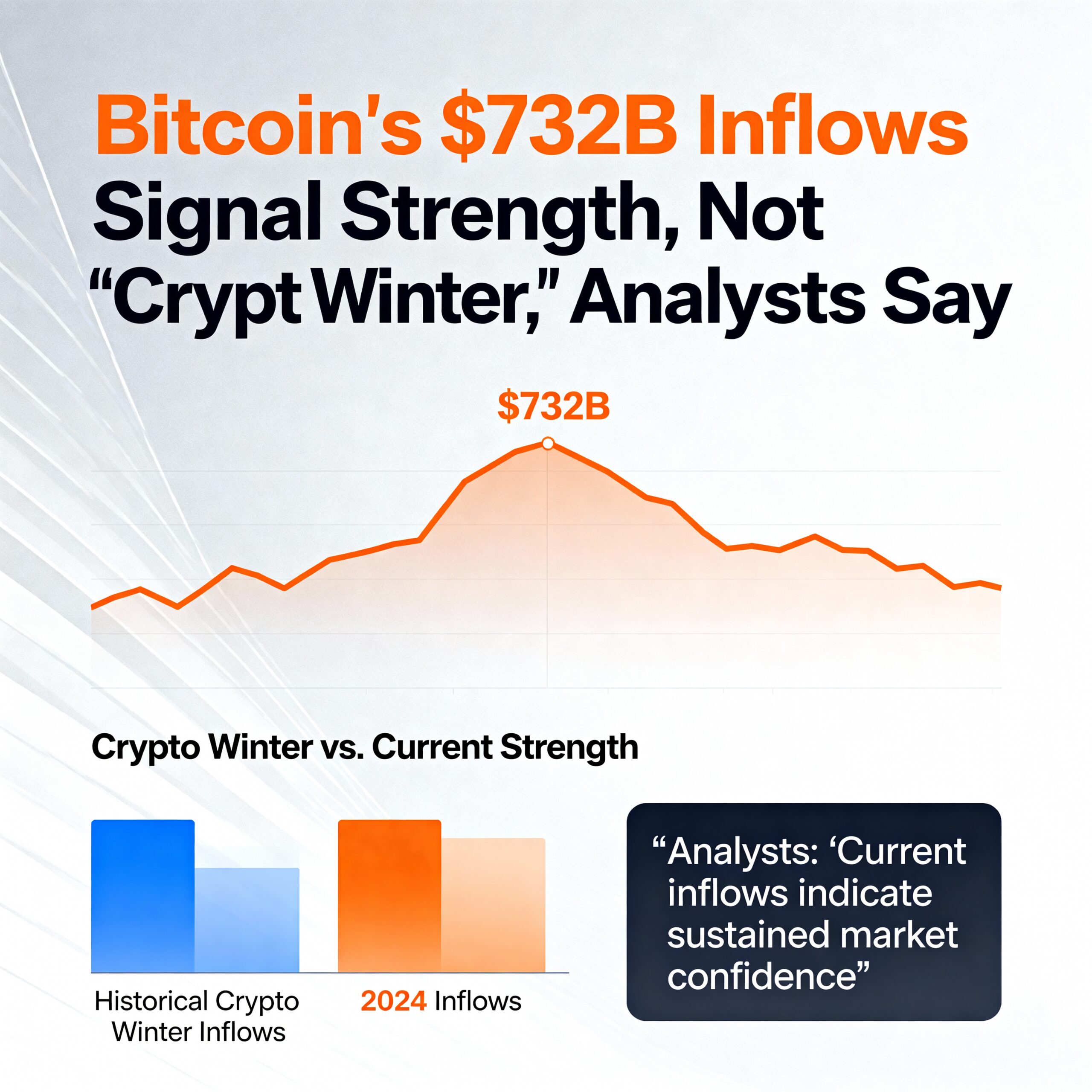
Bitcoin’s Pullback Signals Mid-Cycle Reset, Not ‘Crypto Winter,’ Analysts Say
Bitcoin’s recent decline is likely a normal mid-cycle correction rather than the start of a prolonged crypto downturn, according to a year-end report from Glassnode and Fasanara Digital. Record inflows, rising realized capitalization, and falling volatility suggest the market is consolidating, not entering a “crypto winter.”
Over the past three months, Bitcoin has dropped roughly 18%, sparking speculation of a broader market slump. Some crypto equities have seen steep losses—American Bitcoin Corp. fell about 40% on Tuesday amid heavy trading, briefly affecting majority owner Hut 8. Other Trump-linked digital assets also tumbled, fueling concerns of sector-wide weakness.
However, market data paints a different picture. Bitcoin has attracted more than $732 billion in net new capital since the 2022 cycle low, surpassing all previous cycles combined. Realized capitalization has risen to around $1.1 trillion, while spot prices peaked near $126,000. In past crypto winters, realized cap contracts sharply—an effect not seen today.
Volatility trends further support resilience. BTC’s one-year realized volatility has fallen from 84% to 43%, reflecting deeper liquidity, growing ETF participation, and more cash-margined derivatives. Historically, winters begin with rising volatility and evaporating liquidity—the opposite of current conditions.
ETF and miner performance also diverge from winter patterns. Spot ETFs hold roughly 1.36 million BTC (~6.9% of circulating supply) and account for 5.2% of net inflows since launch. Meanwhile, the CoinShares Bitcoin Mining ETF (WGMI) rose over 35% during the same period BTC fell, indicating recent selloffs are company-specific rather than systemic.
Historical patterns reinforce the mid-cycle view. Similar pullbacks occurred in 2017, 2020, and 2023 during leverage reductions or macro tightening before Bitcoin resumed upward momentum. October 2025’s deleveraging event fits this pattern, with open interest falling sharply while spot liquidity absorbed billions in forced selling.
Bitcoin also remains closer to its yearly high ($124,000) than its low ($76,000), unlike past winters where prices gravitated toward the bottom. Record realized cap, declining volatility, and steady ETF demand all indicate the market is consolidating rather than entering a prolonged downturn.