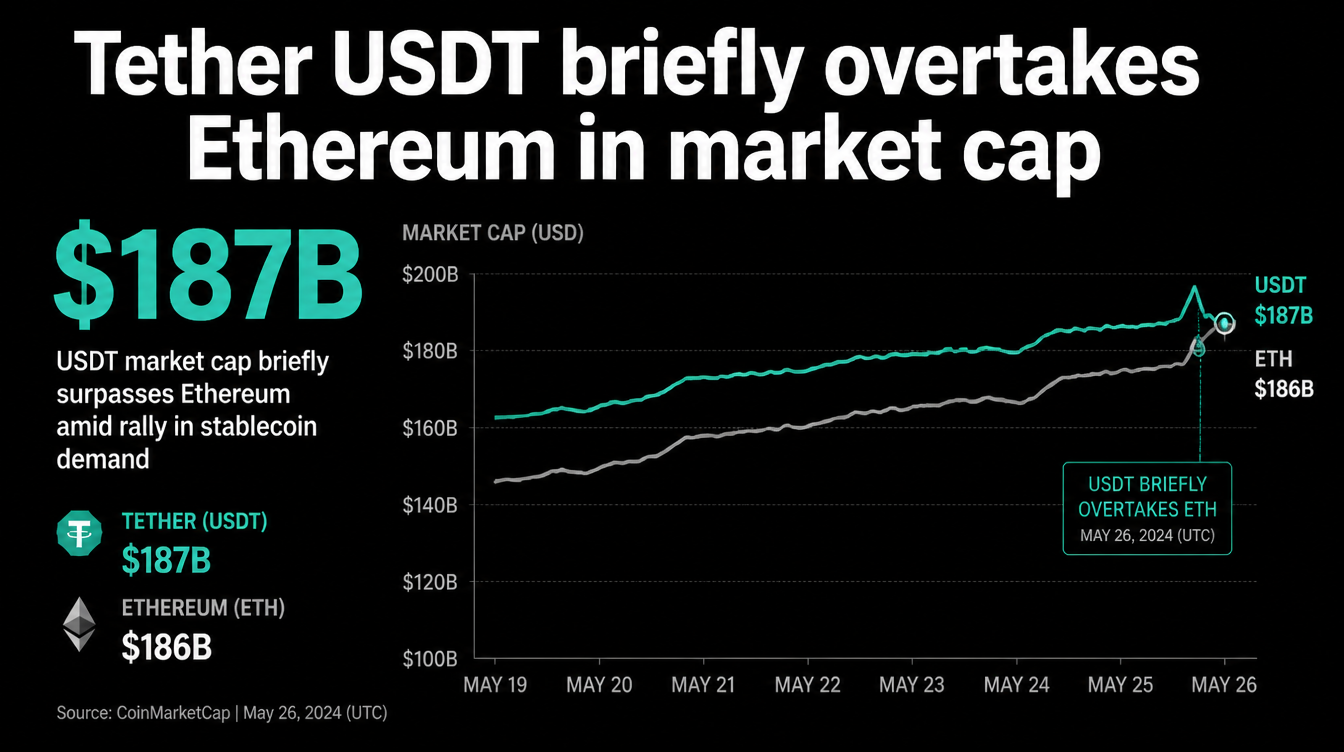
For a brief window earlier this week, Tether’s USDT stablecoin overtook Ethereum in market capitalization—something not seen in eight years. Data from multiple trackers showed both assets trading within the $183 billion to $188 billion range during the crossover, with one snapshot placing USDT at $187 billion and ETH at $186 billion—a difference of less than $1 billion.
The lead was short-lived, with Ethereum quickly reclaiming second place once prices stabilized. However, the forces behind the flip—steady USDT issuance and ongoing ETH price weakness—remain unchanged.
Crypto Market Structure: How USDT Closed the Gap
The crossover wasn’t driven by any change in Ethereum’s supply dynamics. Instead, ETH’s market cap declined due to price pressure, while USDT expanded through continued issuance. Tether’s Q4 2025 attestation reported a record $187.3 billion supply, reflecting a $12.4 billion increase in a single quarter despite broader market weakness.
Over the past year, USDT’s market cap grew from $144.2 billion to $184 billion—a 28% increase—while Ethereum’s valuation trended lower.
In the three weeks leading up to the flip, more than $7 billion flowed out of the stablecoin sector, while the overall crypto market lost roughly $400 billion in value. Ethereum’s DeFi total value locked (TVL) dropped to around $36 billion. Rather than exiting stablecoins entirely, traders appeared to be rotating into them defensively, parking capital while reducing exposure to volatile assets.
USDT now accounts for roughly 59% of the stablecoin market, with USDT and USDC combined making up about 82%, underscoring Tether’s dominant role in this segment.
McGlone’s Thesis: The Trend May Continue
Bloomberg Intelligence strategist Mike McGlone has long highlighted this trajectory. Back in October 2020, when USDT stood at $16 billion versus Ethereum’s $43 billion, he suggested Tether was on track to match Ethereum’s market cap within a year, describing it as part of a persistent shift toward stablecoins.
His updated outlook goes further, suggesting the “flippening” could extend beyond Ethereum. McGlone has indicated that USDT could surpass ETH again in 2026—and potentially even challenge Bitcoin over time. In a more extreme case, he outlined a scenario where Bitcoin drops toward $10,000, allowing USDT—if it grows roughly 7x from current levels—to compete for the top spot.
While such projections may seem aggressive, dismissing them outright mirrors the skepticism that once surrounded the idea of USDT overtaking Ethereum.
ETH vs USDT: Narrow Gap, Uncertain Path
Ethereum has since regained its position as the second-largest asset, but the margin remains thin. For that lead to stabilize, ETH would need sustained price strength, or USDT issuance would need to slow.
Neither outcome is guaranteed. Ethereum’s long-term outlook is supported by ongoing upgrades, including advances in zero-knowledge scaling, but these developments operate on a longer timeline than the short-term price weakness that enabled the crossover.
Meanwhile, USDT’s supply growth shows no signs of slowing. Tether added $12.4 billion during a declining market—suggesting issuance could accelerate further in more favorable conditions. With its $1 peg, USDT’s market cap directly mirrors its circulating supply, meaning every new token minted immediately increases its valuation without exposure to price volatility.
As a result, the conditions that briefly pushed USDT ahead of Ethereum remain firmly in place, even if the ranking has since reversed.