


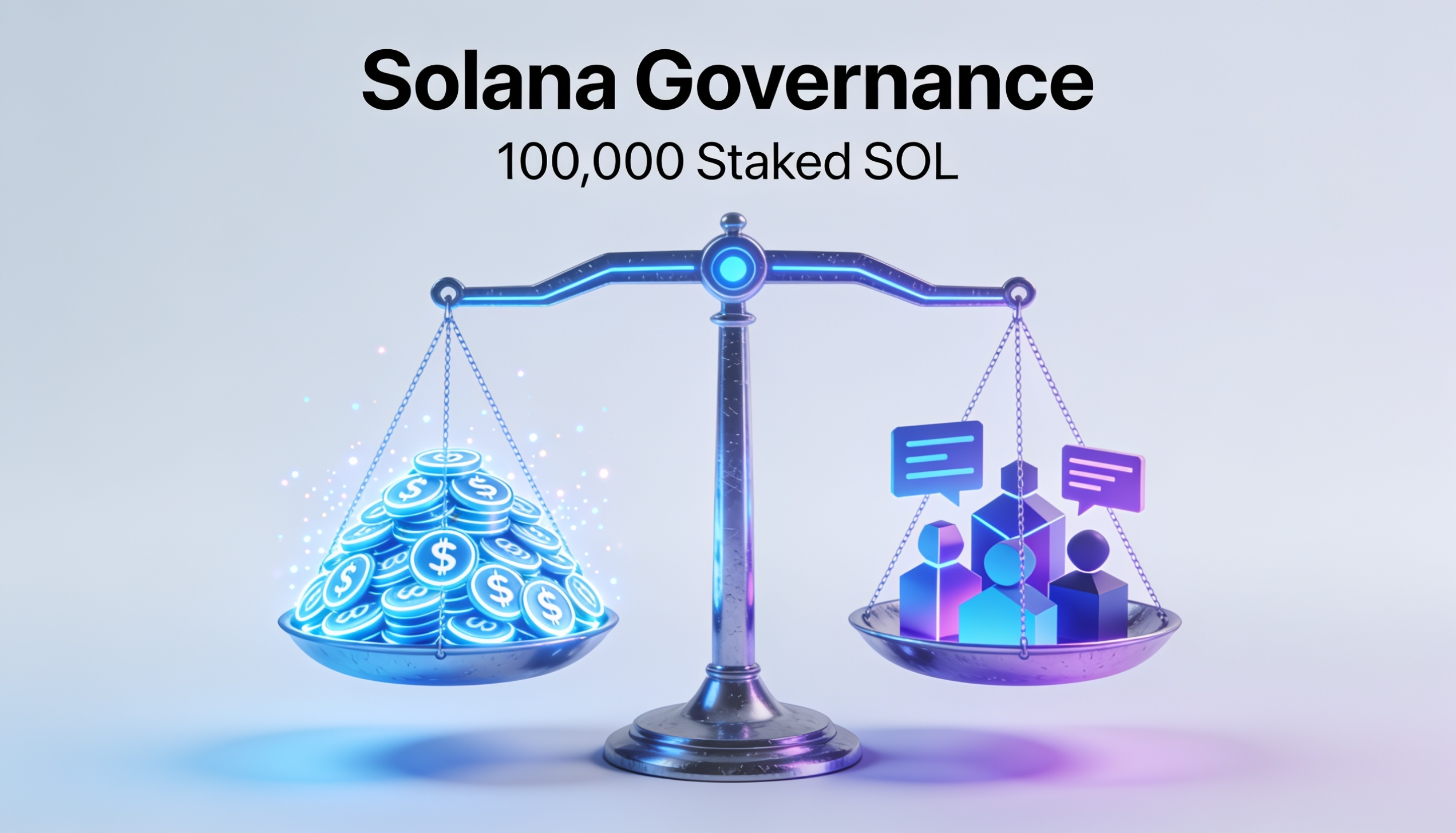
Solana has introduced a formal onchain governance framework that allows validators and their delegators to directly signal the network’s future through a new system known as Solana Governance Proposals (SGPs). Validators with at least 100,000 SOL staked can submit proposals, while delegators can override or replace their validator’s vote.
The programmable blockchain’s new governance model, revealed in its GitHub repository, gives both validators and token holders a transparent, recorded voting mechanism for the first time.
Under the SGP system, validators backed by a minimum of 100,000 SOL (about $7.7 million) can propose high-level changes to the network’s direction. The process functions similarly to shareholder voting, with influence determined by the amount of SOL staked.
Each proposal is framed as a simple, plain-language question about whether the network should pursue a particular path. Votes are weighted by stake, recorded onchain, and verified using Merkle proofs, ensuring the integrity of results without needing to recompute the entire tally.
The framework separates governance into two layers. SGPs address the strategic question — “Should this be done?” — while Solana Improvement Documents (SIMDs) handle the technical execution, answering “How should it be implemented?”
Approval of an SGP signals consensus to proceed, after which developers draft one or more SIMDs to carry out the change.
Before reaching a formal vote, proposals must first secure backing from at least 15% of active stake. This threshold is designed to filter out low-interest topics while allowing routine technical updates to continue without requiring a full network vote.
Once the threshold is met, voting takes place over Solana’s epoch cycle, with each epoch lasting roughly two days.
To pass, a proposal must achieve a two-thirds supermajority of the voting stake, with abstentions excluded from the calculation. There is no minimum participation requirement.
A key feature of the system is the expanded role of delegators — users who stake their SOL with validators instead of running their own nodes. These participants can override their validator’s vote or cast a vote if the validator abstains, with voting power proportional to their stake.
The Solana Foundation refers to this as “staker sovereignty,” ensuring that governance power ultimately rests with token holders rather than being concentrated solely among validators.
The rollout comes as interest in Solana picks up, with SOL rising about 16% over the past week to around $78, making it one of the few large-cap tokens to post gains amid a broader market downturn.












































Leave a Reply