Solana News: Moody’s Brings Live Credit Ratings Onchain in Landmark RWA Step
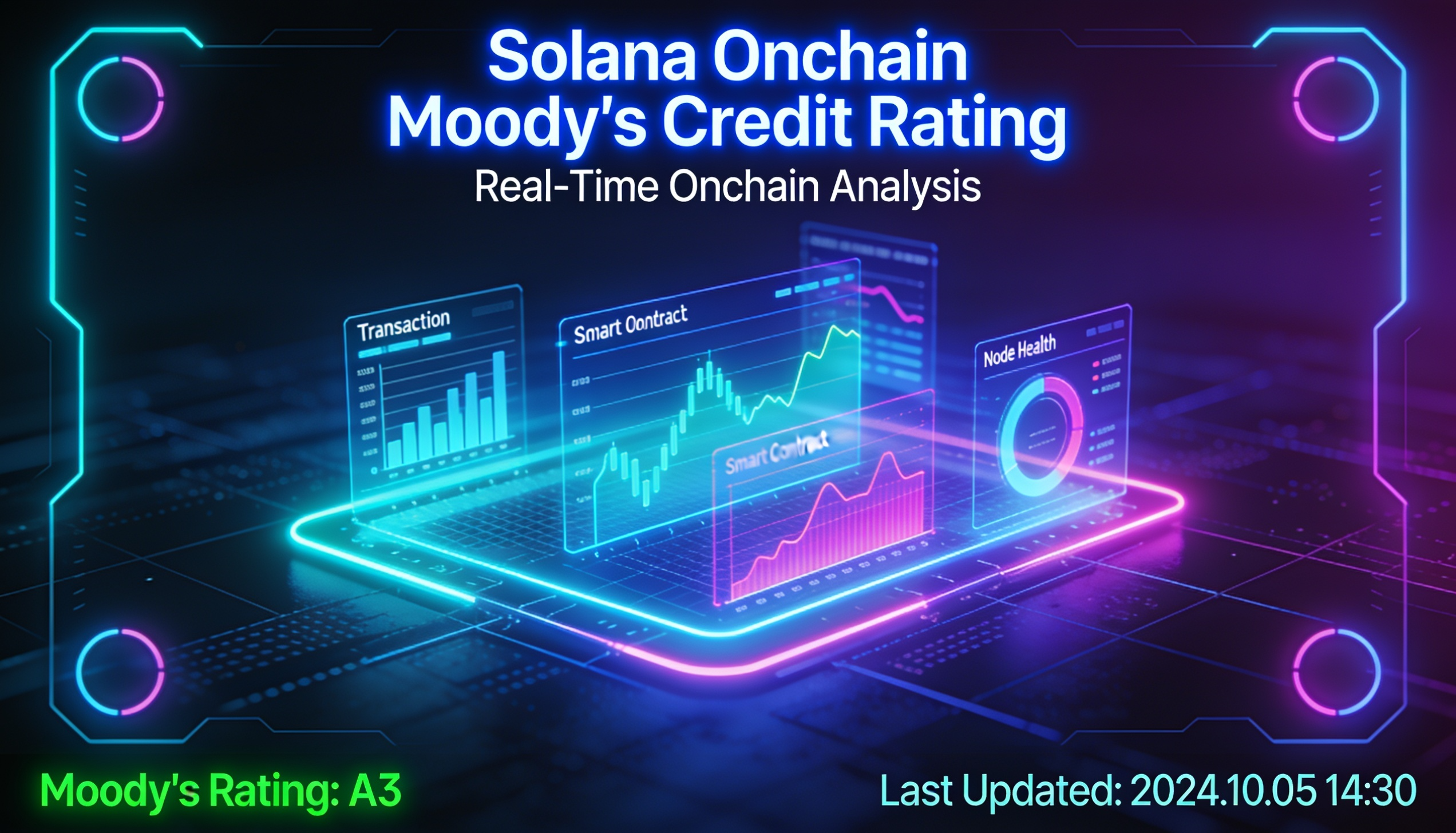
In a major Solana ecosystem update, Moody’s Ratings deployed its credit ratings infrastructure on Solana mainnet on June 17, 2026, via a partnership with AlphaLedger. The move makes Solana the first major public, permissionless blockchain to carry live Moody’s credit ratings in a machine-readable format.
Rather than existing in separate databases or institutional terminals, credit ratings are now embedded directly into the metadata of tokenized bonds and other fixed-income assets. This means the credit assessment travels with the asset itself on-chain.
For institutions building within Solana’s real-world asset (RWA) ecosystem, this helps close a critical gap in tokenized debt markets: access to standardized, verifiable credit data at the protocol level.
Unlike Moody’s earlier deployment on Canton Network—a permissioned blockchain with restricted participants—Solana’s open design allows any wallet, exchange, or DeFi protocol to access credit data directly without gatekeeping. That shift from permissioned to permissionless infrastructure is a key differentiator of this rollout.
How the Moody’s Token Integration Engine Works
Moody’s Token Integration Engine (TIE) separates credit analysis from data delivery. Ratings are still generated off-chain using Moody’s traditional methodology, but AlphaLedger’s infrastructure pushes them on-chain via API and embeds them into token metadata.
Whenever a rating changes—whether upgraded or downgraded—the update is automatically reflected on-chain, ensuring that applications always see the most current credit signal instead of static reports.
The system was initially tested in a June 2025 Solana devnet pilot involving a simulated municipal bond issuance. In that experiment, Moody’s performed a full credit evaluation and the resulting rating was written into token metadata for smart contract consumption.
The mainnet deployment now brings that concept into production, starting with municipal bonds and expanding toward broader fixed-income instruments.
AlphaLedger CEO Manish Dutta said the goal is to make traditional credit intelligence directly usable in tokenized markets without rebuilding parallel rating systems. Moody’s Rajeev Bamra added that institutional investors increasingly require machine-readable credit data for onchain environments.
A key use case is automated risk management, where DeFi protocols and tokenized platforms can integrate ratings into collateral rules, margin systems, and eligibility filters without relying on external proprietary feeds.
Solana’s Expanding Institutional RWA Position
The Moody’s integration lands amid accelerating growth in Solana’s institutional real-world asset ecosystem. Western Union has launched a dollar-backed stablecoin on Solana aimed at reducing remittance costs, while enterprise blockchain firm R3—whose Corda network includes institutions such as HSBC, Bank of America, and the Monetary Authority of Singapore—has partnered with the Solana Foundation to migrate tokenized assets to the network.
Meanwhile, major asset managers including BlackRock, Franklin Templeton, and Apollo continue expanding across the broader tokenized asset landscape, which Boston Consulting Group and Ripple estimate could reach $18.9 trillion by 2033.
Solana Foundation’s Nick Ducoff said the Moody’s integration improves transparency and accessibility for tokenized financial products on the network.
More importantly, embedding globally recognized credit ratings into onchain securities addresses a long-standing objection from institutional fixed-income investors: the absence of standardized, independent credit benchmarks within blockchain markets.
For traditional bond investors, Moody’s, S&P, and Fitch ratings are foundational. Making them directly accessible on a public blockchain is therefore a structural requirement for serious institutional adoption of tokenized debt.
Moody’s has indicated that TIE will expand beyond municipal bonds into corporate, sovereign, and structured credit products, while also extending across multiple blockchains beyond Solana and Canton.
This positions TIE as a broader credit data layer for tokenized finance rather than a Solana-specific integration.
As adoption develops, the real impact will depend on how quickly issuers and protocols incorporate this data into live financial products across the ecosystem.
For now, Solana’s price action remains more closely tied to macro market conditions than individual infrastructure upgrades, reflecting a stage where institutional foundations are being built ahead of visible market repricing.