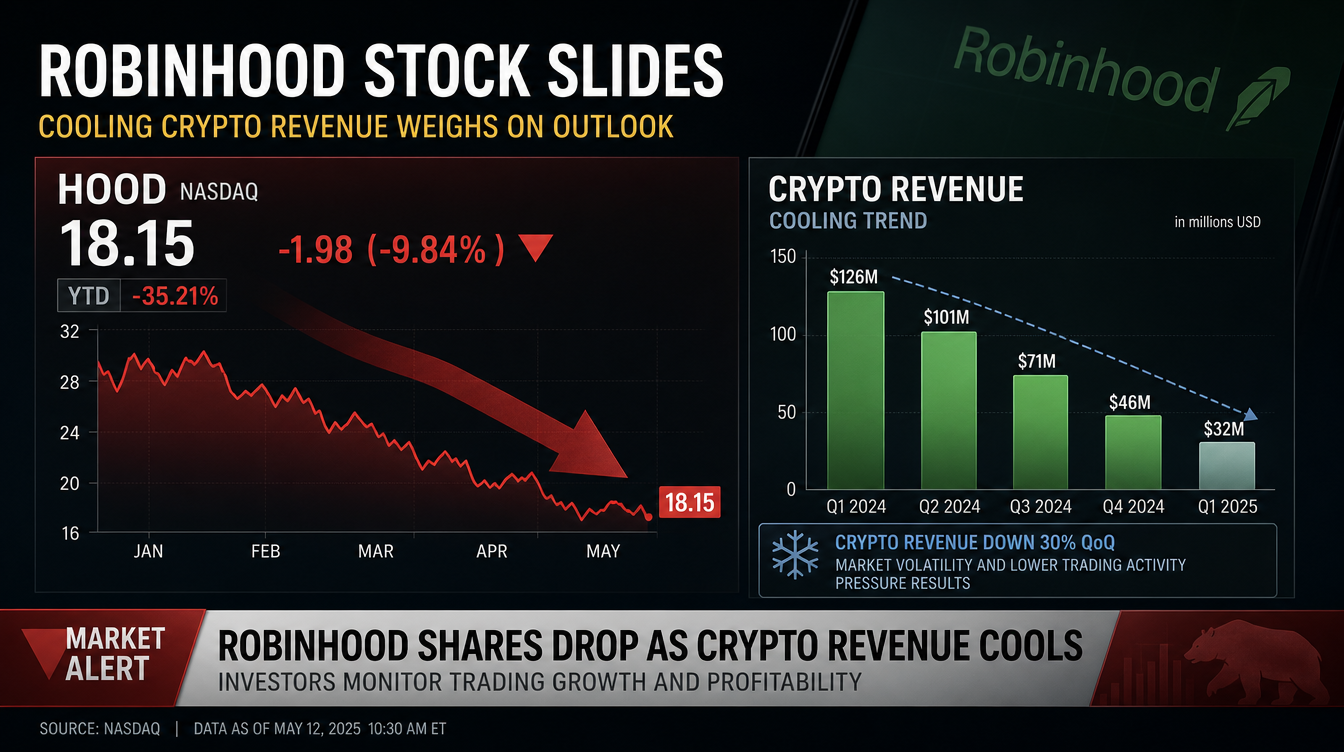
Robinhood recorded $100 million in cryptocurrency trading revenue for the quarter, marking a 38% decline from the previous year. The drop was balanced by increased activity in options, equities, and prediction markets.
Robinhood (HOOD) exceeded Wall Street expectations for the second quarter, but its stock fell roughly 4% in extended trading after already declining 3.1% during Wednesday’s market session.
The brokerage posted adjusted earnings of $0.62 per share, beating analysts’ average estimate of $0.43. Quarterly revenue rose 32% year over year to a record $1.31 billion, slightly above the $1.29 billion expected by analysts.
The performance showed continued growth across Robinhood’s broader product ecosystem, despite weaker crypto demand. Cryptocurrency transaction revenue dropped to $100 million from $160 million a year earlier, while overall transaction income benefited from higher trading activity in options, stocks, and prediction markets.
“Our focus with products like Robinhood Chain, Robinhood Ventures, and Trump Accounts is to accelerate innovation with one goal: helping more people become owners,” Robinhood CEO and Chairman Vlad Tenev said.
The second quarter marked a major period of expansion for Robinhood, with the company rolling out several new offerings. Among them was Robinhood Chain, a blockchain network built to support tokenized U.S. equities and advance the company’s efforts to bring traditional financial products onto blockchain infrastructure.
Network usage has increased rapidly since launch, with decentralized exchange volumes reaching hundreds of millions of dollars per day. Tokenized shares linked to companies such as GameStop, Nvidia, and SpaceX have emerged as some of the most actively traded real-world assets. While memecoins and stablecoins remain dominant sources of activity, tokenized stock trading has continued to grow.
The company also introduced Agentic Trading, an AI-powered feature that enables customers to connect third-party AI assistants to brokerage accounts. The tools can track market conditions and place trades according to user-defined instructions, while Robinhood maintains safeguards through separate trading accounts, spending restrictions, and manual approval settings.
Robinhood’s quarterly results also provide an early signal ahead of Coinbase’s second-quarter earnings report. Although the companies have different business models, both are closely tied to retail investor activity and crypto market sentiment. Analysts will examine whether stronger cryptocurrency prices and increased trading volumes translated into improved transaction revenue for Coinbase after Robinhood’s update.
Robinhood will host its earnings call with investors at 5 p.m. ET.