Here’s a refined, professional rewrite of the passage:
An updated roadmap outlines Ethereum’s plan for a sweeping, multi-year transformation that would overhaul nearly every core layer of the protocol, with quantum security and privacy now elevated to top-tier priorities. The update arrives as ether has gained more than 12% over the past week.
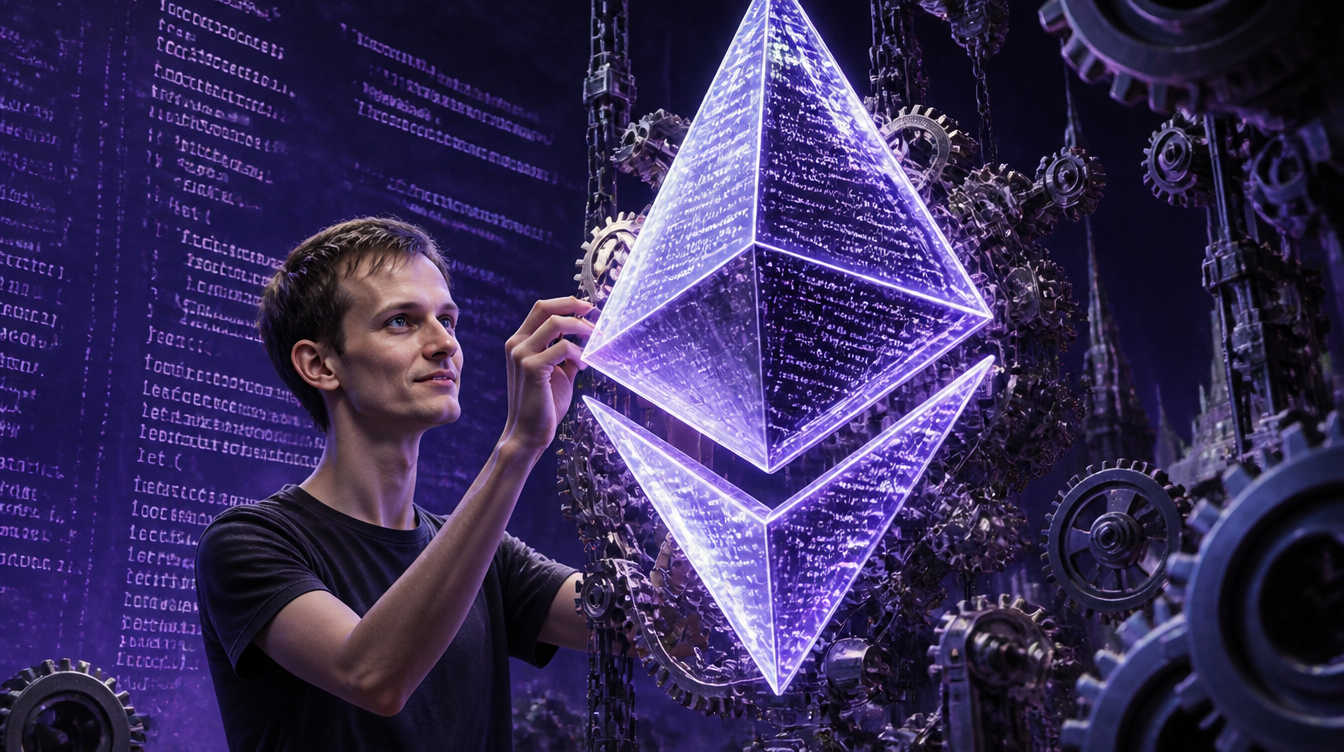
Ethereum co-founder Vitalik Buterin shared new insights into “Lean Ethereum,” a long-term initiative aimed at re-architecting the network following recent research sessions.
He described the effort as Ethereum’s third major evolution, after the 2022 The Merge, which shifted the network from proof-of-work to proof-of-stake. The current plan envisions replacing most major protocol components over a three- to four-year period, while keeping disruptions to existing applications minimal.
First introduced in July 2025, Lean Ethereum serves as a technical blueprint for the network’s next decade, centered on adopting more advanced cryptographic systems than those currently in place.
Buterin’s latest update, paired with a revised internal “strawmap,” provides greater clarity on shifting priorities and the project’s trajectory.
Quantum resistance has now moved significantly higher on the agenda. Although large-scale quantum threats remain years away, prevailing theory suggests that sufficiently powerful quantum computers could eventually break existing cryptographic systems. Ethereum is therefore prioritizing the transition to quantum-safe alternatives across all vulnerable components, including redesigning the low-cost data storage relied upon by rollups.
Privacy has also been elevated to what Buterin described as a “first-class goal.” The plan calls for building core infrastructure that natively supports private, trust-minimized transactions, rather than treating privacy as an optional layer.
Another key shift involves how the network verifies activity. Instead of requiring every node to re-execute all transactions, Ethereum aims to adopt recursive STARKs—a cryptographic proof system that allows nodes to verify compact proofs of computation rather than repeating the work. This change is expected to improve efficiency and reduce the computational burden of running a node.
One of the most significant proposed changes concerns Ethereum’s “state,” the complete record of all balances and smart contract data at any given time.
Each transaction updates this state, modifying balances, ownership records, and contract data. Currently, every node must store and maintain the full state, which grows as network usage increases. This expanding data load raises costs and risks pushing the network toward centralization.
To address this, Lean Ethereum proposes maintaining the existing flexible “dynamic” state with controlled growth, while introducing new, more efficient state types that are significantly cheaper to scale. This approach could expand total data capacity from roughly 2 terabytes today to over 100 terabytes by 2030, without requiring every node to store all data in the traditional way.
The roadmap also suggests Ethereum may eventually evolve beyond the Ethereum Virtual Machine, which currently powers smart contract execution. One potential alternative is the open architecture RISC-V. Buterin indicated that the EVM could remain as a higher-level interface, while the protocol itself transitions to a simpler execution base over time.
Throughout the plan, Ethereum is expected to steadily scale capacity, with higher transaction throughput, expanded data limits, and shorter block times over the coming years.
Buterin pointed to a major capacity boost expected in the upcoming Glamsterdam upgrade and suggested that the following Hegotá upgrade could mark the final major fork before the Lean Ethereum phase begins in full.
Overall, the roadmap represents a long-term commitment to strengthening quantum security and privacy, even ahead of broader industry urgency. The update comes as ether trades near $1,777, marking one of the strongest weekly performances among major cryptocurrencies.