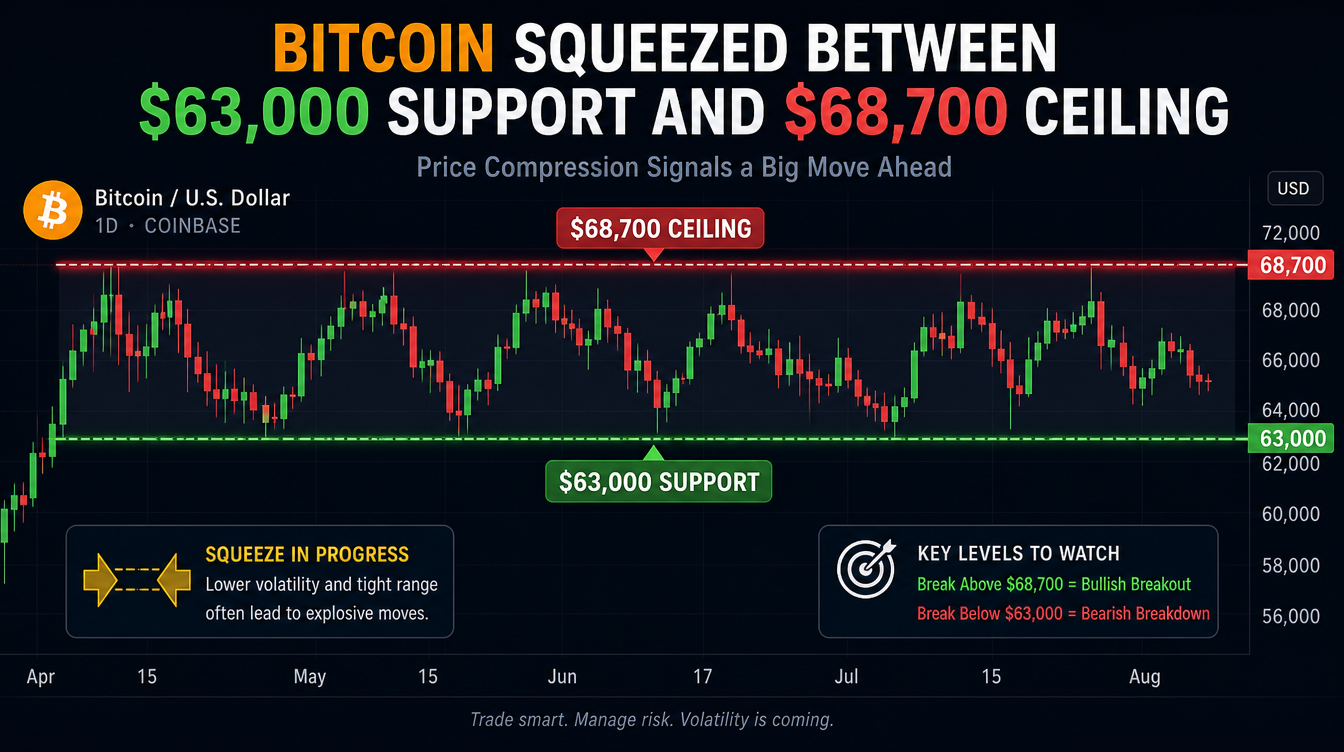
Bitcoin continues to trade in a narrow band between $63,000 and $68,700, with weak spot activity, ETF outflows and whale selling creating a fragile market structure.
BTC moved between about $63,500 and $64,000 this week, according to CoinGecko, remaining below the $65,000 threshold that has repeatedly rejected the cryptocurrency in recent sessions.
Bitcoin’s spot exchange volume has fallen to its lowest level since Glassnode began recording the metric in early 2019, data shared by Wu Blockchain showed. At the same time, Bitcoin volatility has contracted to levels last observed in October 2023, according to Crypto Rover.
The current lack of movement appears to be more than ordinary summer trading. Both fresh buying interest and forced selling have diminished, leaving Bitcoin stuck between two important cost-basis levels that are gradually moving closer together.
Bitcoin Caught Between Key Cost-Basis Levels
BTC is currently positioned between the $63,000 median realized price and the $68,700 short-term holder cost basis.
The $63,000 median realized price represents the midpoint of the cost basis across Bitcoin holders and is currently serving as a major support area. In contrast, the $68,700 short-term holder cost basis reflects the average entry price of recent buyers and is acting as resistance.
Glassnode’s Week 32 report noted that Bitcoin has spent almost three months inside this zone, while the range has continued to tighten as market volatility declines.
Analyst Ted Pillows pointed to Bitcoin’s failure to maintain levels above $65,000 despite gains in equities and precious metals. He interpreted this divergence as evidence of weakening momentum and identified the $60,500-$61,000 area as a potential downside target before a recovery. Bitcoin has previously tested this zone during periods of quiet summer trading.
Glassnode has also highlighted $58,500, the June low, as an important downside level if BTC loses the median realized price. The analytics firm warned that limited liquidity and elevated leverage could accelerate any breakdown.
Whale Selling Adds to Weak Demand
On-chain data from Lookonchain showed that a wallet linked to Paxos sold another 800 BTC, worth around $50.72 million, through Wintermute.
The wallet has now disposed of approximately 2,500 BTC over the past two months, valued at nearly $154 million. The sales have been spread over time rather than executed as a single large transaction. Although the activity is not necessarily enough to cause a major market decline on its own, it adds selling pressure while demand remains subdued.
U.S. spot Bitcoin ETFs saw $61.16 million in net outflows on Aug. 12. Fidelity’s FBTC accounted for $46.82 million of the withdrawals. The combination of ETF outflows and record-low spot trading volume indicates that institutional demand has weakened rather than accelerated.
What Comes Next for Bitcoin?
Bitcoin could regain bullish momentum if it decisively reclaims the $68,700 short-term holder cost basis while spot volume increases and ETF inflows return. Such a move could push recent buyers back into profit and create a path toward new local highs.
Crypto Rover highlighted October 2023 as a historical comparison, when Bitcoin volatility reached similarly compressed levels before BTC eventually climbed more than 330%. While the pattern is not a prediction, traders are monitoring it for clues about what could follow the current period of consolidation.
A sustained move below $63,000 would remove an important support level and could send Bitcoin toward $60,500-$61,000. If selling intensifies, $58,500 could become the next major downside target.
Glassnode’s seller-exhaustion indicators are nearing levels previously seen around major bear-market bottoms. However, the firm said actual spot demand remains weak, while bitcoin continues to move onto exchanges despite signs that sellers are becoming less aggressive.
A potential global interest-rate shock also remains a risk. Any sharp shift in rates could trigger a carry-trade unwind and provide the catalyst needed to break Bitcoin out of its prolonged range.
For now, thin liquidity and exceptionally low trading activity leave the market vulnerable to a larger-than-usual move once either buyers or sellers gain the upper hand.