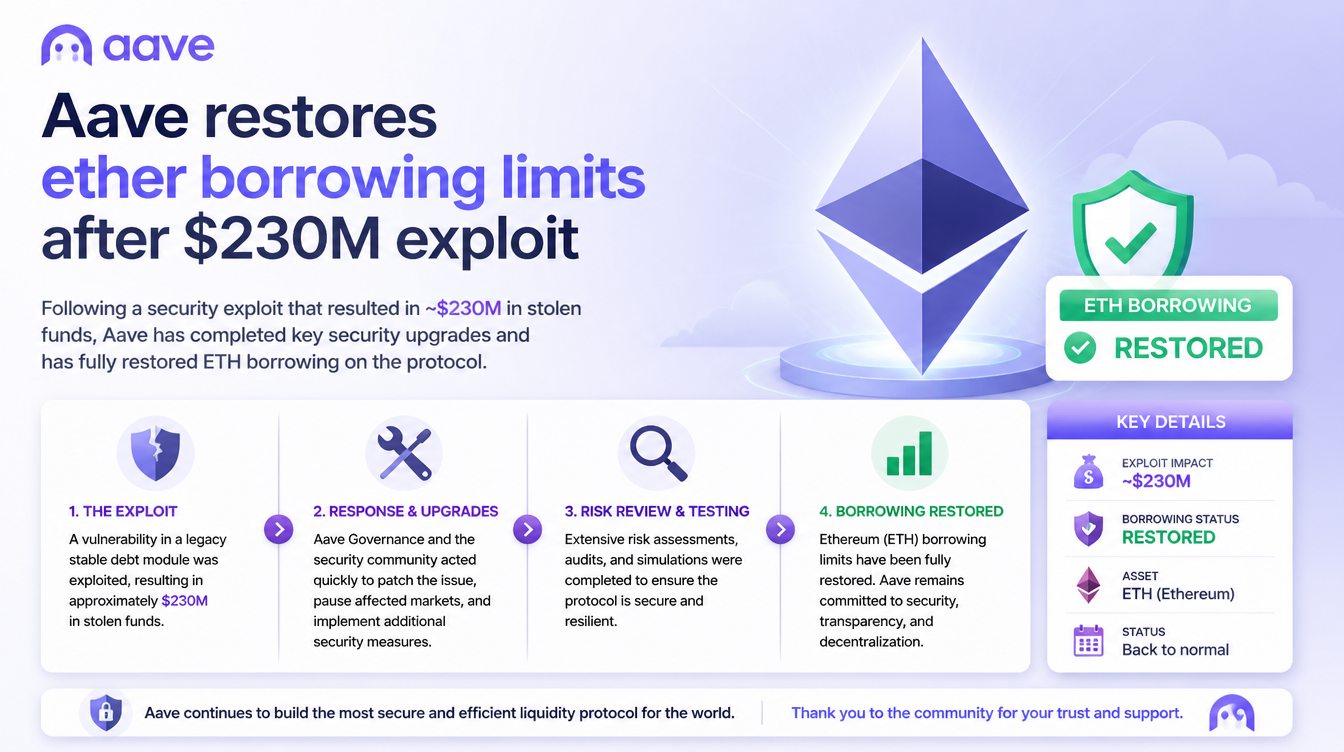
Aave has reinstated wrapped ether (WETH) collateral parameters across major networks, signaling a return to normal operations after April’s exploit disrupted DeFi lending markets.
The protocol restored loan-to-value (LTV) ratios on six chains, reversing emergency controls introduced after attackers leveraged a vulnerability tied to Kelp DAO’s rsETH token. The exploit enabled the creation of roughly $292 million in unbacked assets, which were then used to siphon approximately $230 million in ether from Aave.
As a core collateral asset in decentralized finance, WETH underpins borrowing, leverage, and liquidity provision across multiple ecosystems. In response to the incident, Aave reduced WETH’s LTV to 0%, effectively halting its use as collateral to contain systemic risk.
With the immediate threat now largely mitigated, LTV ratios have been restored to pre-incident levels. These include 80.5% on Ethereum Core, 84% on Ethereum Prime, 80% on Arbitrum, Base, and Linea, and 80.5% on Mantle.
The exploit resulted in the minting of approximately 112,103 unbacked rsETH. Recovery efforts have reclaimed about 106,993 of those tokens through liquidations and coordinated actions — 89,567 via Aave and 17,426 via Compound. A residual shortfall of around 5,200 rsETH is expected to be absorbed by the DeFi United coalition.
For markets, the restoration marks a key step toward normalization. The temporary removal of WETH as collateral constrained leverage, reduced liquidity efficiency, and locked capital across DeFi platforms.
By reinstating borrowing capacity, Aave is signaling confidence that contagion risks have been contained. However, outstanding legal questions around frozen assets and liability allocation continue to cast uncertainty over the aftermath of the exploit.