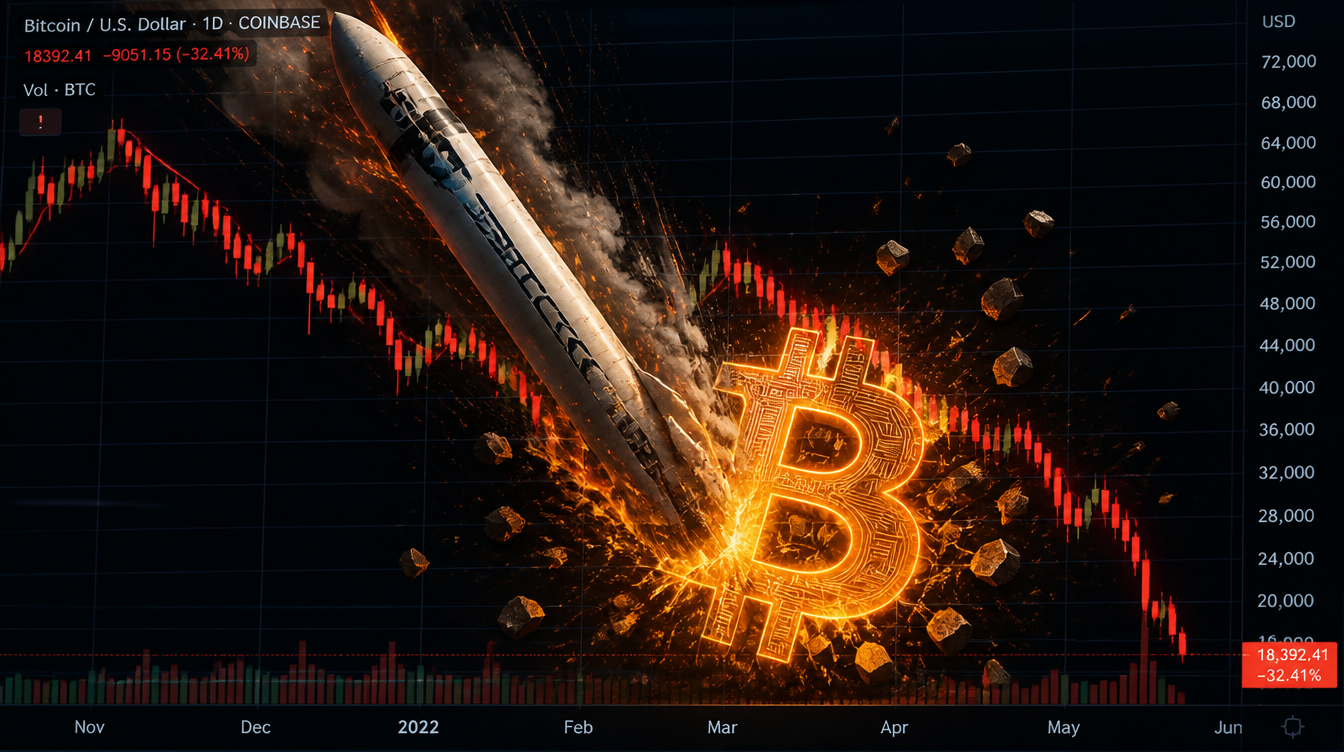
The newly listed company wiped out nearly half of bitcoin’s total market value in just three trading sessions after unveiling its first bond sale. In contrast, bitcoin slipped less than 1% over the same period, showing relative resilience.
SpaceX has shed more than $600 billion in market capitalization in three days—roughly half of bitcoin’s $1.3 trillion valuation—following plans to issue debt for the first time.
Bitcoin held near $63,600 during the stretch, down less than 1%, according to CoinDesk data.
The stock plunged 16% on Monday to $154.60, its lowest level since debuting on June 12, extending its three-day loss to about 23%. The sell-off was driven by plans to raise at least $20 billion through bond sales to fund its artificial intelligence expansion after acquiring Elon Musk’s xAI earlier this year.
Rather than issuing new shares and diluting investors, SpaceX opted to tap debt markets. Just a week earlier, the company was valued near $2.5 trillion, briefly overtaking Amazon and Microsoft, but has since fallen back to just above $2 trillion.
Selling pressure continued into Tuesday, with a perpetual futures contract tracking SpaceX on Hyperliquid dropping another 15% to around $151.
Part of the sharp decline reflects structural factors. With a limited float, meaning fewer shares available for trading, SpaceX’s stock is more prone to exaggerated price swings, making the reaction to a single headline more severe.
Bitcoin, by comparison, benefits from deeper liquidity, allowing it to better absorb similar macro pressures.
Still, both markets are influenced by the same broader forces. The Nasdaq fell 1.3% on Monday as investors questioned whether massive AI spending by major tech firms will deliver returns, dragging down shares of Alphabet and Amazon.
That same AI-driven risk appetite has supported crypto in recent weeks, meaning further weakness in tech could eventually weigh on bitcoin. For now, the sell-off remains concentrated in equities.
At the same time, easing oil prices are offering support. Progress in U.S.-Iran negotiations has led to a 60-day license allowing Iran to resume oil exports, with talks described as constructive. Brent crude has dropped below $78 per barrel.
Lower oil prices help ease inflation concerns that have kept the Federal Reserve hawkish, providing a gradual tailwind for risk assets, including bitcoin.
As a result, bitcoin continues to trade sideways near the lower end of its monthly range, caught between a weakening AI-driven equity rally and improving macro conditions tied to energy markets.
Despite its reputation for volatility, bitcoin has remained relatively stable, while the newly public megacap stock swung sharply, losing 23% in just three days.