Here’s a refined rewrite with a sharper, more analytical and institutional tone:
Bitmine Preferred Stock Offering Signals Possible Expansion of ETH Treasury Strategy
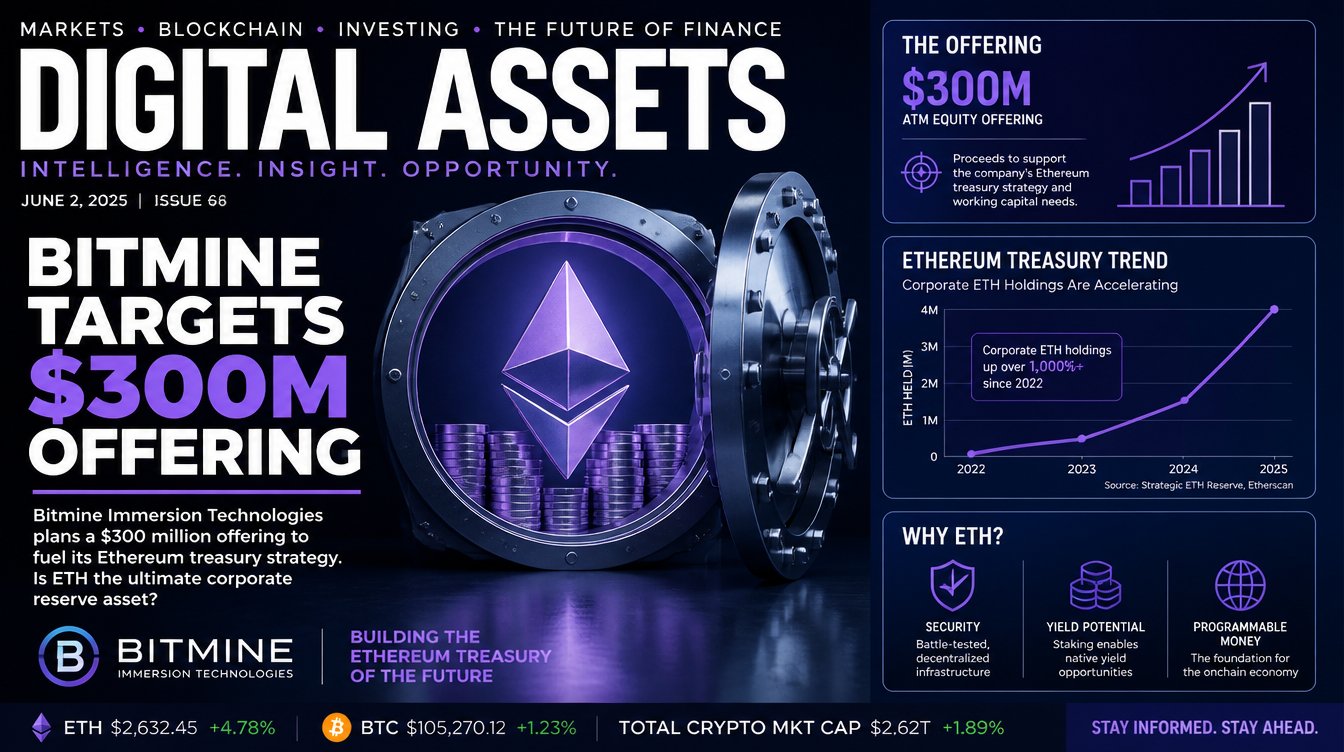
Bitmine Immersion Technologies has submitted a filing with the U.S. Securities and Exchange Commission to issue Series A Perpetual Preferred Stock, offering 3 million shares at $100 each, with a targeted raise of approximately $300 million. Market reaction, however, has focused less on general financing needs and more on the potential for further Ethereum accumulation.
Shares of Bitmine (BMNR) advanced roughly 5.8% on Thursday, even as Ethereum declined 1.7% over the past 24 hours to around $1,650, marking a weekly drop of nearly 17%.
The central question is not the company’s need for capital, but whether this issuance reflects standard balance sheet management or a continued, deliberate buildout of what is already the largest Ethereum-focused treasury strategy.
Breakdown of the Offering Structure
Under the proposed terms, Bitmine will issue 3 million preferred shares priced at $100 each, carrying a cumulative annual dividend of 9.5%, payable weekly in cash subject to board approval. Missed payments trigger a step-up mechanism, increasing the dividend rate by 0.05% per week, capped at 15% annually until obligations are fulfilled.
The shares are expected to trade on the New York Stock Exchange under the ticker BMNP, with listing anticipated approximately 30 days after issuance.
The company’s guidance on capital deployment remains broad. Funds may be allocated toward acquiring ETH and other digital assets, expanding staking and validator operations through MAVAN, supporting working capital, pursuing ecosystem-aligned investments, or repurchasing common equity. While ETH accumulation is clearly an option, it is not the sole stated objective.
This follows earlier financing activity. In September 2025, Bitmine raised capital through a direct common stock sale, with proceeds largely directed toward Ethereum purchases. Chairman Thomas Lee described that move as “materially accretive,” emphasizing increased ETH exposure per share.
As of January 2026, Bitmine reported holdings of approximately 4.14 million ETH and 192 BTC, alongside a $25 million investment in Eightco Holdings and roughly $915 million in cash—bringing total crypto and cash exposure to about $14.2 billion. Notably, around 659,000 ETH are staked through MAVAN, generating yield that may support dividend payments tied to this preferred issuance.
Echoes of the MicroStrategy Model—with a Yield Twist
The structure draws clear comparisons to Strategy’s perpetual preferred stock (STRC), which carries an 11.5% dividend. Strategy’s capital model demonstrated how public companies can repeatedly issue securities to accumulate digital assets, relying on long-term appreciation to justify dilution.
Bitmine appears to be applying a similar approach to Ethereum, though with a key distinction.
Two interpretations persist. One views the raise as a diversified capital allocation toward infrastructure, liquidity, and selective asset purchases. The other—more widely reflected in market sentiment—sees it as a continuation of a multi-year strategy to increase ETH holdings per share, with staking yield helping to service the dividend.
Evidence leans toward the latter. Previous raises have consistently emphasized ETH accumulation, and the company has outlined ambitions to control 5% of global ETH supply. At the Proof of Talk conference in France, Thomas Lee highlighted a treasury model built on staking rewards funding ecosystem development.
A critical difference from Strategy lies in income generation. When Strategy sold 32 BTC to fund dividend obligations—its first sale since 2022—Bitcoin briefly dipped below $62,000, exposing the challenge of funding payouts through asset liquidation.
Bitmine’s reliance on staked ETH introduces a different dynamic, as native yield generation could partially offset dividend costs. However, whether current staking returns and ETH price levels can sustainably support a 9.5% annual dividend on a $300 million issuance remains uncertain.