Here’s another clean, distinct rewrite with a slightly more analytical + institutional tone:
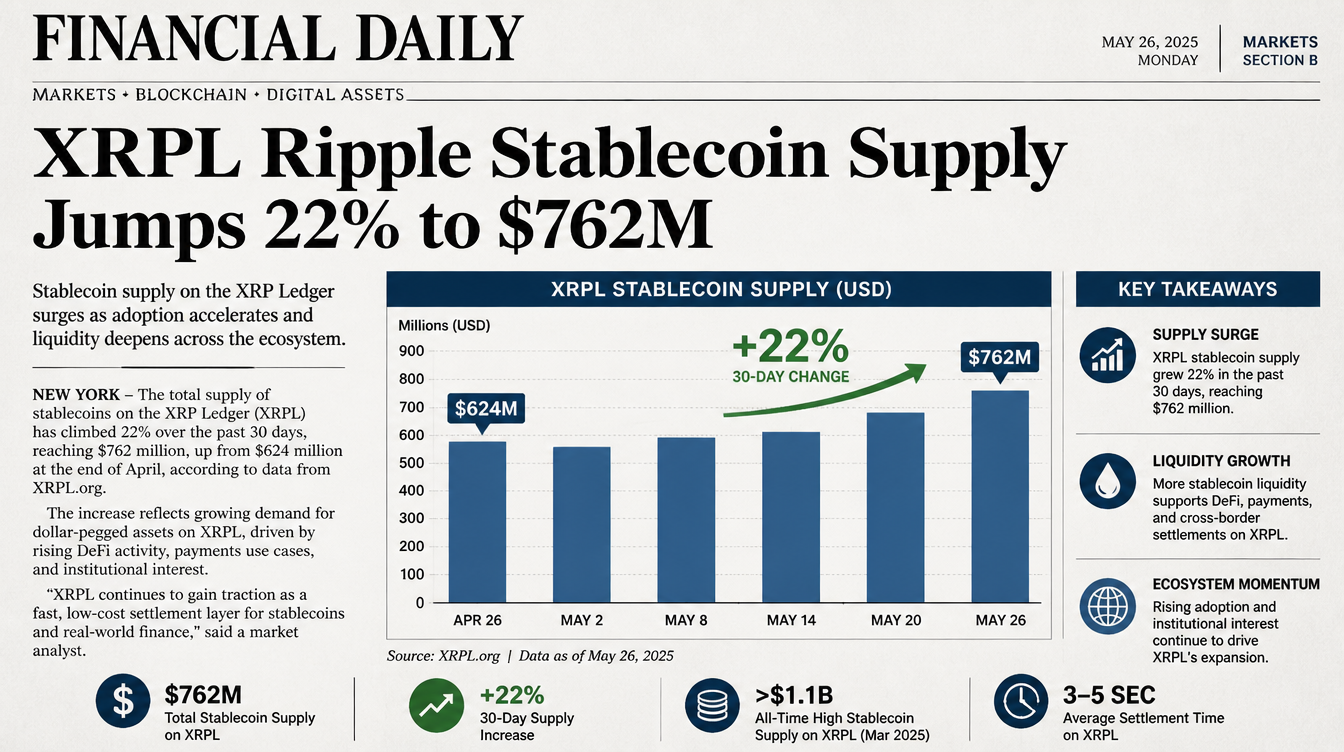
XRPL Stablecoin Supply Climbs to $762M as RLUSD Tightens Grip on Liquidity
The XRP Ledger’s stablecoin supply has expanded by 22% in recent weeks, reaching approximately $762 million. This increase represents more than a simple rise in liquidity—it reflects RLUSD’s growing dominance, with Ripple’s stablecoin now controlling an estimated 83%–88% of XRPL’s native stablecoin market.
Network usage has accelerated alongside supply growth. Monthly transfer volume surged 123% to $4.71 billion, while 30-day stablecoin capitalization surpassed $888.5 million, pointing to a sustained shift in network activity rather than a one-time spike.
While infrastructure development is progressing rapidly, adoption remains limited. The network currently supports just 110 RWA holders, underscoring a disconnect between expanding capacity and actual participation.
This growth phase has coincided with XRP gaining 3.2% over the past 24 hours, reclaiming the $1.10 level and trading near $1.16, supported by roughly $2 billion in daily trading volume.
Understanding the Drivers Behind XRPL’s $762M Expansion
RLUSD was launched by Ripple in December 2024 as a fully backed, fiat-pegged stablecoin regulated by the New York Department of Financial Services, with reserves held 1:1 in U.S. dollars at BNY Mellon.
Its regulatory structure helped establish credibility among institutional users, with issuance accelerating throughout 2025, particularly through exchange integrations and early-stage pilot programs.
For much of 2025, XRPL’s stablecoin supply remained below $100 million, primarily tied to cross-border payments. Momentum shifted in November 2025, when supply crossed $200 million and entered a sustained growth phase. By June 2026, it had reached $762 million, driven largely by RLUSD.
It is important to distinguish that RLUSD’s dominance applies to XRPL-native liquidity. The majority of its total supply—roughly 77% to 82%—resides on Ethereum, where it is used as collateral in DeFi markets, reflecting a multi-chain deployment strategy.
The $762 million figure represents XRPL’s share within this broader ecosystem. Meanwhile, the sharp rise in transfer volume signals growing activity, although the composition of these transactions remains uncertain.
RWA Expansion: Infrastructure Scaling Faster Than Adoption
XRPL’s tokenized asset ecosystem has grown significantly, with total represented value reaching $3.57 billion, while only $385 million is actively circulating on-chain. This gap highlights the difference between registered assets and actual utilization.
Messari data for Q1 2026 places XRPL’s RWA market cap at $2.25 billion, reflecting a 124% quarter-over-quarter increase and ranking it among the top global platforms. Key contributors include OpenEden’s TBILL Vault, Ondo Finance’s tokenized U.S. Treasury product, and RLUSD.
A major institutional milestone occurred in May 2026, when a tokenized U.S. Treasury redemption pilot was executed involving Ondo Finance, JPMorgan Kinexys, Mastercard, and Ripple. The cross-border transaction, tied to approximately $250 million in assets under management, was completed in just 4.2 seconds—demonstrating XRPL’s efficiency as a settlement layer.
JPMorgan’s involvement highlights growing institutional confidence in XRPL’s infrastructure and raises the prospect of broader adoption in financial operations.
Adoption Constraints: High Value, Low Participation
Despite strong infrastructure, participation remains concentrated. As of June 2026, XRPL has only 110 RWA holders representing $3.57 billion in value—implying an average holding size exceeding $30 million per participant.
This concentration suggests institutional dominance rather than broad-based adoption. While it may reflect early-stage pilot programs, it also indicates limited engagement from key liquidity providers such as market makers and fund managers.
Critical questions remain around whether the number of participants will expand, whether holdings are becoming more concentrated, and how much activity is occurring off-chain before assets are deployed on-chain.
The gap between $3.57 billion in represented assets and just $385 million actively circulating highlights ongoing uncertainty around liquidity and real usage, leaving XRPL’s long-term adoption trajectory still evolving.