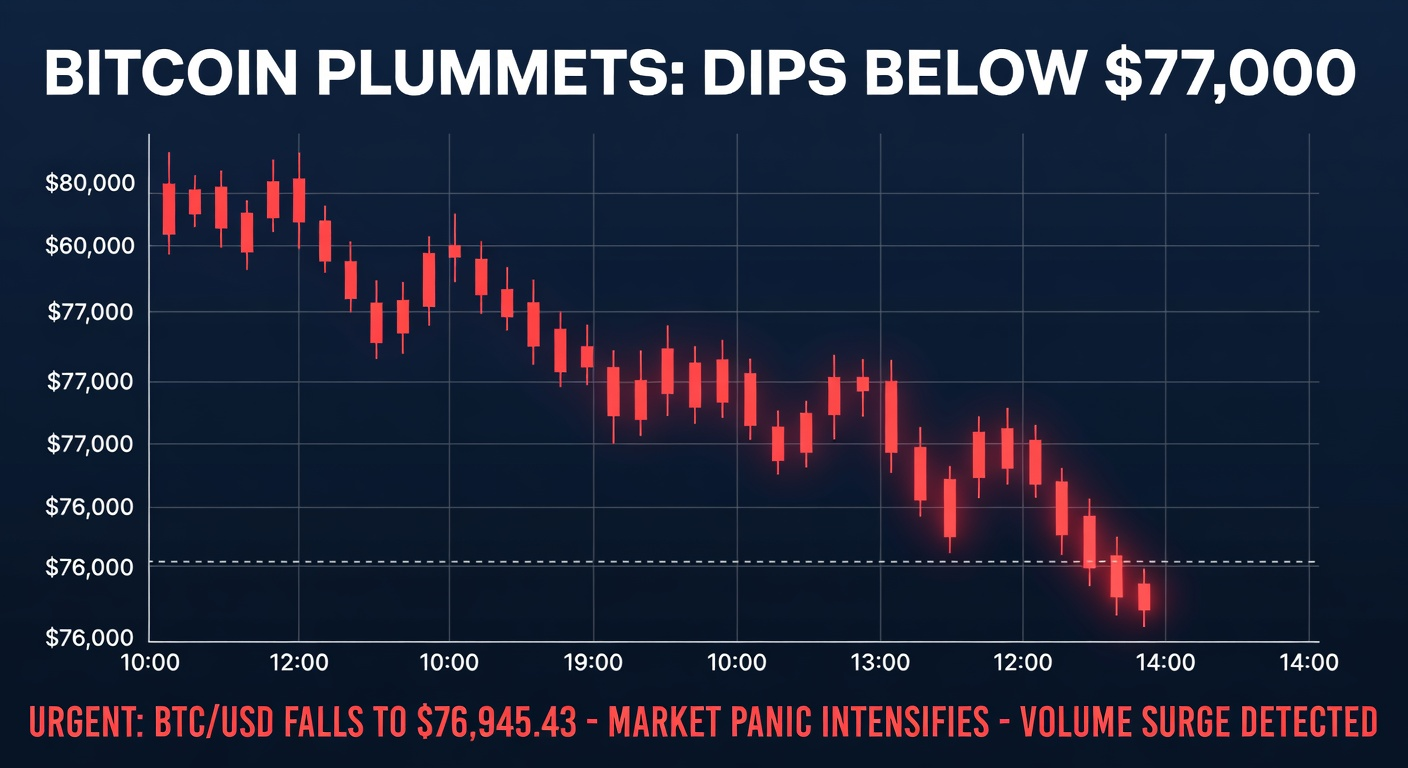
Bitcoin and ether slid lower as geopolitical tensions escalated after U.S. President Donald Trump warned Iran that the “clock is ticking,” sending oil prices higher and sparking a wave of liquidations across crypto markets.
Bitcoin (BTC) came under pressure at the open of CME futures trading late Sunday (23:00 UTC), falling roughly 2.4% to around $76,500 — its lowest level since April 30. The decline followed Trump’s social media comments urging Iran to act quickly or face severe consequences, which dampened global risk sentiment.
Brent crude briefly climbed above $112 per barrel following the remarks, while risk assets broadly weakened. U.S. equity futures also moved lower, with S&P 500 and Nasdaq 100 contracts slipping 0.3% and 0.25%, respectively.
Ether (ETH) underperformed bitcoin, dropping about 3.5% to trade near $2,116, effectively erasing gains from April’s rally as liquidation pressure intensified.
Derivatives data pointed to widespread deleveraging. Total futures trading volume surged 65% to $159 billion over 24 hours, while open interest fell 1.48% to $125 billion. Liquidations spiked 500% to $677 million, indicating positions were being forcefully unwound rather than new directional bets being added.
Bitcoin Cash (BCH) stood out, with open interest rising 13% to 1.47 million coins — the highest level since early April — even as funding rates plunged to an annualized minus 72%, the most negative among major cryptocurrencies. Alongside sharply negative cumulative volume delta (CVD), the data suggests a heavily crowded short trade that could unwind sharply if sentiment shifts.
In contrast, Zcash (ZEC) showed relative strength. Open interest climbed for a third consecutive day, surpassing 2 million tokens, while CVD remained strongly positive, driven by aggressive buying. Funding rates hovered near 4%, indicating positioning is not overheated. Despite a recent pullback, ZEC remains up 111% this quarter, with further upside possible if broader market conditions stabilize.
Other tokens such as HYPE, CRO, and TON also posted gains in open interest, while BTC and ETH positioning remained largely steady over the past 24 hours.
Across the broader market, selling pressure dominated. Excluding ZEC, TON, and HYPE, all other top 25 cryptocurrencies recorded negative 24-hour CVDs, confirming that the downturn was driven by aggressive selling rather than passive distribution.
Volatility indicators also ticked higher. Bitcoin’s 30-day implied volatility index rose to 42% from 40% earlier in May, maintaining its inverse relationship with spot prices. Meanwhile, the MOVE index — a key gauge of U.S. Treasury market volatility — jumped 14% on Friday, marking its largest single-day rise since late March and signaling heightened global financial stress.
Options markets suggest traders are positioning for larger moves ahead. On Deribit, block trades were skewed toward BTC straddles, reflecting expectations of significant price swings in either direction and a view that current implied volatility may be relatively cheap.
Altcoins underperformed major cryptocurrencies, with assets such as BCH and Dogecoin dropping 10% and 4.5%, respectively, since the start of Monday trading. Weakness in memecoins weighed on broader benchmarks, with related indices posting the steepest losses.
Other crypto indices also declined, including DeFi and large-cap benchmarks, reflecting the broader risk-off tone.
Despite the downturn, a handful of tokens bucked the trend. Thorchain (RUNE) rose 3.8% as it recovered from last week’s exploit, while layer-1 token KAIA extended its rally, gaining 1.6% on the day and 3.5% over the past 24 hours. Trading activity in KAIA surged, with daily volume nearly tripling to $53 million.