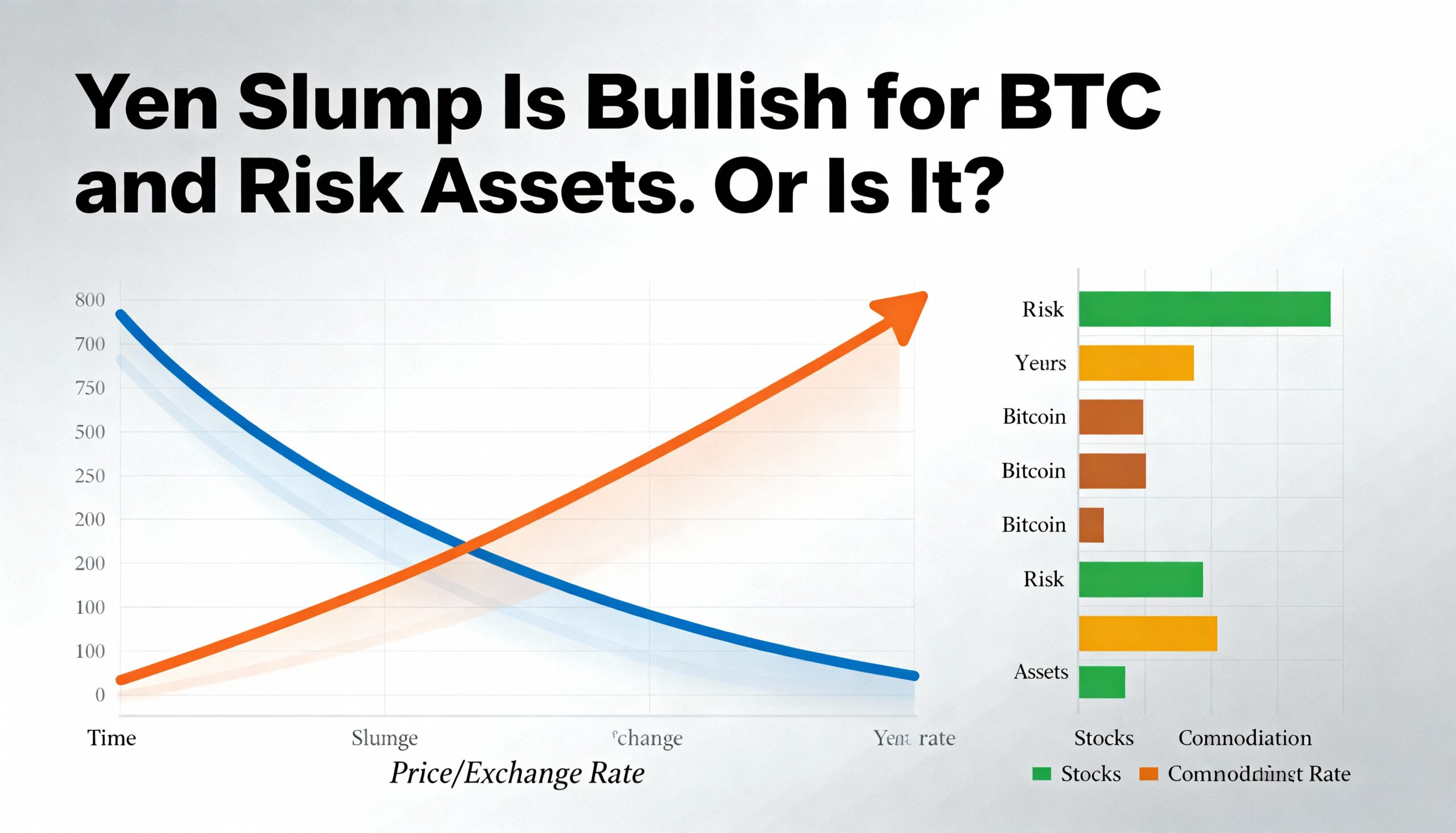
The Japanese yen has tumbled to 157.20 against the U.S. dollar, a sharp move for a major currency and one that has FX traders bracing for potential action from the Bank of Japan. But the yen’s slide isn’t just an FX story — it has broad implications for global risk appetite and crypto markets.
For years, the yen’s ultra-low interest rates made it the foundation of global carry trades. Investors borrowed cheaply in Japan, converted the funds into higher-yielding currencies, and poured the capital into risk assets. When the yen declines, these trades become even more profitable because the cost of repaying the yen-denominated loans falls.
Historically, this dynamic has linked yen weakness with a risk-on environment. Conversely, periods of yen strength have often coincided with risk-off moves. A clear example occurred in August 2024, when the BOJ’s first rate hike in a decade strengthened the currency and helped push bitcoin from about $65,000 down to $50,000 in a matter of days.
Given that backdrop, one might assume the yen’s latest decline is supportive for BTC and risk assets. The BOJ’s policy rate remains just 0.5%, in stark contrast to the Fed’s 4.75% rate, and Japanese retail investors are reportedly chasing returns in high-yield plays such as the Turkish lira.
However, Japan’s macro landscape has changed. The country’s debt burden — roughly 240% of GDP — is among the highest globally. Inflationary pressure in the post-pandemic era and Prime Minister Sanae Takaichi’s commitment to aggressive fiscal expansion have intensified concerns around fiscal sustainability. The government’s newly approved ¥21.3 trillion ($135 billion) stimulus package only adds to the strain.
Bond markets reflect that pressure. Japan’s 10-year government bond yield has climbed to 1.84%, its highest level since 2008. Yields on longer maturities are also sitting near multi-decade highs. Crucially, these rising yields are occurring alongside a weakening yen — a break from historical norms and a signal that fiscal stress, rather than rate differentials, is now driving currency weakness.
This leaves policymakers trapped. Allow yields to rise further, and they risk triggering a fiscal crisis. Cap yields and keep rates low, and the yen may continue sliding into a destabilizing devaluation cycle. As economist Robin Brooks of the Brookings Institution put it: “If Japan stabilizes the yen by allowing yields to rise, there’s a fiscal crisis. If it keeps rates low, the yen goes back into a devaluation spiral. Too much debt is a killer.”
The result is a more unpredictable yen — and a less reliable indicator of global risk sentiment. Its long-standing role as a funding and safe-haven currency is being undermined by structural fiscal concerns.
Other currencies are now taking its place. The Swiss franc, with a 0% policy rate and a 10-year government yield near 0.09%, has emerged as a new favorite for carry trades, according to Bannockburn Global Forex strategist Marc Chandler.
For BTC traders, that means the traditional “yen equals risk-on” relationship may be fading. Going forward, Switzerland’s franc — not Japan’s yen — may offer clearer clues about shifts in global risk appetite.