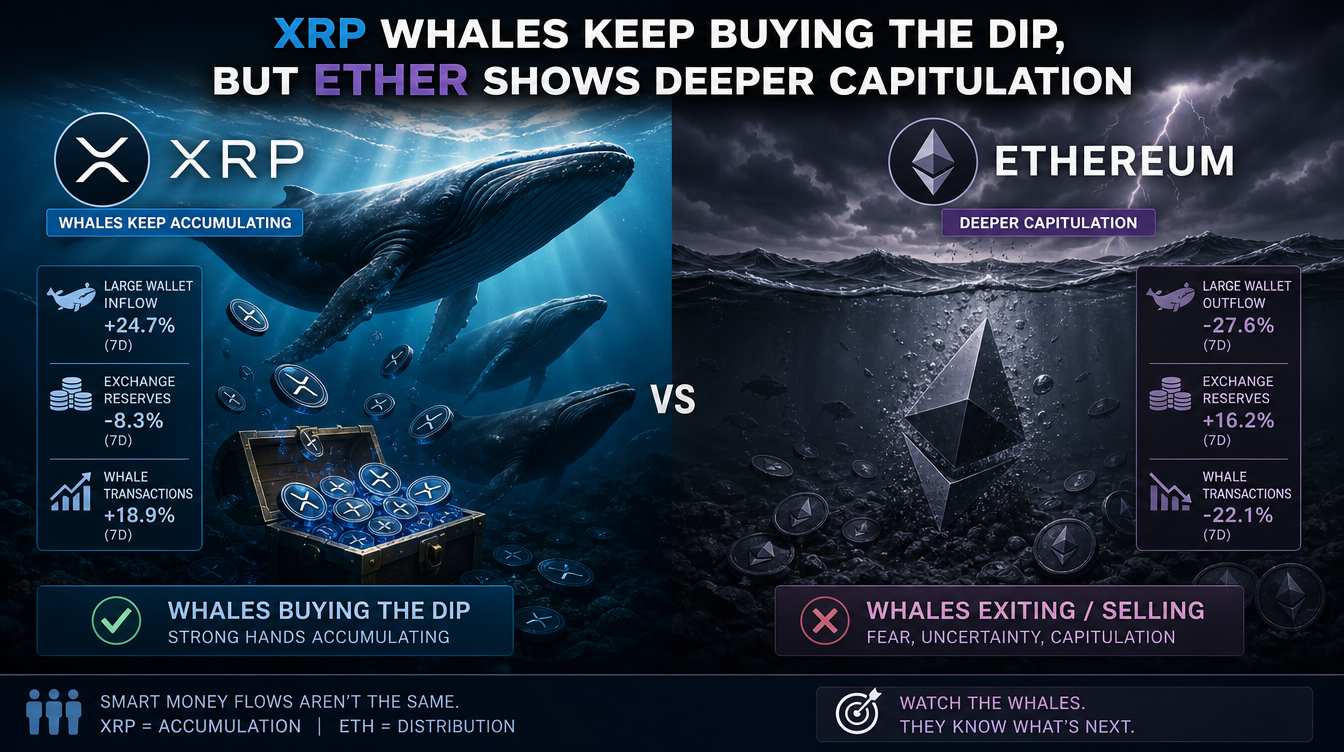
CryptoQuant said continued large XRP spot purchases indicate a phase of “quiet accumulation” rather than a signal of an immediate breakout. Meanwhile, ether’s price below its realized value suggests widespread unrealized losses among holders and gives ETH the strongest valuation setup compared with Bitcoin and XRP.
Large XRP investors have continued adding to their positions as the token declined from around $2.40 in January to the current $1.00-$1.20 range. Despite the steady buying activity, the accumulation has not yet been strong enough to push prices higher.
According to blockchain analytics platform CryptoQuant, average XRP spot order sizes have remained at levels typically associated with major whale activity throughout 2026. At the same time, the 90-day taker cumulative volume delta — which tracks whether buyers or sellers are dominating trades — has moved closer to neutral after showing stronger buyer demand earlier in the year.
Crypto whales are large holders whose market activity is closely followed because their accumulation and selling behavior can often influence broader price trends.
CryptoQuant described XRP’s current market behavior as “quiet absorption,” suggesting investors are gradually building positions within a consolidation range rather than the token experiencing a major selloff or entering a confirmed rally.
Ether currently offers the most attractive valuation profile among the three assets. ETH is trading around $1,900, below its realized price of approximately $2,450, meaning the average acquisition cost of all existing ETH is higher than the current market price and many holders are holding unrealized losses.
In comparison, Bitcoin remains around 17% above its realized price of roughly $52,900, while XRP trades near $1.10 against a realized value of about $0.75.
Ethereum’s holder distribution, however, shows a mixed picture. Wallets containing between 10,000 and 100,000 ETH have steadily increased their holdings, rising from around 14 million ETH in mid-2025 to nearly 19.6 million ETH currently.
Large wallets holding more than 100,000 ETH dropped to about 2.6 million ETH in mid-2025 but later recovered to approximately 4.6 million by May 2026. CryptoQuant estimates this group added nearly 1.8 million ETH during that recovery period.
Meanwhile, addresses holding between 1,000 and 10,000 ETH have reduced their exposure. Holdings in this group peaked at roughly 15.6 million ETH in January 2026 before declining to around 12.9 million.
Bitcoin whales, excluding exchange and mining addresses, also increased their holdings after reaching a low of about 2.87 million BTC in December 2025. Their balances have since grown to roughly 3.06 million BTC, with the strongest buying occurring when Bitcoin dropped below $60,000 in June. However, whale holdings remain about 170,000 BTC below the 2025 cycle peak of approximately 3.23 million BTC.
CryptoQuant described the current market environment as the final phase of the decline but warned that prices could still experience another move lower before a lasting bottom is established.
The main metric to watch is ether’s position below its realized price. Among BTC, ETH, and XRP, Ethereum is the only asset currently showing a full paper capitulation scenario, with holders collectively underwater. CryptoQuant noted that ETH reached a similar bottom structure in early 2025 when it traded at a comparable discount to its lower valuation range.