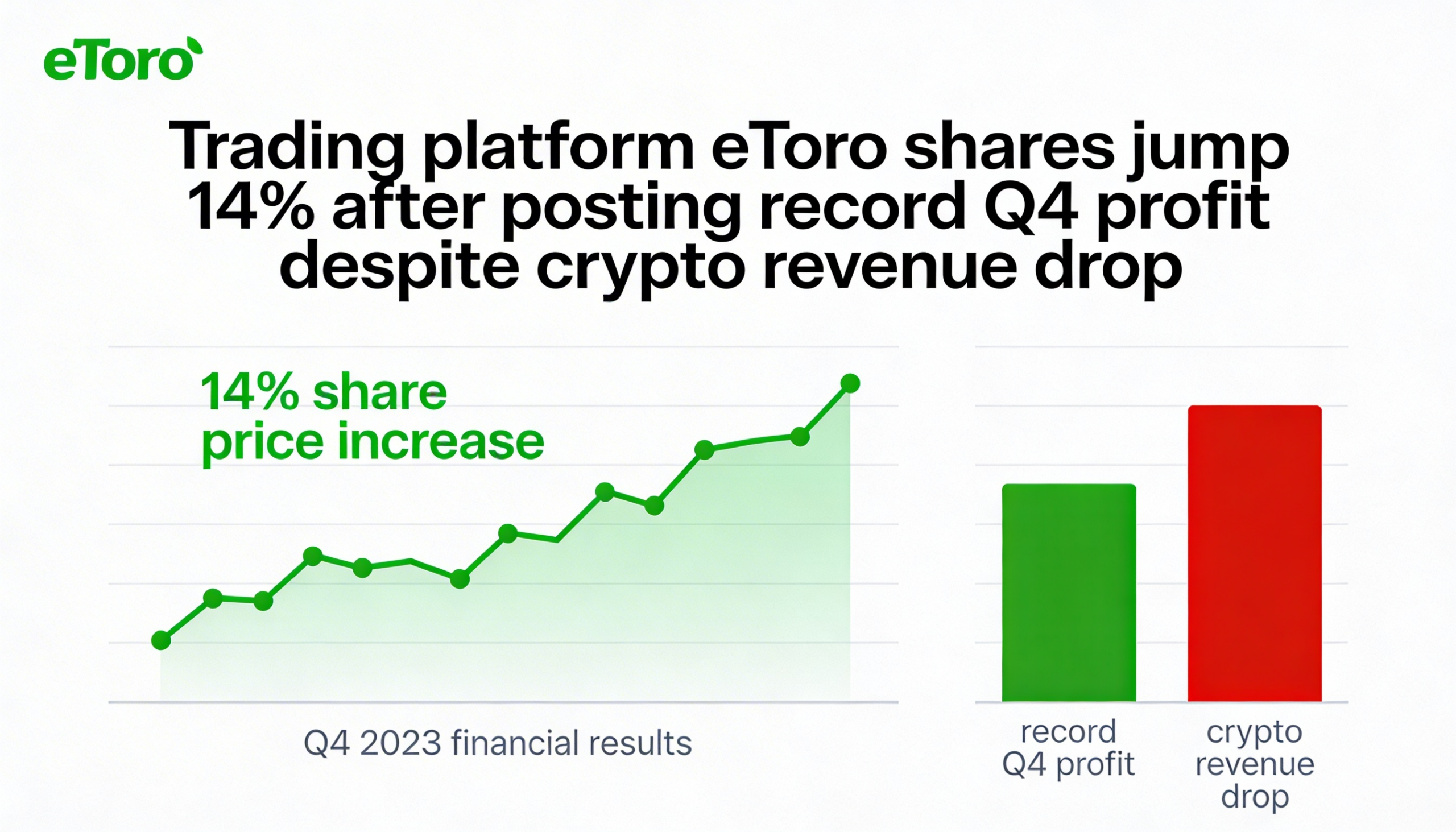
Shares of eToro (ETOR) jumped 14% on Tuesday after the brokerage delivered a standout fourth quarter, even as crypto trading volumes remained under pressure across the industry.
The Israel-based platform reported $227 million in revenue for the fourth quarter, a 6% increase from the prior three months, alongside a record net profit of $69 million. For the full year 2025, revenue rose 10% to $868 million from $788 million the year before.
The results contrasted with those of competitors Robinhood (HOOD) and Coinbase (COIN), both of which recently posted weaker-than-expected quarterly earnings as softer crypto prices and reduced volatility dampened trading activity.
At eToro, crypto-related revenue declined to $3.59 billion in the fourth quarter from $5.8 billion in the same period a year earlier. However, stronger performance in equities and commodities trading helped offset the slowdown in digital assets.
Chief executive Yoni Assia said during the company’s earnings call that some users historically focused on crypto are reallocating toward commodities as volatility shifts.
“We’re seeing a rotation from crypto, where volatility has moderated, into assets like gold and silver that are currently experiencing more pronounced price movements,” Assia said.
eToro now provides access to more than 100 cryptocurrencies for U.S. clients, but management underscored the company’s diversified approach. Assia described the firm as both a crypto-native platform and a global equities brokerage, positioning it to benefit as more elements of the financial system move on-chain.
Despite the strong fourth-quarter showing, early 2026 data indicates softer engagement. January trading volumes totaled 4 million trades, with crypto trades down 50% year over year. The average amount invested per trade also fell 34% to $182 compared with January 2025.
Even so, the company’s broad exposure across asset classes appears to have helped cushion the impact of the ongoing downturn in crypto markets.