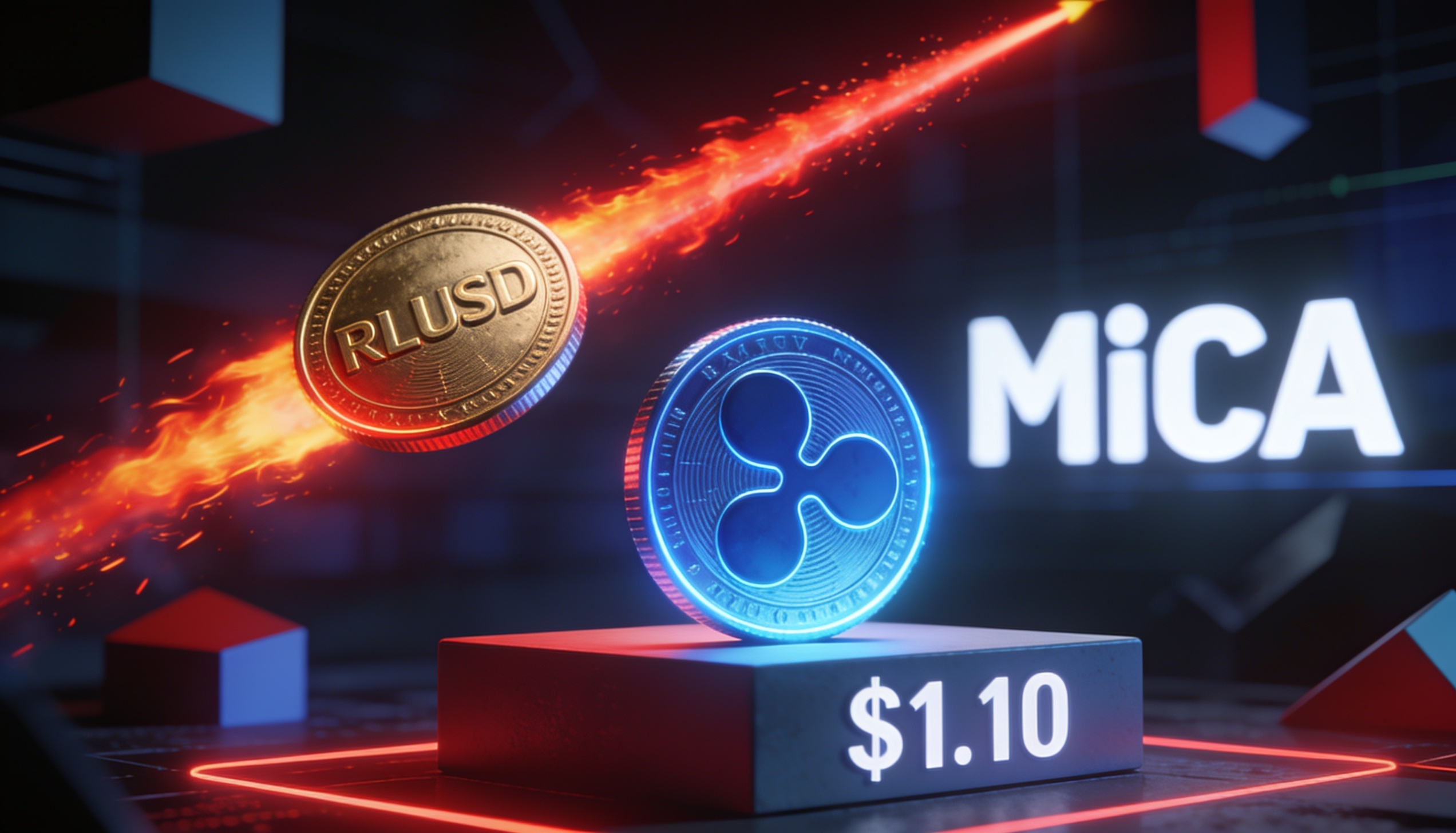
Ripple has received preliminary Crypto Asset Service Provider (CASP) approval from Luxembourg’s CSSF under the EU’s MiCA framework, but the development failed to support XRP’s price. The token fell 3% on the news and is trading near $1.10, down about 5% over the past 24 hours in a weak broader market.
Despite the significance of the regulatory milestone, it did not translate into an XRP catalyst. Ripple’s announcement focused primarily on its RLUSD stablecoin and Ripple Payments infrastructure, with XRP referenced only as an underlying component rather than a core value driver.
The CASP approval enables Ripple to offer regulated crypto services across the 30 countries of the European Economic Area. However, it does not introduce a direct demand driver for XRP.
The CSSF’s approval comes in the form of a conditional “Green Light Letter,” meaning final authorization depends on meeting additional requirements. Once completed, Ripple’s CASP license—combined with its existing Luxembourg-based Electronic Money Institution (EMI) license—would bring the company into full MiCA compliance.
In practical terms, the approval supports Ripple Payments and RLUSD distribution, allowing banks, fintechs, and corporates to manage collections, foreign exchange, and payouts through a single integrated platform across the EEA.
However, an important regulatory question remains unresolved. A CASP license governs crypto services but is separate from the approval required to issue a stablecoin as a MiCA-compliant e-money token. Ripple has emphasized its stablecoin infrastructure without clearly outlining RLUSD’s regulatory standing, particularly given restrictions on non-euro stablecoins used for payments within the EU.
By comparison, Tether’s USDT has faced constraints in Europe under MiCA, while Circle successfully aligned USDC and EURC with the framework through its EMI license. RLUSD’s position within this structure remains unclear, which could influence institutional adoption decisions.
Ripple also trails some competitors in securing approvals. MiCA became fully applicable in December 2024, with firms such as Circle, B2C2, OKX, Coinbase, and Kraken obtaining licenses throughout 2025.
The company’s key differentiator lies in its combined EMI and CASP model, offering a fully regulated, end-to-end payments infrastructure. Backed by more than $100 billion in transaction volume across 60+ markets and over 75 licenses globally, this presents a strong enterprise case—but one that does not inherently channel demand toward XRP.
This pattern has not gone unnoticed. The XRP community has recently criticized Ripple for prioritizing RLUSD development while XRP performance lags. Meanwhile, RLUSD continues to face additional regulatory steps beyond Europe, including requirements in California.
Overall, the MiCA approval reinforces a broader narrative: Ripple is building a compliant global payments network centered on RLUSD, with XRP functioning in a secondary, infrastructural role. As a result, the market has not treated the development as a meaningful driver for XRP’s price.