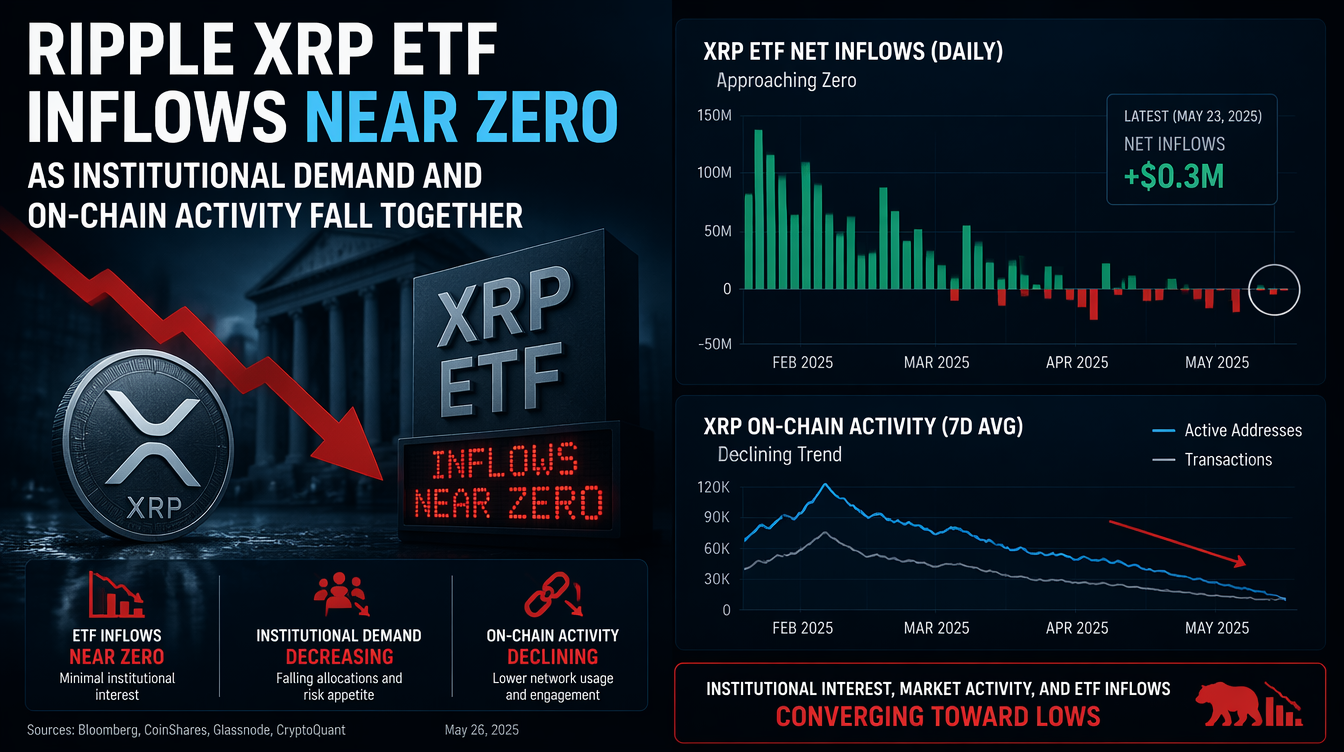
U.S. spot XRP ETFs attracted just $107,000 in inflows on July 10—a figure that barely registers for a product group that pulled in over $100 million in a single month just two months ago.
Total assets under management (AUM) across the seven XRP funds have now dipped below $1 billion to around $996 million, bringing an end to what had looked like one of the more consistent institutional accumulation trends in this crypto ETF cycle.
The real question is no longer whether institutional demand has weakened—it clearly has—but whether this marks a temporary pause in a longer-term allocation strategy or the start of a deeper, sustained pullback.
That distinction is crucial for XRP’s price outlook, which has so far managed to hold above $1 despite simultaneous declines in both retail and institutional demand.
From Strong Inflows to Near Standstill
The reversal in XRP ETF flows has been swift. In May 2026, the funds collectively attracted more than $100 million, with steady inflows week after week.
July has flipped that narrative. Multiple days have recorded zero inflows, while July 8 saw $7.29 million in net outflows—one of the largest daily losses since March 2026.
In just six weeks, the trend has shifted from consistent accumulation to near stagnation. Notably, a large portion of July’s outflows appears concentrated in a single issuer, suggesting the move may reflect fund-specific redemptions rather than a broad institutional exit. This is a key detail to monitor as more data becomes available.
What Could Turn the Tide
Ripple’s RLUSD stablecoin is already generating around $2.5 billion in volume on the XRP Ledger, with roughly $4 billion in tokenized real-world assets currently on the network.
Upcoming upgrades include native lending functionality and an Ethereum-compatible sidechain that is already live. If these developments translate into sustained on-chain activity—measured by growth in active addresses and new wallets rather than just transaction volume—they could help restore ETF inflows by signaling genuine network usage.
If not, XRP may continue to trade sideways, supported primarily by large holders while institutional investors wait for clearer signals before re-entering.
The bearish case is less about a sudden drop and more about a slow grind lower, where ongoing ETF outflows gradually weaken support and point to a more meaningful shift in institutional conviction.
Broader market dynamics will also matter. A pickup in Bitcoin ETF inflows and improving risk sentiment could trigger renewed capital rotation into XRP products.
For now, July’s data serves as an early warning. While XRP ETFs have attracted nearly $1.5 billion in cumulative inflows since launch, whether institutional patience holds through another stretch of weak prices and muted on-chain activity remains the key question.