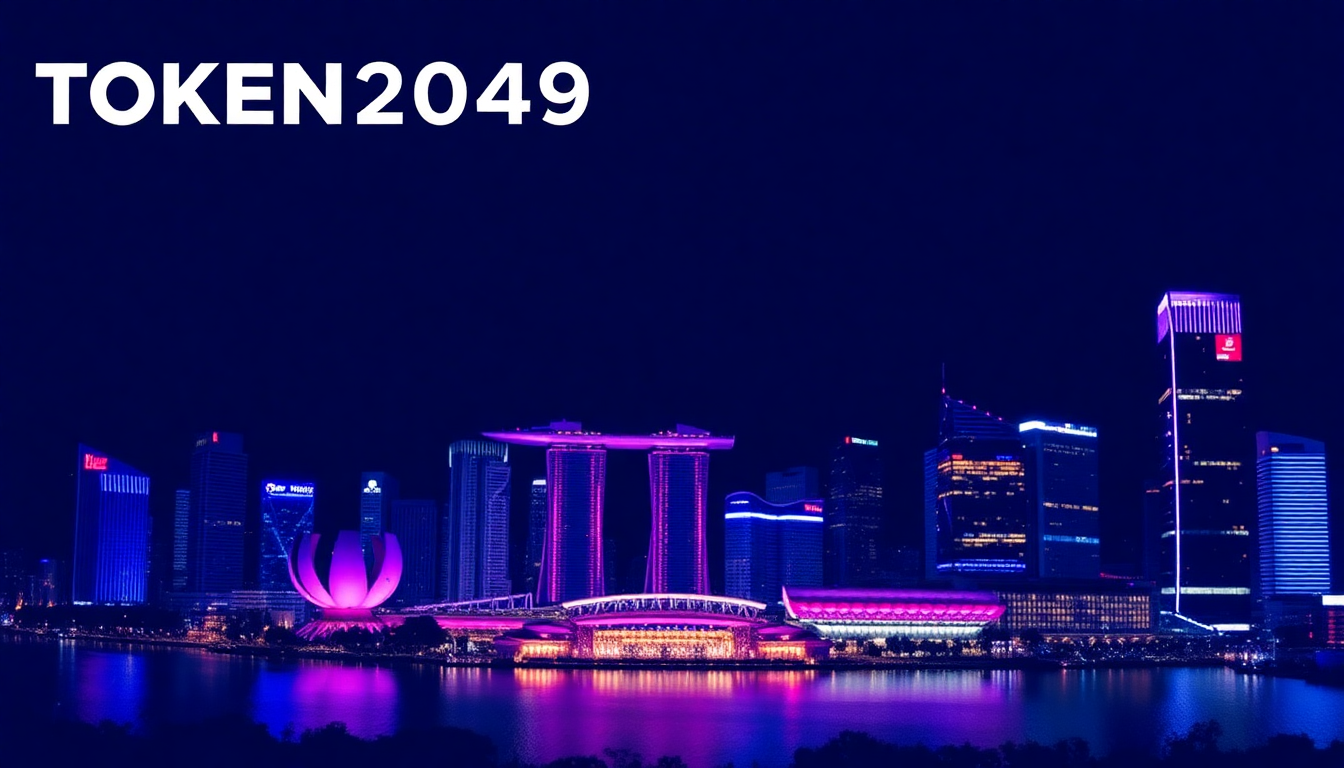
TOKEN2049 Singapore will run from October 7–8, 2026, with its speaker lineup bringing together executives from established financial institutions and leaders from crypto-native companies. Representatives from Nasdaq, BlackRock and Franklin Templeton are scheduled alongside figures from Hyperliquid, Solana, Polygon, Base and Ethereum-linked projects.
The composition of the program indicates that institutional DeFi, tokenization and the infrastructure needed to operate financial markets on-chain are expected to feature prominently.
The traditional-finance roster includes Nasdaq Chair and CEO Adena Friedman, BlackRock Director of Digital Assets Nikhil Sharma, Franklin Templeton CEO Jenny Johnson and Morgan Stanley Head of Digital Asset Strategy Amy Oldenburg. Their participation puts major financial institutions on the same agenda as blockchain developers and crypto businesses.
Crypto industry participants include Hyperliquid Labs’ Jeff Yan, Base’s Jesse Pollak, Solana Foundation’s Lily Liu, Polygon Foundation’s Sandeep Nailwal and Joseph Lubin, listed in connection with Ethereum and MetaMask. The schedule also features executives associated with Aave, Ethena, Synthetix, StarkWare and Offchain Labs, covering DeFi, blockchain infrastructure and scaling.
Institutional DeFi Moves Into Focus
The institutional angle is highlighted by the scheduled “DeFi’s Institutional Breakthrough” session. Aave Labs founder Stani Kulechov, Ethena Labs founder Guy Young and Infinex/Synthetix founder Kain Warwick are listed as participants, with a16z crypto’s Robbie Petersen serving as moderator.
Jeff Yan is also scheduled for a separate main-stage discussion, “Hyperliquid: Rebuilding Finance from First Principles,” giving the derivatives-focused platform a dedicated place in the conference program.
These speaker and session announcements show which subjects TOKEN2049 plans to explore, but they do not establish that the participating companies have entered commercial agreements or that specific institutional products will be deployed as a result of the event.
For financial institutions considering on-chain markets, infrastructure questions remain important. Custody, transaction execution and operational safeguards all influence how institutional assets can interact with blockchain-based systems. These requirements are distinct from the underlying protocols and are central to institutional key custody and execution.
October 7 Schedule Covers DeFi and Trading
The first day begins with “Welcome to TOKEN2049 Singapore” on the OKX Main Stage from 9:00 to 9:10 a.m. Balaji Srinivasan follows with the “The Open Source Network State” keynote from 9:10 to 9:30 a.m.
The schedule then moves toward subjects involving investment, decentralized finance and market infrastructure. “DeFi’s Institutional Breakthrough” is scheduled for 10:20–11:00 a.m., followed immediately by “Hyperliquid: Rebuilding Finance from First Principles” from 11:00 to 11:35 a.m.
Additional sessions include “Wall St. 2049: Everything Trades, Nobody Sleeps,” “The New Trilemma: Confidential, Compliant, Composable,” and discussions covering on-chain options, derivatives and the U.S. market.
The mix of sessions brings together several challenges facing institutional adoption. Privacy, compliance, derivatives and around-the-clock trading are featured alongside discussions about how traditional financial firms could participate in decentralized markets.
The conference will also host TOKEN2049 Institutional on October 8. Organizers describe it as a private, invitation-based gathering for senior figures from global finance and the digital-asset industry.
Hyperliquid and Tokenized Markets
Hyperliquid’s inclusion reflects the increasingly blurred boundary between crypto-native exchanges and institutional trading infrastructure. The platform has its own scheduled discussion at the conference, while separate reporting has looked at Hyperliquid data on the Bloomberg Terminal.
Those developments should not be interpreted on their own as evidence of a commercial relationship between the firms attending the event.
Tokenization represents another major theme within the institutional-finance narrative. Bringing securities onto blockchain rails could alter how financial assets are issued, transferred and traded.
Overall, the TOKEN2049 Singapore program presents institutional DeFi as part of a broader transition toward on-chain financial infrastructure, where traditional finance, decentralized protocols, tokenized assets and professional trading systems increasingly intersect.