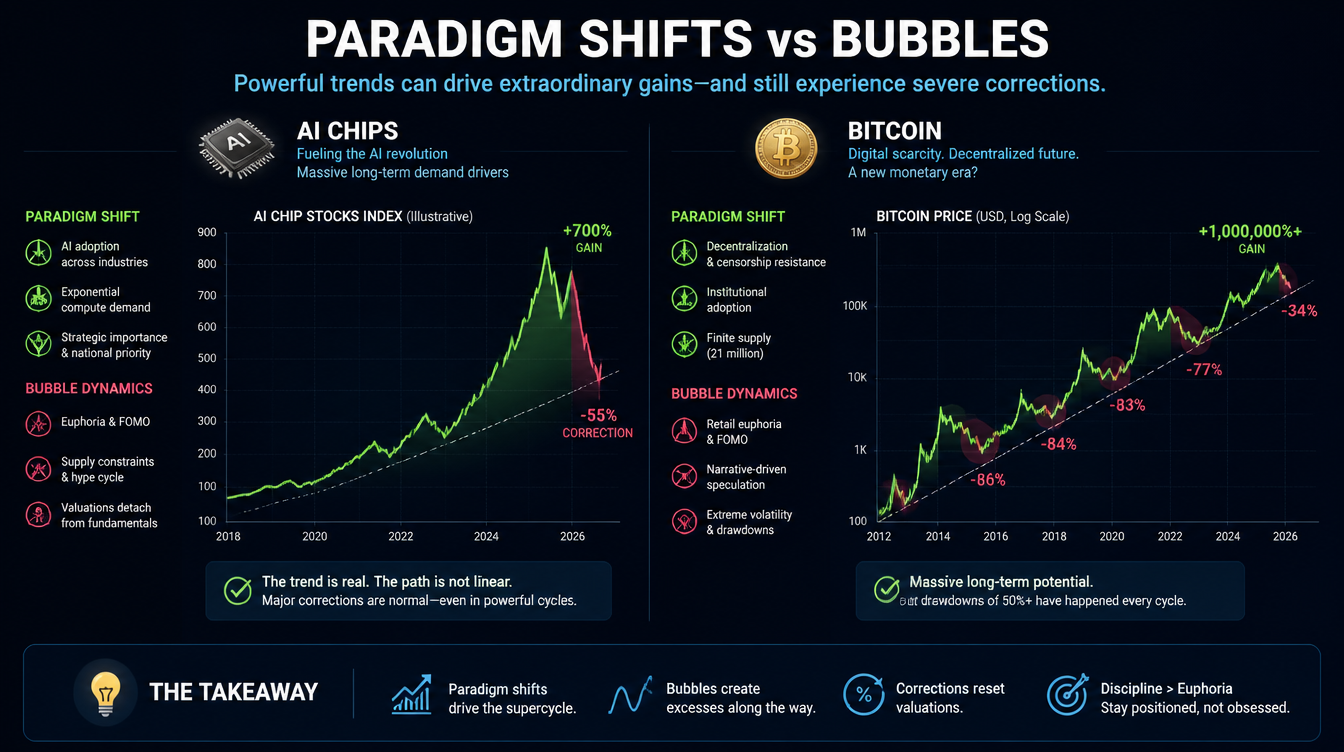
Structural shifts can create significant long-term opportunities, but the sharp rallies seen in semiconductor stocks, precious metals, and bitcoin show that even legitimate trends can quickly become driven by excessive speculation.
The term “paradigm shift” is often used broadly to describe market movements that may actually be short-term rotations into popular themes. The recent AI-fueled semiconductor rally is a clear example of how investor enthusiasm can rapidly concentrate around emerging narratives.
Large technology companies such as Amazon and Google are pouring billions into AI infrastructure, expanding data centers equipped with thousands of advanced AI accelerators. These systems require massive amounts of high-bandwidth memory for processing workloads and NAND flash storage for data capacity, tightening chip supply and pushing prices higher.
Micron Technology (MU), which produces DRAM, NAND, and other memory products, and Sandisk (SNDK), a specialist in NAND flash and solid-state storage, benefited heavily from the AI boom. Micron shares surged about 700% over the past year, while Sandisk climbed more than 4,000%. However, both stocks later pulled back from their highs, demonstrating how quickly investor excitement can reverse.
The AI enthusiasm also fueled historic capital-market events, including SpaceX (SPCX) achieving the largest U.S. IPO on record. SK Hynix (00060), one of the world’s leading suppliers of high-bandwidth memory, raised $26.5 billion through the biggest U.S. listing ever by a foreign company. Although its American depositary receipts initially rallied sharply, later market swings highlighted the risks of buying during periods of extreme optimism, with SK Hynix shares dropping 15% during Asian trading.
The same pattern appeared in precious metals. Gold and silver surged during the “debasement trade,” as investors sought protection against concerns over government debt, money supply expansion, and inflation-driven currency erosion. Silver gained more than $120 in January 2026 before later falling as much as 50%, while gold experienced a more moderate correction.
Strategy (MSTR), the largest corporate bitcoin holder, also saw its investment narrative weaken. The company’s strategy of issuing shares at a premium to the value of its bitcoin holdings and using the proceeds to purchase more BTC was viewed as a self-reinforcing growth model. However, Strategy’s stock has since fallen roughly 80% from its peak as that premium compressed closer to the value of its underlying bitcoin assets.
The key takeaway is that major structural trends can be genuine and transformative, but market valuations often move in cycles. Strong narratives may drive powerful rallies, yet excessive optimism can still lead to sharp corrections.