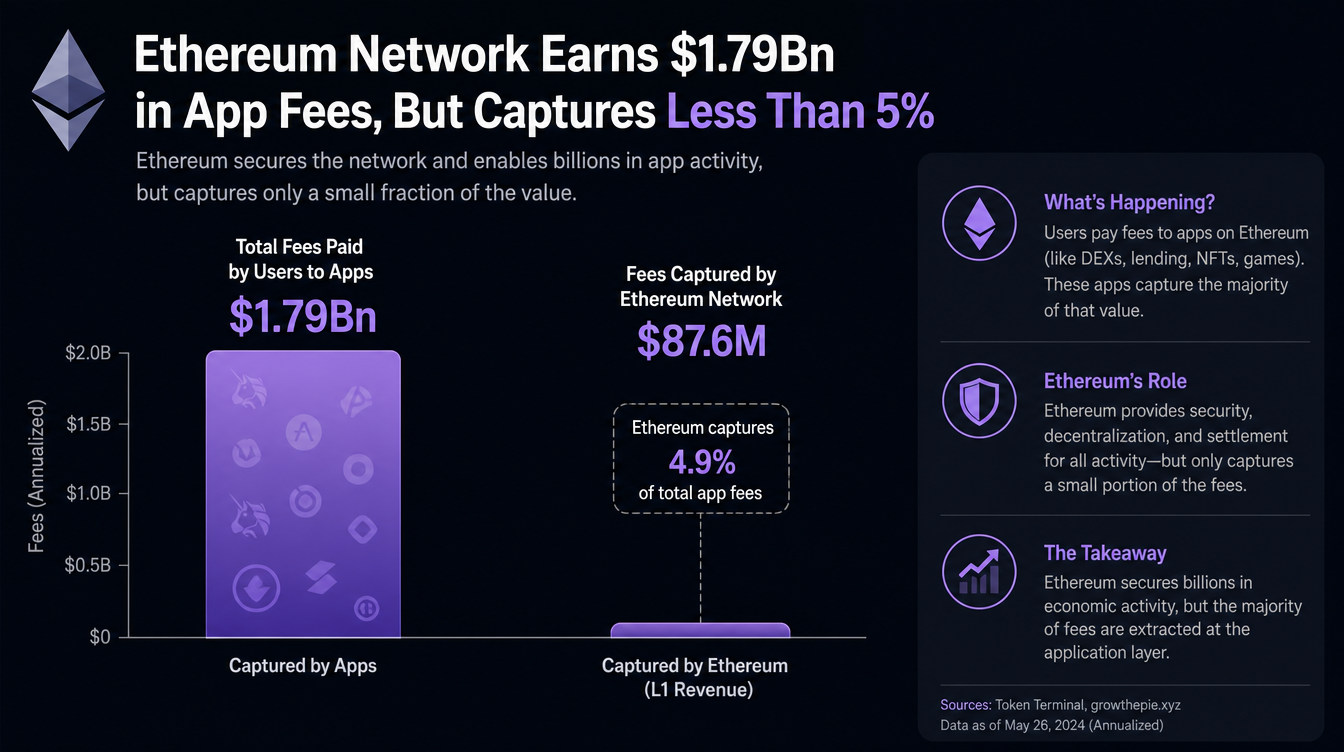
Ethereum’s application ecosystem produced $1.79 billion in fees during the second quarter of 2026, while layer-2 networks handled roughly 1,270 user operations per second and real-world assets worth $17.2 billion were tokenized on-chain.
However, ETH’s market performance has not reflected this growth. The asset remains below $2,000, nearly 60% under its record high of approximately $4,950 reached in August 2025. While Ethereum usage continues to expand, the economic value flowing back to ETH itself has weakened, creating a major debate around the network’s long-term value proposition.
On-chain analyst @Tanaka_L2 outlined the growing disconnect in a July 31 report, revealing that Ethereum’s layer-1 captured only 4.9% of the value generated by applications operating on top of the network during Q2.
Ethereum’s mainnet generated $88.4 million in Real Economic Value, compared with the $1.79 billion earned across decentralized applications. This gap helps explain ETH’s recent underperformance compared with both its previous market cycles and Bitcoin, which has declined roughly 11% in 2026 compared with Ethereum’s nearly 32% drop.
The weakness in ETH’s value capture appears to be caused by fundamental changes in Ethereum’s architecture rather than short-term market conditions. Layer-2 rollups have become the primary source of user activity, with Tanaka’s figures showing approximately 1,270 user operations per second on rollups versus just 20.4 on Ethereum’s base layer.
Blob Fees Weaken Ethereum’s Burn Mechanism
Ethereum’s shift toward rollup-based scaling has improved network efficiency, but the introduction of inexpensive blob fees has reduced the transaction costs that previously contributed to ETH supply reduction through burning.
During a recent seven-day period, blob fees resulted in only about 0.22 ETH being burned, a minimal amount. With annual ETH supply growth at around 0.85% and staking returns near 2.6%, the economic conditions behind the “ultrasound money” narrative have become less compelling.
The ETH/BTC ratio has fallen toward multi-year lows as Bitcoin continues attracting consistent institutional demand. Meanwhile, Ethereum has faced pressure from ETF outflows and a lack of a clear demand driver strong enough to offset concerns about value capture.
The current debate around Ethereum extends beyond network activity and focuses on whether institutional adoption, tokenization, and financial infrastructure can create stronger demand for ETH.
ETH’s Role May Shift From Gas Token to Settlement Asset
Tanaka believes Ethereum’s traditional narrative as a fee-generating blockchain is no longer sufficient. Instead, he argues that ETH’s future value could come from becoming reserve collateral and a settlement asset for institutional tokenized finance.
Under this model, growth in on-chain financial markets would increase demand for ETH as collateral and settlement infrastructure, moving the investment thesis away from retail transaction fees.
Ethereum’s ecosystem already supports significant financial activity, with stablecoins worth approximately $299.4 billion and tokenized real-world assets totaling around $17.2 billion on the network.
According to Tanaka, Ethereum’s core strengths are institutional liquidity, settlement credibility, and the large percentage of ETH supply secured through staking. These factors, rather than transaction fees alone, could drive future demand among major financial institutions.
However, he identified three requirements before this thesis can translate into stronger ETH price performance:
- L2 activity must create meaningful demand for Ethereum’s limited throughput resources.
- Stablecoins and tokenized assets must experience higher transaction activity instead of remaining inactive.
- Institutions must hold ETH as a reserve asset rather than only use Ethereum’s infrastructure.
At present, these conditions have yet to develop at a significant level.
Ethereum’s Next Phase Depends on Stronger Revenue Capture
Ethereum’s future performance will depend on whether growing network usage can eventually generate more economic value for the base layer.
If demand for real-world asset settlements and stablecoin activity grows enough to exceed available blob capacity, Ethereum could experience renewed fee pressure and reactivate stronger ETH burn dynamics.
Such a scenario would allow Ethereum’s scaling strategy to translate into improved token economics. However, if network activity continues rising while L1 fees remain compressed, ETH could face continued pressure against Bitcoin and reinforce market concerns over its value-accrual model.
ETH’s short-term outlook also remains affected by broader market conditions. The asset continues to show stronger correlation with Nasdaq compared with Bitcoin and currently lacks a direct catalyst capable of resolving the network’s revenue capture challenge.
Tanaka describes Ethereum’s current stage as a deliberate period of reduced margins: the network has prioritized affordable execution and ecosystem expansion, while the financial benefits for the base layer have been postponed.
The key question for investors is whether this delayed value capture eventually results in a major ETH revaluation or becomes a permanent characteristic of Ethereum’s modular design.