Marathon Digital Holdings (MARA) has revealed that it spent $869,160 on armored vehicles for its senior executives, according to its latest DEF 14A proxy filing. The company allocated $430,780 for CEO Fred Thiel and $438,380 for CFO Salman Khan. Including other protection-related expenses, Thiel’s total security costs reached $4.3 million for the year, while Khan’s climbed to $3.9 million.
The disclosure underscores a growing reality within the crypto industry: large, publicly known Bitcoin holders are increasingly investing in extensive physical security measures. What might once have seemed excessive is now becoming standard risk management for executives overseeing significant digital asset holdings.
MARA’s filing reflects a broader shift among Bitcoin veterans and crypto whales who are turning a portion of their crypto wealth into real-world protection assets. Armored vehicles are just one piece of the puzzle.
Across the industry, wealthy Bitcoin investors are putting money into underground bunkers, off-grid compounds, so-called Bitcoin citadels, second passports, and diversified residency strategies. Measures that once appeared extreme are increasingly viewed as practical safeguards against economic and geopolitical uncertainty.
This trend is rooted in Bitcoin’s cypherpunk origins. Early supporters of the movement viewed financial privacy, personal sovereignty, and distrust of centralized institutions as interconnected principles. Those ideas shaped Bitcoin’s creation and continue to influence how many long-term holders think about wealth preservation.
The concept has evolved beyond theory. Former Coinbase CTO Balaji Srinivasan popularized the idea through The Network State, advocating for independent communities and alternative governance structures as hedges against institutional failure. Likewise, the long-running “Bitcoin citadel” meme—once a niche forum fantasy about fortified communities for Bitcoin holders—has gained renewed attention as investors increasingly seek physical security alongside digital wealth.
MARA justified its armored vehicle spending by highlighting the unique risks associated with cryptocurrencies. Unlike traditional assets, Bitcoin and Ethereum can be transferred instantly and irreversibly, meaning a victim forced to surrender wallet credentials could lose substantial holdings within moments.
Coinbase has disclosed similar concerns. The exchange spent $7.6 million on personal security measures for CEO Brian Armstrong last year, covering executive protection, home security, family protection, and secure transportation.
Together, disclosures from MARA and Coinbase reveal more than $16 million in executive security spending in a single reporting cycle, signaling a wider reassessment of risk across the crypto sector.
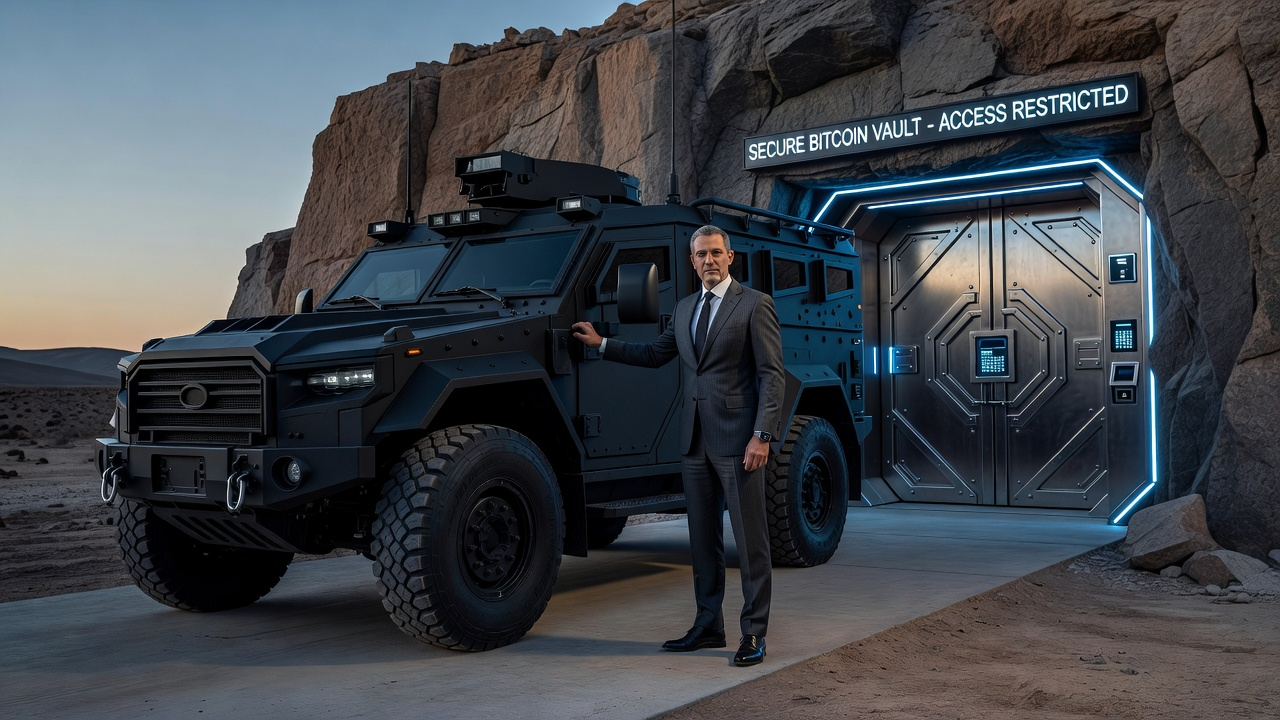
Beyond public companies, demand for luxury survival infrastructure is also rising. Firms such as Survival Condo, Oppidum, and Vivos market fortified underground residences equipped with high-end amenities, while armored vehicles are often sold as part of broader security packages.
For early Bitcoin investors who accumulated BTC at prices below $1,000, allocating a small portion of their holdings toward physical resilience may seem like a logical hedge. If major disruptions never occur, they own secure properties and advanced protection systems. If the scenarios they have long prepared for materialize, those investments could prove invaluable.