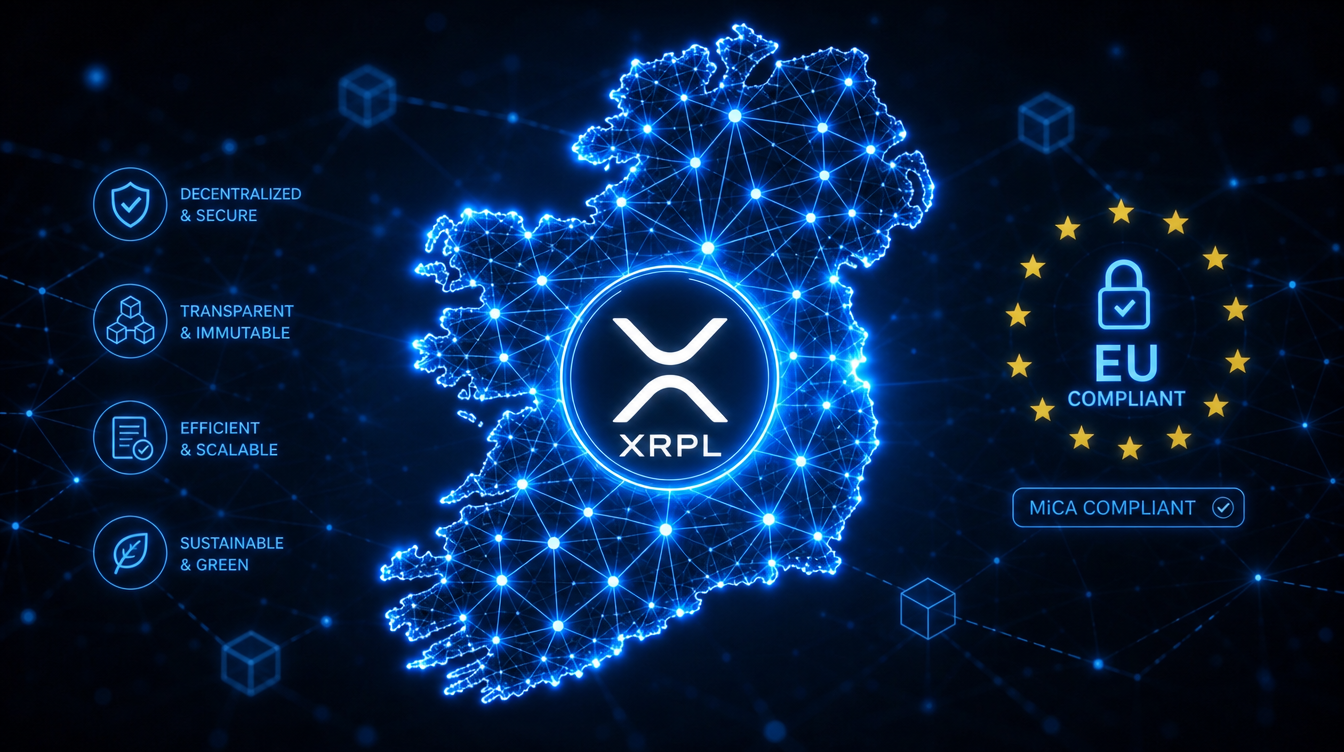
Aviva Investors and Ripple have officially rolled out a tokenized fund on the XRP Ledger (XRPL) with approval from the Central Bank of Ireland (CBI), offering EU asset managers a concrete framework for meeting compliance requirements on public blockchains.
Launched on July 29, 2026, the product introduces a tokenized share class of the Aviva Investors USD Liquidity Fund on XRPL, becoming the first public-chain fund structure to receive regulatory clearance from the CBI.
Under the arrangement, BNY Mellon is responsible for safeguarding the underlying assets, Komainu provides regulated digital asset custody services, and Licuido supports the tokenization layer.
This milestone goes beyond a routine institutional crypto pilot. It marks the first time a major European regulator has approved a tokenized fund operating on a public blockchain, giving asset managers across Ireland and the EU a working compliance model instead of a theoretical reference point.
The development came as XRP slipped 0.7% overnight, trading near $1.08 after falling below the $1.10 support level. At the same time, Ripple’s daily trading volume climbed to $1.14 billion from $1.05 billion the previous day.
Partnership Timeline: From Announcement to Launch
Ripple and Aviva Investors first announced their collaboration on February 11, 2026, outlining plans to tokenize multiple fund products on XRPL across different asset classes over several years. The USD Liquidity Fund’s tokenized share class now represents the first real-world execution of that plan—moving beyond testing into full deployment.
The fund is structured to deliver daily liquidity by investing in high-quality, USD-denominated short-term debt instruments. It mirrors the same objectives, risk profile, and regulatory protections as its traditional version. Investors using digital wallets can participate under identical terms, with XRPL acting as the transaction and record-keeping backbone.
Institutional Setup and XRPL Infrastructure
The system operates through an integrated structure: Licuido issues the tokenized shares on XRPL, Komainu manages custody of the digital assets within a regulated framework, and BNY Mellon holds the underlying assets within the traditional financial system. This hybrid model bridges conventional finance with blockchain-based settlement.
Since its inception in 2012, XRPL has processed more than 4 billion transactions, supports around 8 million active wallets, and runs on a network of over 130 independent validators.
Its fast, low-cost settlement and built-in tokenization capabilities were key factors in its selection, particularly for institutional users requiring reliable finality and embedded compliance tools.
Nigel Khakoo, Ripple’s Senior Vice President of Trading and Markets, noted that the launch proves a fully regulated, institutional-grade tokenized product can operate on live blockchain infrastructure while maintaining robust investor protections.
Aviva Investors CEO Mark Versey described tokenization as a major advancement for the investment industry and emphasized the importance of the partnership with Ripple in delivering the product.
Implications for RWA Tokenization
The key question has shifted from whether real-world assets can be tokenized on public blockchains to whether regulators will provide the clarity needed for large-scale adoption.
The CBI’s approval effectively answers that question within Ireland, positioning this fund as a blueprint for other EU-based asset managers.
In the near term, the decision may influence firms weighing public versus private distributed ledger networks for their tokenization strategies. Having a regulator-approved example on a public chain significantly reduces perceived compliance risk.
Aviva Investors managed approximately $310 billion in assets as of 2025, and both companies have indicated that this launch is the first step in a broader pipeline of tokenized fund offerings on XRPL.
How quickly additional funds gain regulatory approval will determine whether this remains a one-off milestone or evolves into a sustained tokenization initiative on the XRP Ledger.