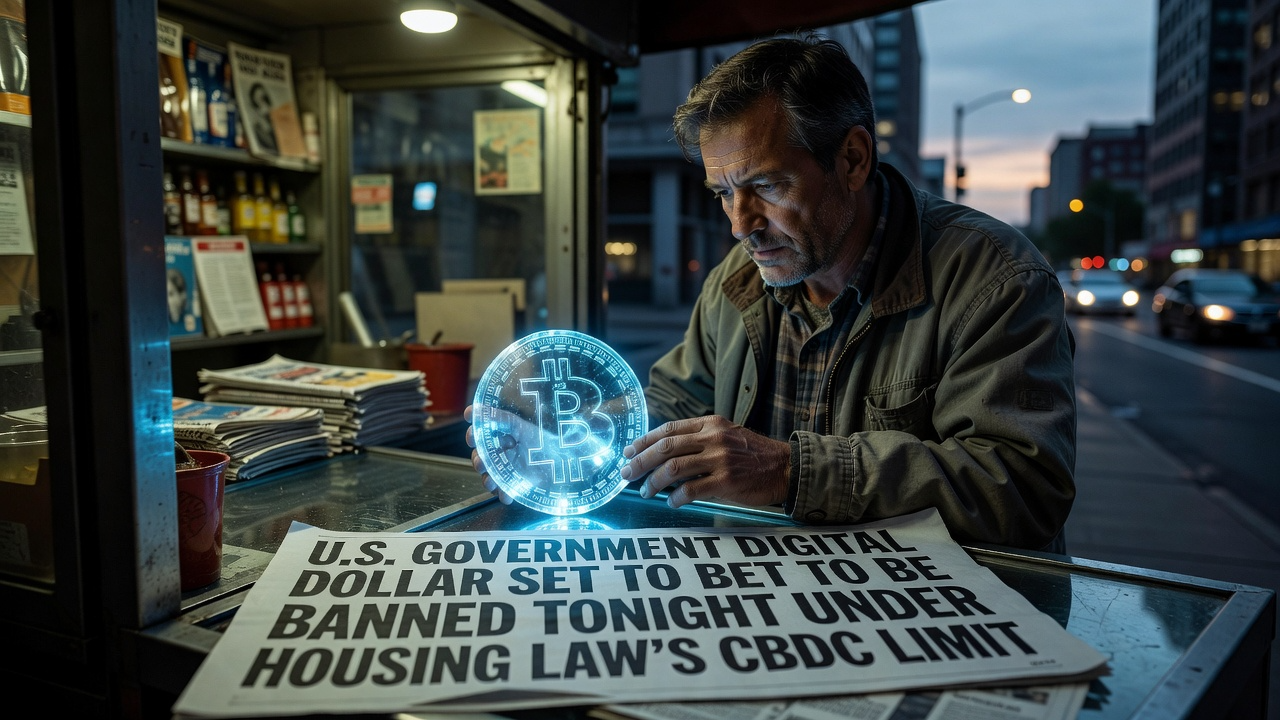
Despite President Donald Trump declining to sign Congress’s bipartisan housing bill, it is still scheduled to take effect at midnight—bringing a temporary ban on a U.S. central bank digital currency (CBDC) with it.
The crypto industry’s long-standing opposition to a government-issued digital dollar appears to be paying off, as the housing legislation is set to enact a restriction on CBDCs as soon as it becomes law.
Under the measure, the Federal Reserve will be barred from issuing a digital dollar for four years. Republican lawmakers have argued that such a currency could enable excessive government surveillance, even though the U.S. has not made any serious push to launch one. The provision was included in the broader housing-affordability bill that Trump chose not to sign.
In a post on Truth Social, Trump said he refused to approve the bill in protest, criticizing the United States Senate for failing to pass the “SAVE AMERICA Act.”
However, under the United States Constitution, a bill automatically becomes law 10 days after reaching the president if it is neither signed nor vetoed. Since Trump did not issue a formal veto, the legislation is set to take effect at midnight.
The CBDC restriction will remain in place until the end of 2030. Still, the likelihood of the Fed launching a digital dollar within that timeframe was already low. Even before the appointment of new Fed Chair Kevin Warsh, central bank officials had maintained that any such initiative would require both White House support and congressional approval—neither of which has been strongly present.
While the crypto sector has pushed back against CBDCs due to concerns they could compete with privately issued stablecoins, other regions like Europe and China have actively explored or advanced digital currency initiatives. In the U.S., however, the issue has become increasingly politicized, with Republicans inserting the CBDC limitation into unrelated legislation after earlier attempts to attach it to bills like the Foreign Intelligence Surveillance Act.
Although the housing bill itself had broad support, Trump made a last-minute decision to oppose it—despite previously planning a signing ceremony. He stated he would not approve any legislation until Congress passes stricter voter identification measures, including proof-of-citizenship requirements, which currently lack sufficient backing.
Trump has warned that failing to enact such election-related laws could hurt Republicans in upcoming midterm elections, where Democrats are seen as having a strong chance to regain control of the House.
His stance has also raised uncertainty about the fate of other pending legislation, including the Digital Asset Market Clarity Act, which could face similar resistance if it reaches his desk later this year.