Here’s another rewritten version with a tighter, more market-report tone:
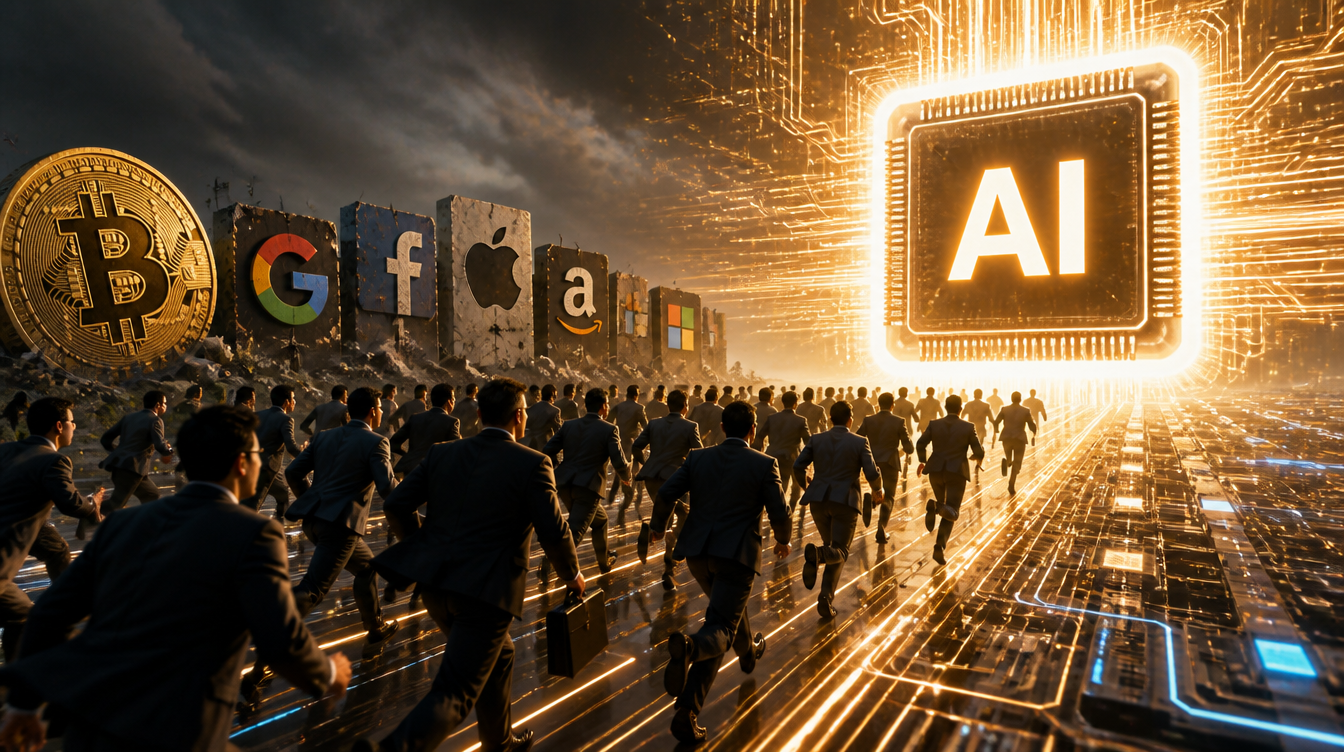
Capital is rotating out of the largest technology names and Bitcoin as investors shift toward semiconductors, memory chips, and space-related plays tied to the AI supply chain.
The AI-driven growth story behind the Magnificent 7 is facing increasing scrutiny.
The market’s biggest winners of the past decade are now under pressure as investors reassess the scale and sustainability of AI investment, rotating into sectors with stronger near-term momentum.
Microsoft (MSFT) has fallen 33% from recent highs, while Meta (META) is down 28%. Tesla (TSLA), Amazon (AMZN), Nvidia (NVDA), and Alphabet (GOOGL) are each more than 10% lower, with Apple (AAPL) the relative outperformer, down about 7%.
The shift is also evident in crypto, where Bitcoin (BTC) has dropped roughly 50% from its October record high.
Rather than abandoning AI exposure, capital is moving into the infrastructure layer powering the boom. That includes semiconductor firms, particularly memory-chip makers, as well as data center and real estate assets supporting large-scale AI compute.
The strongest gains have been concentrated in this segment. Sandisk (SNDK) has surged roughly 800% year-to-date, while the Global X Artificial Intelligence & Technology ETF, focused on memory-related names, is up about 140%. Micron Technology (MU) has risen around 230%, and the VanEck Semiconductor ETF (SMH) has gained about 67%.
The trend reflects a clear preference for companies enabling AI infrastructure rather than hyperscalers funding it.
Investor attention has also expanded into SpaceX (SPCX), Elon Musk’s space-focused company increasingly viewed as part of the broader AI infrastructure ecosystem. The firm recently raised $75 billion in what is being described as the largest IPO in history.
Despite AI remaining the dominant market theme, the cost of expansion continues to rise. Alphabet (GOOGL), Amazon, Microsoft, and Meta are expected to spend a combined $725 billion in capital expenditures this year, up 77% from last year’s record.
However, free cash flow is no longer sufficient to fully fund this buildout. Alphabet, Amazon, and Meta collectively raised about $93 billion in debt last year, accounting for roughly 6% of total corporate bond issuance.
At the same time, share buybacks—a key source of equity demand—have fallen 33% to $132 billion in 2025.
Taken together, the story is no longer just about AI spending concerns, but a broader capital rotation. Investors are moving out of the Magnificent 7 and Bitcoin, and into semiconductors, memory chips, and space-linked assets viewed as the next phase of the AI investment cycle.