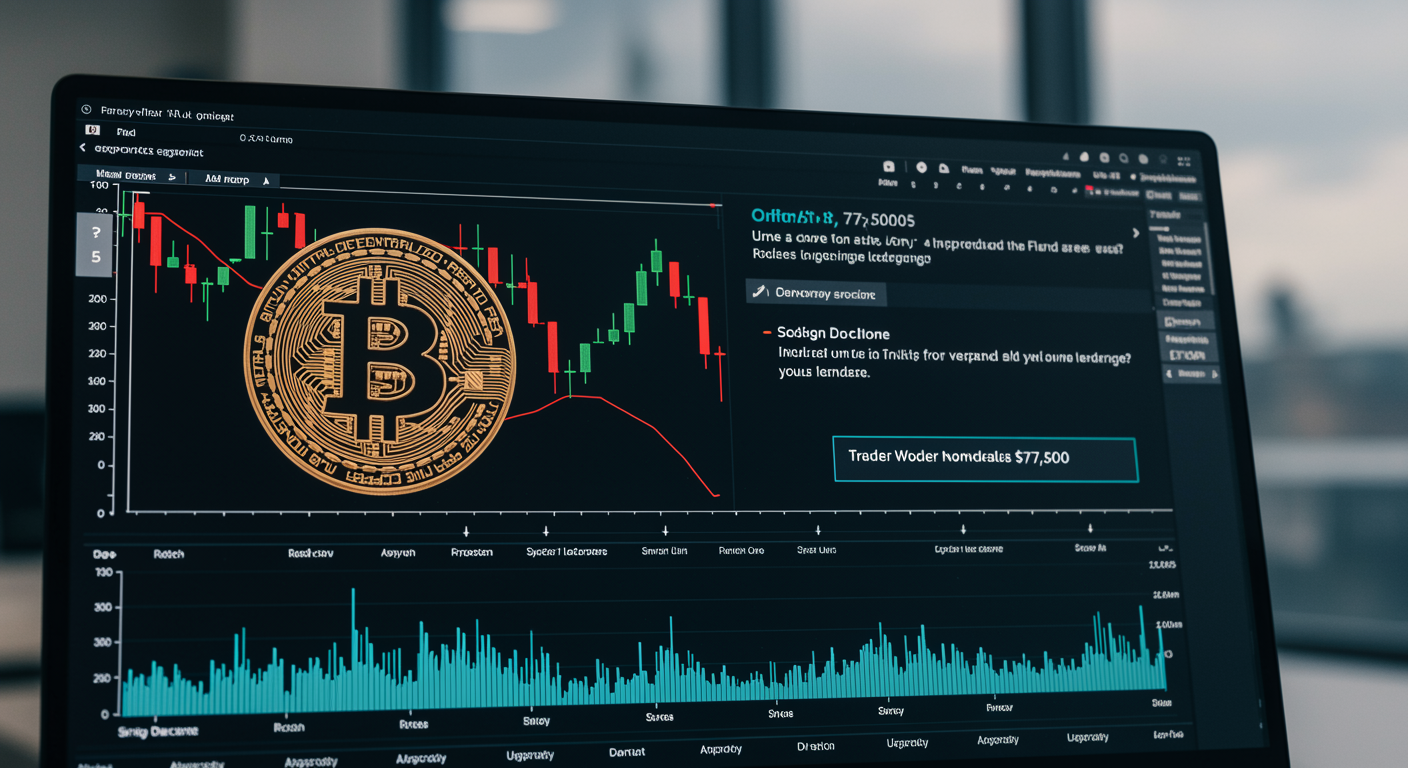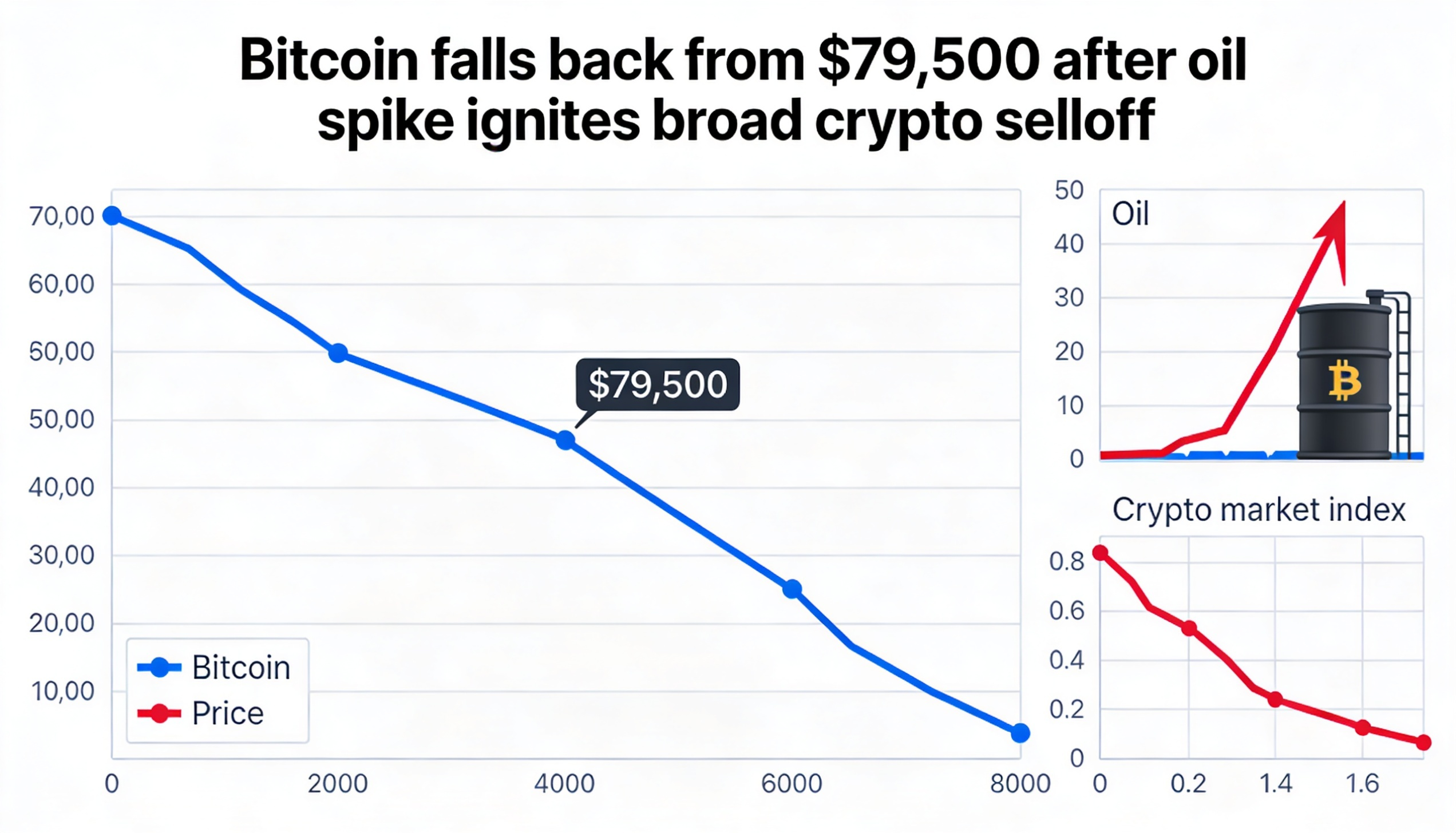
Bitcoin (BTC) failed to sustain a move above $80,000 on Monday, reversing lower and dragging the broader crypto market down as rising oil prices weighed on risk sentiment. The pullback saw bitcoin fall roughly 2%, with altcoins leading losses in a volatile trading session.
BTC surged to an intraday high of $79,480 before quickly retreating to around $77,800. The move began near 23:00 UTC, coinciding with the opening of U.S. equities and CME bitcoin futures — a window typically associated with increased volatility. By 05:30 UTC, momentum faded after bitcoin was unable to break through the $80,000 level, triggering a sharp decline.
The downturn aligned with a surge in oil prices, with Brent crude climbing to $107 per barrel — its highest level since the U.S.–Iran ceasefire began. The move followed reports that U.S. President Donald Trump canceled plans to send officials for talks in Pakistan over the weekend.
Ether (ETH) traded near $2,320, down 2.2% since midnight UTC, underperforming bitcoin’s 1.1% decline but holding up better than several major altcoins.
Liquidations totaled nearly $300 million over the past 24 hours, largely impacting short positions that were caught offside during bitcoin’s brief rally toward $79,500.
In derivatives markets, XRP futures saw the largest increase in open interest among major tokens, rising 2.5% to a one-week high of 1.82 billion XRP. Combined with negative funding rates and weakening cumulative volume delta, the data points to a bearish positioning backdrop, consistent with trends in bitcoin and ether markets.
Analysts noted, however, that persistently negative funding rates in bitcoin are partly driven by institutional hedging strategies rather than outright bearish bets.
Other tokens such as HBAR, CC, XLM and HYPE also recorded notable gains in open interest, while SUI showed the most negative cumulative volume delta, signaling aggressive selling pressure. The token came under additional strain following a hack of the Sui-based DeFi protocol Scallop, with attackers reportedly stealing around 150,000 SUI tokens worth just over $140,000.
Despite the price volatility, implied volatility metrics for bitcoin and ether continued to trend lower over the past 30 days, suggesting relatively stable conditions that could support longer-term price advances. This aligns with subdued readings in traditional markets, including a decline in the VIX and continued strength in major equity indices such as the Nasdaq.
Options markets on Deribit show a persistent bias toward put contracts across most maturities, though longer-dated ether options appear less bearish than bitcoin equivalents. The $80,000 bitcoin call option remains the most popular strike, with more than $1.5 billion in notional open interest. Positive dealer gamma at this level suggests market makers may sell into breakouts and buy dips, potentially dampening volatility.
Flow data from Laser Digital indicates traders are favoring risk reversal strategies over outright downside protection, signaling a preference for positioning around volatility rather than directional bets.
Altcoins bore the brunt of the selloff during the 05:30 UTC drop. Lido (LDO) led losses, falling roughly 17% and erasing gains from the previous session.
The CoinDesk 20 (CD20) Index declined 1.5% since midnight UTC, while the DeFi Select Index (DFX) fell 2.3%. The Smart Contract Platform Select Index (SCPX) posted the steepest losses, down 2.5%.
A few tokens bucked the trend, including PENGU, JUP and CHZ, which gained 9.1%, 4% and 3.1%, respectively.
Meanwhile, CoinMarketCap’s “Altcoin Season” index remained neutral at 39/100, unchanged from the previous week and well below last month’s peak of 51/100.