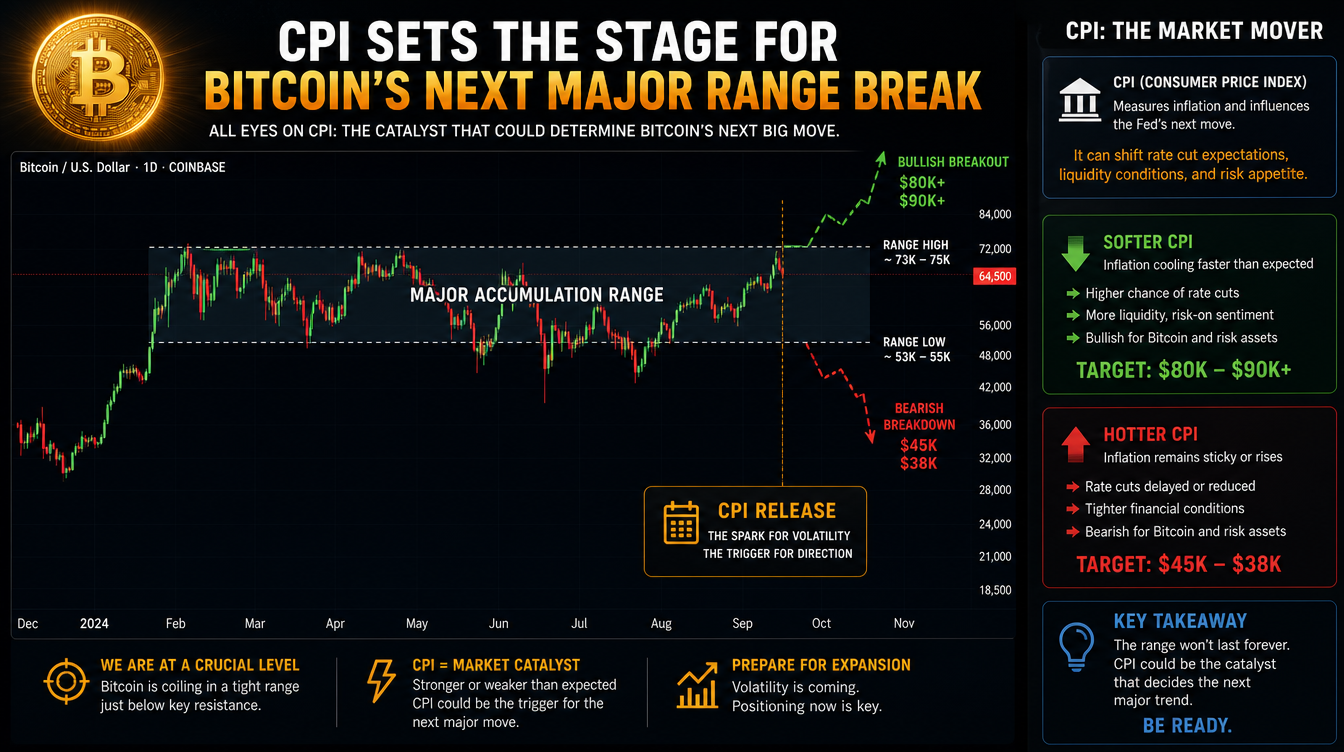
Bitcoin has remained stuck between $62,000 and $66,000 for weeks, while Deribit options activity shows traders have spent roughly $2.5 million in premiums betting that BTC will break above $70,000 by late September.
The options positioning comes as the latest U.S. Consumer Price Index report could provide the catalyst that finally pushes Bitcoin out of its narrow trading range.
A softer-than-expected inflation reading could support the risk-on sentiment already evident in equities, while a hotter CPI figure could strengthen expectations for another Federal Reserve rate hike in September. Either outcome could force Bitcoin to break out of its current consolidation, with the $64,000 area remaining a closely watched support level.
CPI Could Determine Bitcoin’s Next Move
Economists surveyed by Reuters, Dow Jones and Bloomberg expect headline CPI to rise 0.1% from the previous month and 3.4% from a year earlier, easing from June’s 3.5% annual increase. Core CPI is forecast to climb 0.2% month over month and 2.5% annually.
Because the estimates are tightly clustered, even a relatively small surprise could trigger a meaningful adjustment in expectations for the Federal Reserve’s interest-rate path.
The report arrives as Bitcoin’s trading range has narrowed considerably. Traders positioning ahead of the release appear to be preparing for a potentially sharp move once the inflation data removes some of the current uncertainty.
Laevitas data shows that much of the recent Deribit BTC options activity has focused on the Sept. 25 expiration at the $70,000 strike. Buyers of those calls risk losing the premiums paid if Bitcoin remains below the strike at expiration, while the contracts provide leveraged exposure to an upside move.
The activity should not be treated as a definitive forecast for Bitcoin. Concentrated call buying indicates that some derivatives traders are positioning for gains, but it does not necessarily reflect the broader market’s expectations or indicate how quickly BTC would need to reach $70,000.
TDX Strategies has adopted a different strategy, favoring December strangles on Bitcoin and Solana. Unlike the September call buyers, these traders are positioning for a significant move in either direction rather than betting specifically on an upside breakout.
That difference highlights the uncertainty surrounding the CPI release. Some traders are positioned for Bitcoin to rise, while others are primarily betting that volatility will increase regardless of direction.
September Seasonality Could Challenge Bulls
Historical trends provide another reason for caution. STS Digital managing partner Jeff Anderson has pointed to September as Bitcoin’s weakest month historically, with BTC averaging a decline of about 4% since 2013.
Anderson expects volatility to increase sharply if Bitcoin breaks through either boundary of its current range. However, the seasonal trend presents a challenge for traders holding September $70,000 calls because they are betting on an upside breakout during a historically weak month.
Spot-market activity is also sending mixed signals. Nansen reported Ether exchange net outflows of $49.7 million over the previous 24 hours and $164.6 million over the past week. Such outflows are often interpreted as a sign that investors are moving assets away from exchanges for longer-term holding.
Meanwhile, Hyperliquid data shows smart-money traders holding net short positions of about $46.8 million in Bitcoin and $20.9 million in Ether.
The divergence between spot flows and derivatives positioning leaves the market without a clear consensus. The CPI release could therefore become the catalyst that determines whether Bitcoin breaks higher, falls through support or remains trapped within its current range.