

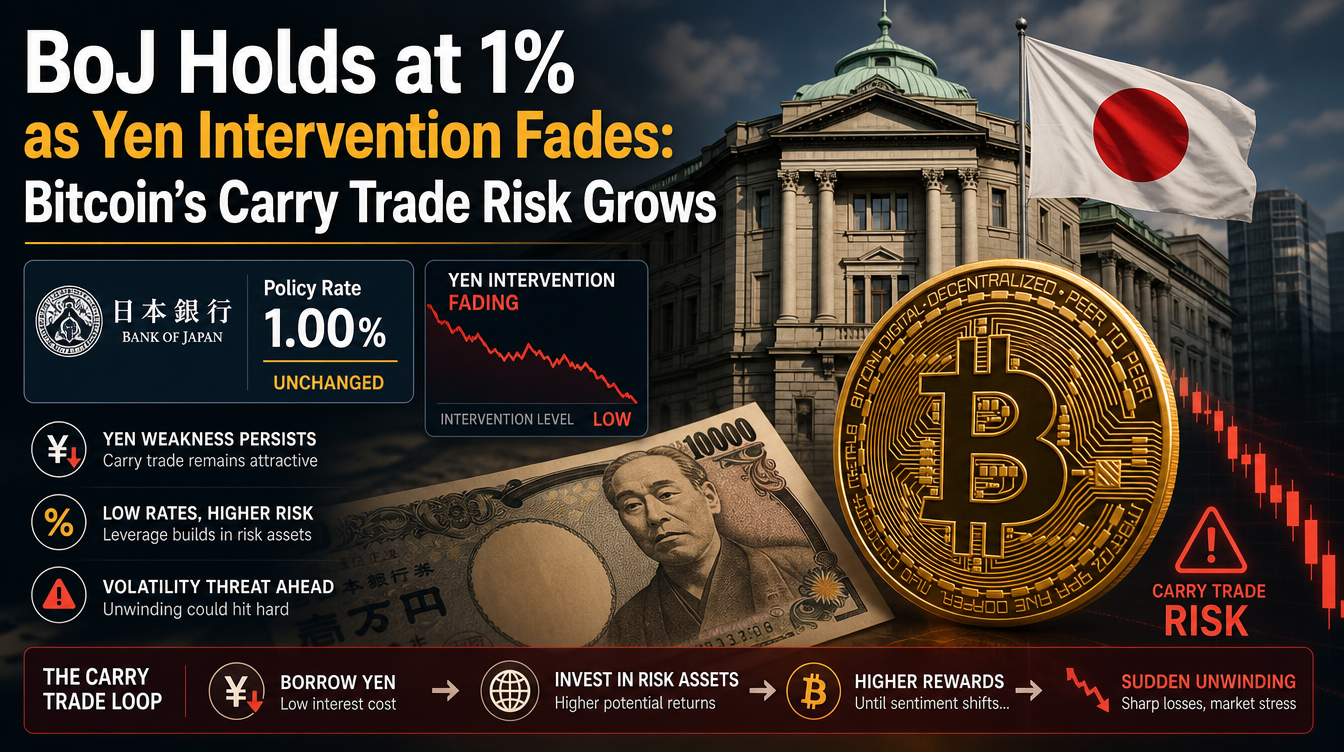
Japan’s Ministry of Finance confirmed that it intervened on July 30 by purchasing yen and selling dollars, pushing USD/JPY sharply lower before the pair later bounced back. The rebound showed that intervention alone is not enough to reverse a sustained trend without backing from monetary policy.
Meanwhile, the Bank of Japan left its policy rate unchanged at 1.0% following its July meeting, while continuing to signal a tightening bias. For crypto markets, a shrinking interest rate gap between the U.S. and Japan, combined with a weaker dollar, could put pressure on the yen carry trade—a key source of funding for leveraged assets like Bitcoin.
Over the past two years, Japan has repeatedly intervened to support its currency, including large-scale actions in 2024 and the latest move on July 30. In each case, the yen strengthened briefly before broader market forces took over again. This trend reflects the persistent interest rate gap between Japan and the U.S., which still makes dollar-denominated assets more attractive than yen.
Reports also indicated that Japanese officials stayed in close contact with their U.S. counterparts during the intervention. However, there was no confirmation of any coordinated action with the Federal Reserve or the U.S. Treasury. While U.S. officials acknowledged the yen’s weakness, the move remained a unilateral effort by Japan rather than a joint operation.
The quick recovery in USD/JPY highlights the underlying structural challenge. With the BoJ holding rates at 1.0%, investors are focusing more on Governor Kazuo Ueda’s guidance on future rate hikes. That outlook—rather than intervention—will likely determine whether the yen can sustain further gains.
Why the Yen Carry Trade Matters for Bitcoin
The yen carry trade involves borrowing low-cost yen to invest in higher-yielding assets. As Japanese rates gradually increase while the Federal Reserve pauses, the appeal of this strategy diminishes. However, the rate differential between the two economies remains wide enough to keep it attractive for many investors.
Economists generally expect the BoJ to continue raising rates gradually in the coming quarters, though the exact timing is unclear. Some forecasts suggest another hike before year-end, while others expect policymakers to wait until inflation and wage growth strengthen further. A gradual approach would likely lead to a controlled unwinding of carry trades rather than a sudden market disruption.
A useful comparison is August 2024, when an unexpected BoJ rate hike triggered a sharp rally in the yen and forced investors to unwind leveraged positions. Bitcoin fell alongside equities as liquidity tightened. While the current environment shares some similarities, the risks are lower now since markets are already anticipating further tightening.
For Bitcoin, the most likely outcome is a gradual normalization in Japan that creates modest headwinds rather than a major downturn. However, a faster pace of BoJ tightening or another surge in the yen could speed up deleveraging across crypto markets. This makes Japanese monetary policy an increasingly important macro factor for traders, even if intervention alone is unlikely to shift the broader trend.