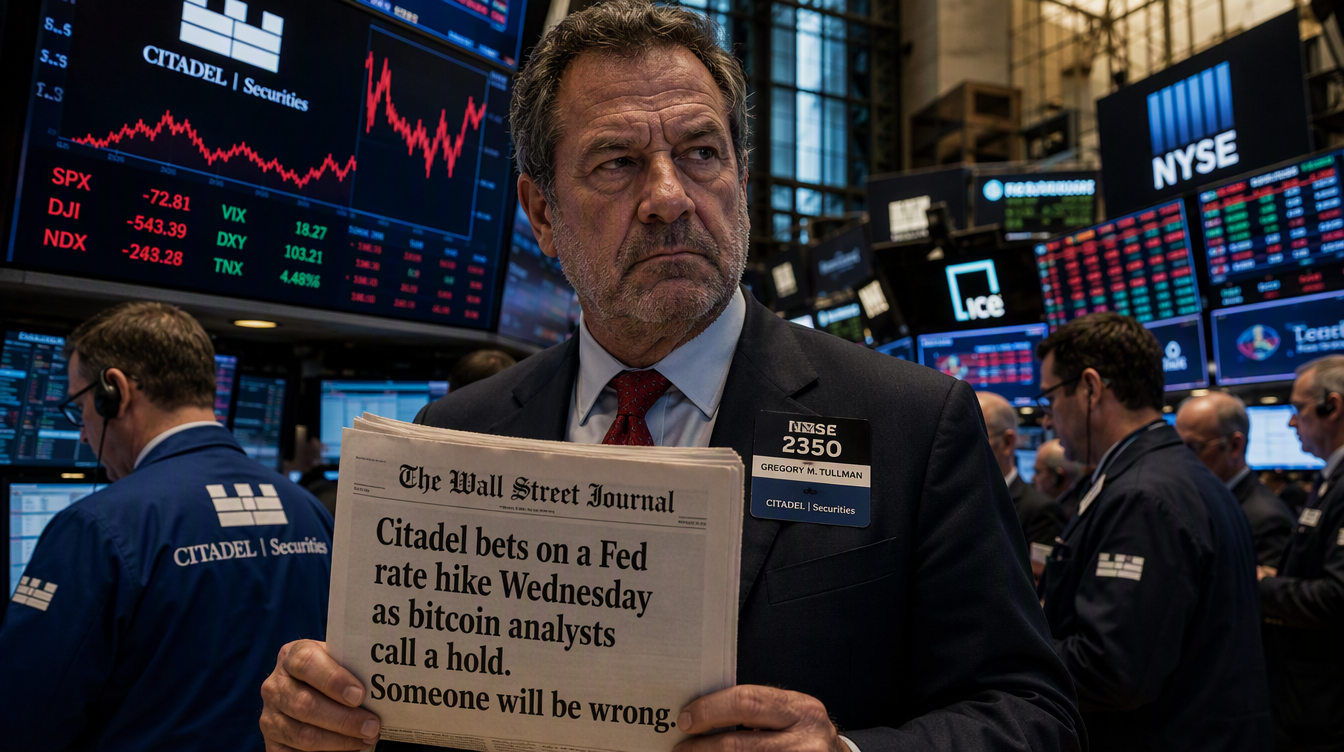
Citadel’s macro team believes a potential Fed rate hike on Wednesday is less about the latest economic figures and more about timing. The firm argues that Chair Kevin Warsh has a narrow opportunity to make a surprise policy move before markets begin fully pricing it in.
That difference in expectations has become the key macro issue heading into Wednesday’s Federal Reserve rate decision.
Citadel, one of the largest hedge funds in the United States with approximately $67 billion in assets under management, is advising investors to prepare for a 25-basis-point rate increase this week rather than a move in September. Such a hike would raise the Fed’s benchmark interest rate target to the 3.75%-4% range.
Most crypto and traditional market analysts, however, expect the central bank to keep rates unchanged. Kraken economist Thomas Perfumo reflected the broader consensus, saying the most likely result of the July FOMC meeting is no change in interest rates.
The disagreement has increased the risk of a sharp market reaction. If the Fed surprises investors with a hike, Treasury yields could rise further, creating additional pressure on risk-sensitive assets such as Bitcoin and the broader crypto market.
While a rate increase is not the market’s base expectation, traders have not completely dismissed the possibility. CME Group’s FedWatch tool currently places the probability of a hike at 35.8%, compared with 25.7% one week earlier. However, there is a clear difference between recognizing a potential risk and positioning for that outcome, with most investors still expecting the Fed to remain on hold.
Bitcoin has been trading cautiously ahead of the decision. The leading cryptocurrency has struggled to maintain its recent momentum, slipping from last week’s high near $67,000 to below the $64,000 level.
Citadel’s Case for a July Hike: Challenging Fed Predictability
Citadel’s argument is not primarily based on economic data but on policy strategy. The firm believes Warsh could gain more by delivering a surprise hike now rather than waiting until September.
Frank Flight, head of macro strategy at Citadel Securities, said a July increase would effectively end the era of predictable Fed communication, forcing markets to focus more on economic fundamentals instead of relying heavily on anticipated policy signals.
He also argued that such a move would strengthen perceptions of Federal Reserve independence after years of debate over whether external pressures have influenced monetary policy.
Forward guidance has traditionally helped central banks communicate future policy expectations, allowing businesses, consumers, and investors to adjust gradually. However, critics argue that prolonged reliance on this approach has changed market behavior, with assets increasingly reacting to expectations of Fed decisions rather than actual economic developments.
Citadel’s broader argument centers on market psychology. The firm believes an unexpected rate hike could influence pricing behavior and wage negotiations before inflation pressures become more difficult to control, potentially reducing the need for more aggressive tightening later.
The strategy, however, depends on the move being a genuine surprise. Flight argued that waiting until September could weaken the impact because markets would likely view the decision as a continuation of the Fed’s usual communication-driven approach.
Fed Timing Becomes the Main Debate
Citadel’s view is that the next major Fed move is likely to be a rate hike, with markets and policymakers already moving closer to that expectation. CME FedWatch data suggests investors are increasingly pricing in a September increase.
The firm argued that if a majority of FOMC members are already likely to support a September hike, they may have limited reason to oppose moving the decision forward by several weeks if Warsh believes acting sooner provides a strategic advantage.
The potential for additional inflation pressure from rising oil prices and renewed tensions involving Iran has added another layer of uncertainty for policymakers.
With markets split between a widely expected pause and the possibility of a surprise increase, Wednesday’s Fed meeting is shaping up to be one of the most closely watched policy decisions in recent months.