Here’s a sharper, more streamlined rewrite:
The current move isn’t a broad market rally. Bitcoin has risen about 4% over the same period, while solana, TRON, and hyperliquid have all posted losses.
Ether is the clear standout among large-cap cryptocurrencies this week, and its strength can’t be fully explained by Tuesday’s softer U.S. inflation data that lifted overall markets.
On Thursday, ether traded near $1,920, gaining 2.2% on the day and roughly 11% over the past seven days, giving it a market cap of around $231 billion with about $12 billion in daily volume. Bitcoin hovered near $64,600, down 0.3% on the day but still up 4.2% for the week. Beyond these two, most major assets are in the red.
Solana slipped 1.1% to $77 and remains down on the week. TRON fell to $0.32, losing 1.6% over seven days, while hyperliquid’s HYPE dropped 1.8% to $66 and is down 1.7%. XRP, BNB, and dogecoin each gained just over 2% for the week — far less than ether’s advance.
Two main factors appear to be driving ether’s outperformance.
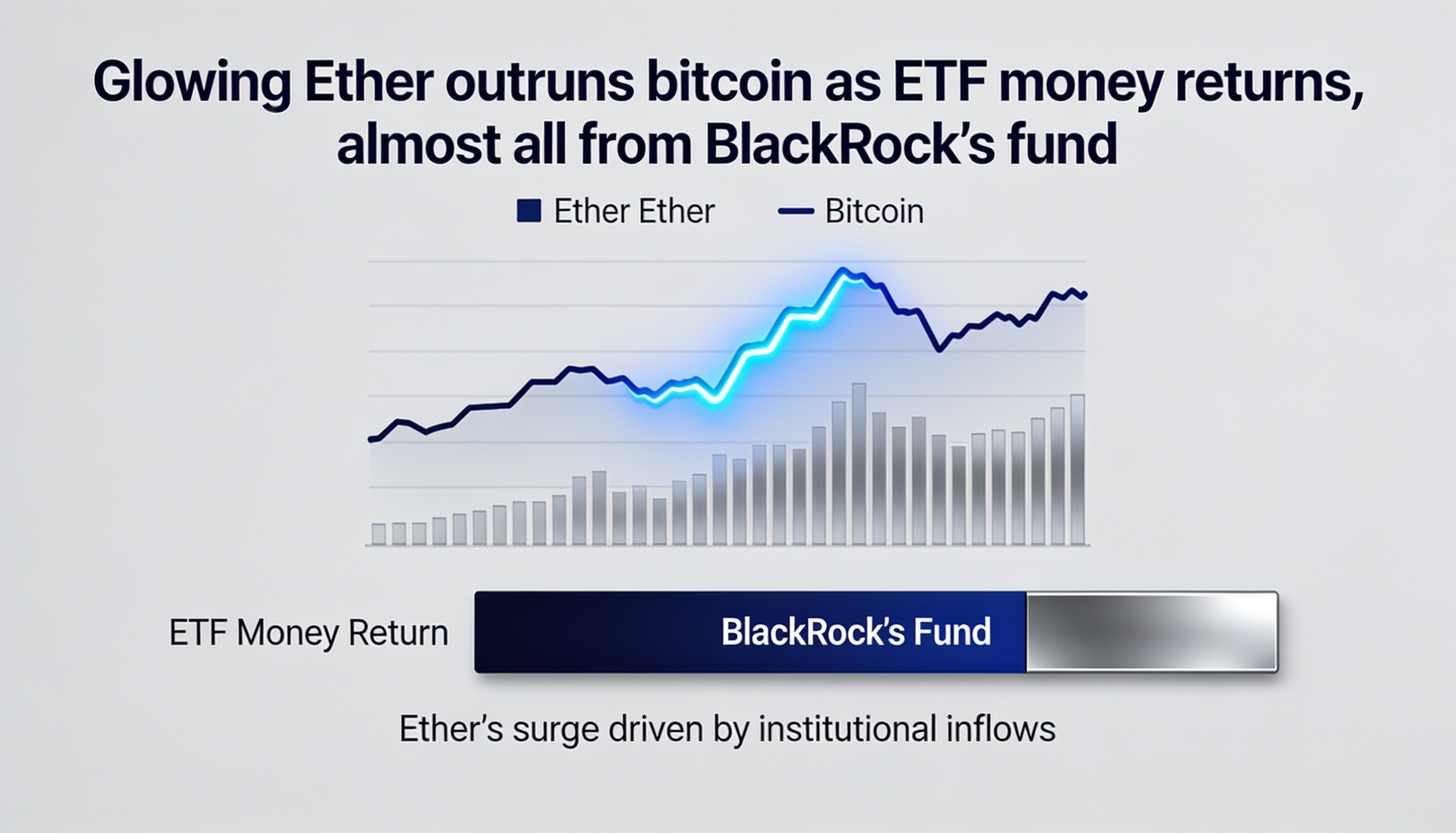
First, U.S. spot ether ETFs have seen a pickup in inflows. Data from SoSoValue shows $96 million entered these funds in the first three days of the week, already exceeding last week’s total of $84 million. This follows a period of outflows in late June, including $82 million withdrawn on June 25 alone.
Bitcoin ETFs, in contrast, have been volatile. They recorded $424 million in outflows on July 13, followed by $181 million in inflows the next day — a pattern that suggests short-term positioning rather than sustained allocation.
As a result, ether demand appears more concentrated. Of the $53.8 million in inflows on Wednesday, BlackRock’s ETHA fund captured $45.3 million, with its smaller ETHB fund adding $4 million. The remaining ETF products shared less than $5 million combined.
Meanwhile, Grayscale’s original ether trust — which carries a 2.5% fee compared to BlackRock’s 0.25% — has seen total outflows of $5.3 billion since its launch.
Ether has also gained a new source of demand. Robinhood Chain, the brokerage’s layer-2 network launched on July 1, uses ether for gas fees and settles transactions on Ethereum. It is already processing over $800 million in daily decentralized exchange volume, much of it tied to memecoin activity.
Despite the choppy ETF flows, bitcoin itself remains relatively stable. Nansen data shows steady exchange outflows even as Middle East tensions escalate, with no significant move into stablecoins — typically a sign of investors stepping back.
Funding rates are near neutral, indicating that the highly leveraged long positions behind June’s liquidation events have largely been cleared. Bitcoin dominance currently sits at 58.3%.