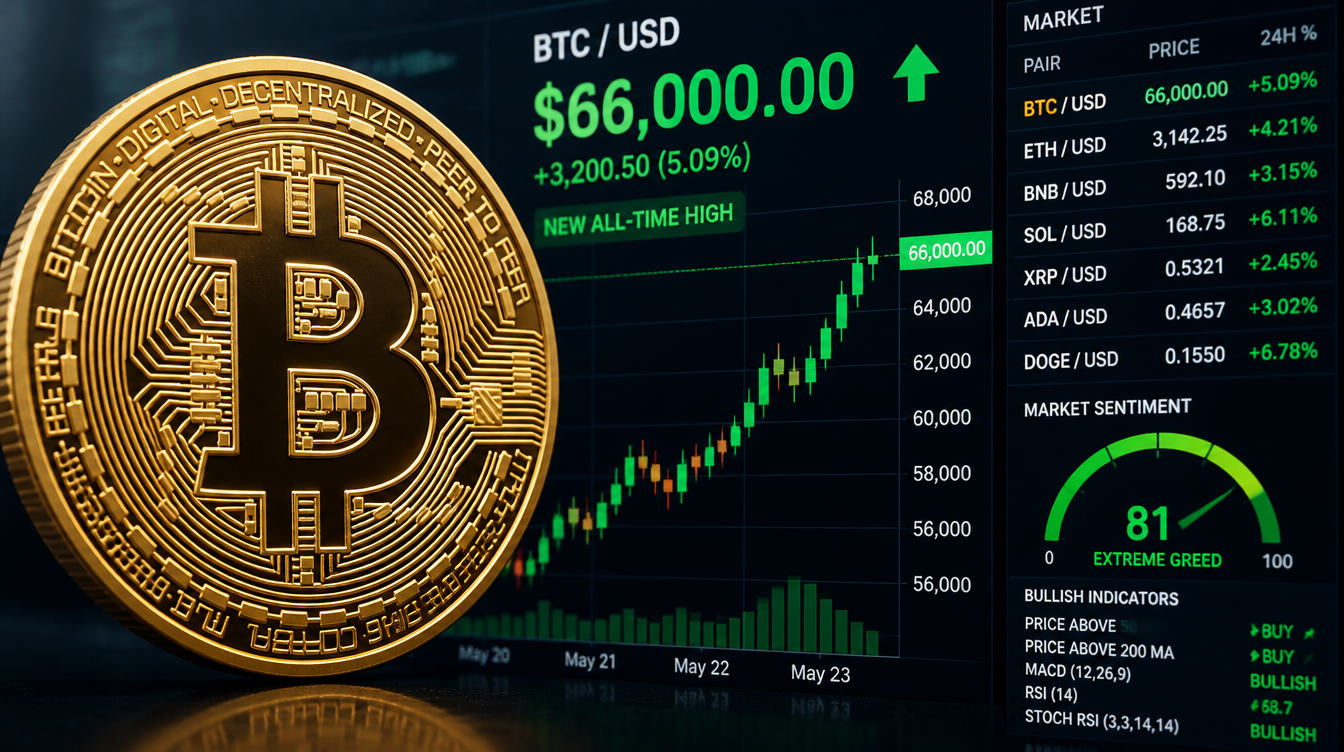
Bitcoin Nears $66K as US–Iran Peace Accord Sparks Market Optimism
Bitcoin climbed 2% to $65,800 on Monday, June 15, after the United States and Iran announced a landmark memorandum of understanding designed to end ongoing hostilities. The agreement includes an immediate ceasefire and a commitment to reopen the Strait of Hormuz within 30 days, easing fears of prolonged geopolitical disruption and supply-chain risks.
The announcement triggered a broad rally across risk assets. S&P 500 futures advanced 1.2% during Asian trading hours, while Brent crude tumbled 4.5% to $83.39 as traders welcomed the prospect of restored oil flows through one of the world’s most critical shipping routes. The positive sentiment extended to the crypto market, with XRP, Solana, and Cardano each posting gains of 3% to 4%.
At the same time, pressure from institutional selling showed signs of easing. According to SoSoValue, spot Bitcoin ETFs recorded net outflows of $315.8 million last week, a notable improvement from the more than $1 billion withdrawn in each of the previous four weeks. While ETF flows remain negative, the slowdown in redemptions provided some support for Bitcoin’s rebound.
The focus now shifts from the geopolitical catalyst itself to whether improving market sentiment can translate into a sustained recovery for Bitcoin. Despite the rally, institutional demand remains weak, and the Crypto Fear & Greed Index continues to signal caution, standing at just 20 out of 100 in Extreme Fear territory.
Why the Strait of Hormuz Matters for Bitcoin
The reopening of the Strait of Hormuz has implications that extend well beyond the energy market. By reducing concerns over oil supply disruptions, the agreement helped remove a major risk premium from crude prices, contributing to Monday’s sharp decline in Brent oil.
Lower energy prices can help ease inflation expectations, potentially reducing pressure on the Federal Reserve to maintain restrictive monetary policy. For risk assets such as Bitcoin, a softer inflation outlook can improve liquidity conditions and strengthen investor appetite for higher-risk investments.
ETF flows, however, continue to send mixed signals. Although outflows slowed considerably during the week ending June 13, investors were still net sellers. The moderation suggests institutional deleveraging may be losing momentum, but it does not yet point to a meaningful return of large-scale capital into the market. As a result, Bitcoin’s latest advance appears driven more by relief and sentiment than by renewed institutional accumulation.
Bitcoin’s Recovery Faces Key Resistance Levels
Since bottoming near $59,100 on June 5—its lowest level since October 2024—Bitcoin has gained roughly $6,700. Monday’s close near $65,809 marked the strongest finish of the current rebound, but the broader technical picture remains uncertain.
Analysts note that previous rallies fueled by Middle East developments pushed Bitcoin toward $79,500 in late April before momentum faded. Major resistance levels remain significantly higher, including the 50% Fibonacci retracement level near $78,962 and the 200-day exponential moving average around $81,700.
For now, Bitcoin is trading within the $62,000–$66,000 range, an area that previously acted as a battleground between buyers and sellers. A decisive daily close above $66,440 would strengthen the bullish case and suggest that former resistance has turned into support.
However, several resistance zones remain overhead, particularly above $68,000. Until those levels are challenged and broken, the current rally is best viewed as a relief-driven rebound rather than a confirmed trend reversal.
While the US–Iran peace agreement has improved market sentiment and lifted risk assets, Bitcoin’s longer-term recovery will likely depend on stronger institutional demand, improving ETF flows, and a sustained break above key technical resistance levels.