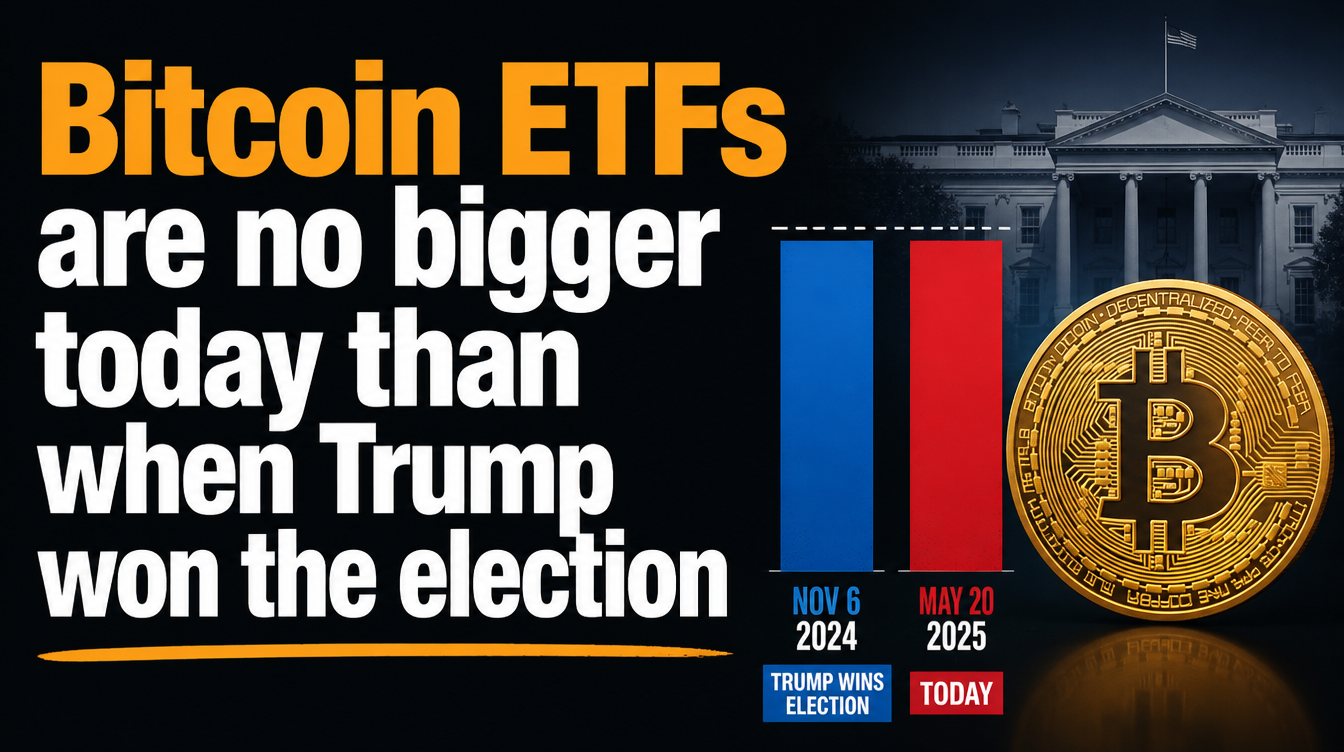
U.S.-listed spot Bitcoin ETFs have seen their total net assets slip back to levels last recorded shortly after Donald Trump’s election victory in early November 2024.
Investor demand for Bitcoin spot ETFs has cooled noticeably, with sustained outflows weighing on the sector.
As of June 9, total net assets across the 11 spot Bitcoin ETFs stood at $77.58 billion, essentially back to the level seen immediately after Trump’s election win in November 2024.
While the ETFs initially expanded strongly following the election—helped by expectations of more crypto-friendly policy under Trump—assets quickly climbed above $90 billion within a week and later peaked at $169.54 billion in October 2025.
Since that peak, however, all of those gains have been erased, even as the regulatory backdrop improved, including reduced SEC enforcement actions, the creation of a U.S. strategic Bitcoin reserve, and progress on the Digital Asset Market Clarity Act aimed at clarifying oversight between the SEC and CFTC.
Despite this more supportive policy environment, investor behavior has shifted decisively toward redemptions rather than accumulation.
Over the past four weeks, spot Bitcoin ETFs have recorded more than $5 billion in net outflows. Cumulative inflows since launch, which reached a high of $62.77 billion in October 2025 during Bitcoin’s all-time high, have since fallen by nearly $9 billion to $53.77 billion—the lowest level since August last year.
Analysts say macroeconomic conditions remain the primary driver, particularly persistent inflation that has kept the Federal Reserve in a tighter policy stance.
Binance Research commented, “ETF outflows reflected short-term pressure as inflation drives the Fed hawkish, while on-chain supply tightening remains intact.”
Meanwhile, former 21Shares co-founder and analyst Ophelia Snyder noted that capital is increasingly shifting toward competing narratives such as artificial intelligence and other high-growth sectors.
She also highlighted ongoing uncertainty across geopolitics, inflation data, U.S. labor reports, and tensions around the Strait of Hormuz as additional factors contributing to investor caution and ETF outflows.