Bitcoin Faces a Defining Week as Inflation Data and Fed Outlook Take Center Stage
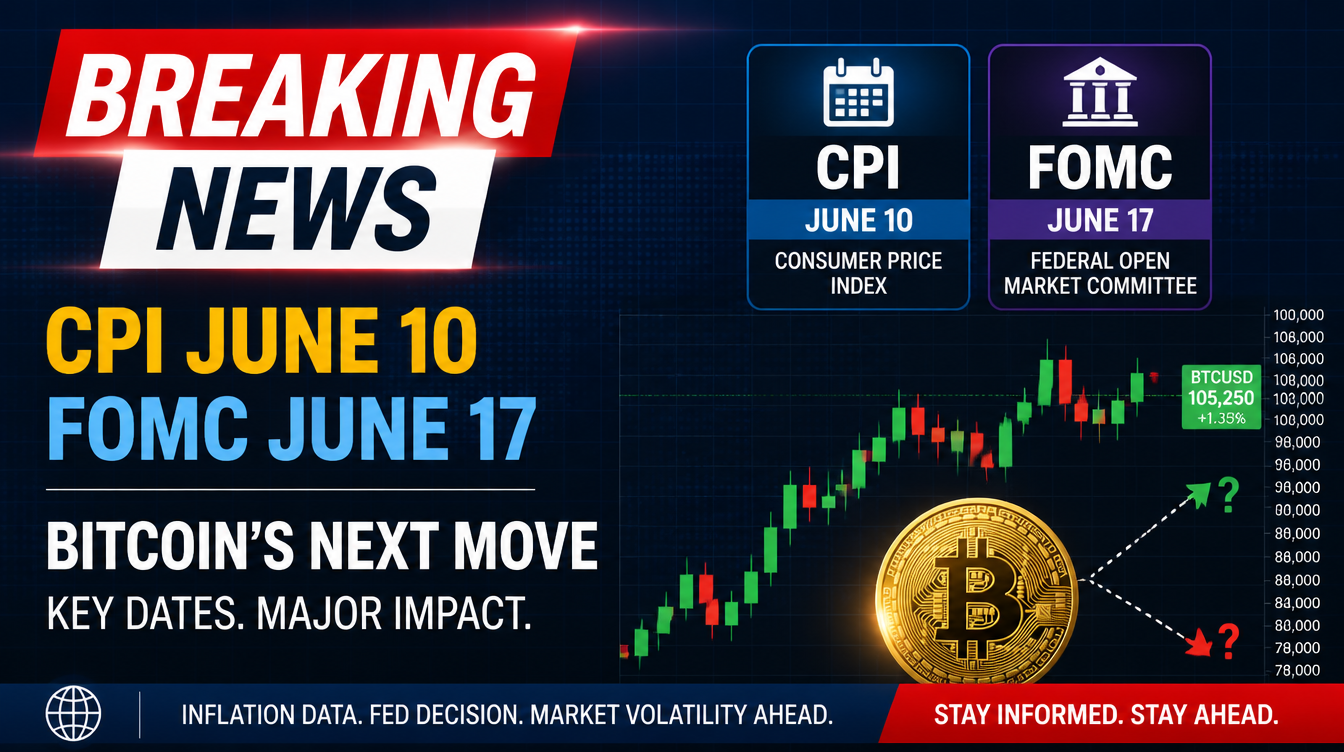
Bitcoin is heading into a critical stretch that could determine its direction for the rest of the year. Two closely watched macroeconomic events—the May Consumer Price Index (CPI) report on June 10 and the Federal Reserve’s updated FOMC dot plot on June 17—are expected to provide fresh clues about the future path of U.S. monetary policy.
With only seven days separating the two releases, markets are bracing for heightened volatility across risk assets, including Bitcoin.
April’s CPI rose 3.8% year-over-year, its highest level in nearly a year. Another stronger-than-expected inflation reading could force investors to reassess expectations for future rate cuts, creating significant ripple effects across financial markets.
The connection between inflation and Bitcoin is straightforward. CPI data shapes expectations for Federal Reserve policy, which influences Treasury yields and the strength of the U.S. dollar. As the dollar moves, Bitcoin often reacts in the opposite direction due to its sensitivity to global liquidity conditions.
Why CPI Matters for Bitcoin
Inflation data impacts markets through several channels. Higher inflation generally reduces expectations for interest-rate cuts, pushes bond yields higher, and strengthens the dollar. Lower inflation tends to have the opposite effect.
Because Bitcoin often performs best in periods of expanding liquidity and a weaker dollar, upcoming inflation data could become a major catalyst for price action.
Scenario 1: Inflation Remains Elevated
If May CPI exceeds 3.6%, markets may conclude that inflation remains stubbornly persistent.
Such an outcome would likely reduce expectations for policy easing in 2026, boost the DXY toward higher levels, and tighten overall financial conditions. Under this scenario, Bitcoin could face renewed selling pressure and potentially retest support in the mid-$60,000 range.
Scenario 2: Inflation Meets Expectations
A CPI reading between 3.3% and 3.6% would likely shift attention to the Federal Reserve’s updated rate projections.
If policymakers signal fewer rate cuts than investors currently anticipate, Bitcoin may remain range-bound while traders await clearer direction from the June 17 FOMC meeting. Volatility could stay elevated, but conviction may remain limited until the Fed provides additional guidance.
Scenario 3: Inflation Cools Faster Than Expected
A reading below 3.0% would strengthen the argument that inflation pressures are easing.
Such a result could encourage markets to price in a more dovish policy path, weakening the dollar and improving liquidity conditions. For Bitcoin and other risk assets, that would likely be viewed as a bullish development.
Labor Data Adds Another Variable
Before CPI is released, investors will also digest the latest Nonfarm Payrolls report. The labor market remains one of the Federal Reserve’s primary considerations when evaluating future policy decisions.
Strong employment data could reinforce concerns about inflation persistence, while signs of labor-market weakness may strengthen the case for future rate cuts.
Taken together, payrolls data, CPI, producer inflation, and the FOMC meeting form a sequence of interconnected events that could significantly reshape market expectations over the coming weeks.
Key Technical Levels for Bitcoin
While macroeconomic developments remain the primary focus, Bitcoin’s technical structure also points to a potentially significant move.
Resistance remains near $68,000, while support sits around $63,500. A weekly close above $68,000 could signal a breakout and renewed bullish momentum.
On the downside, a break below $62,500 would expose the psychologically important $60,000 level, where stronger demand is expected to emerge.
Another key area is near $65,000, which closely aligns with the average cost basis of short-term Bitcoin holders. This level has become an important battleground between buyers and sellers.
Momentum indicators remain relatively balanced. RSI is sitting in neutral territory, and funding rates suggest leverage remains under control. In other words, the market appears positioned for a major move but is not excessively stretched in either direction.
The weekly chart continues to compress, with lower highs and higher lows forming a tightening range. Historically, such periods of consolidation rarely persist through major macroeconomic catalysts.
As June 10 and June 17 approach, Bitcoin appears to be entering a decisive phase. A volatility spike looks increasingly likely—the only uncertainty is whether it results in a breakout to new highs or a move lower toward key support levels.