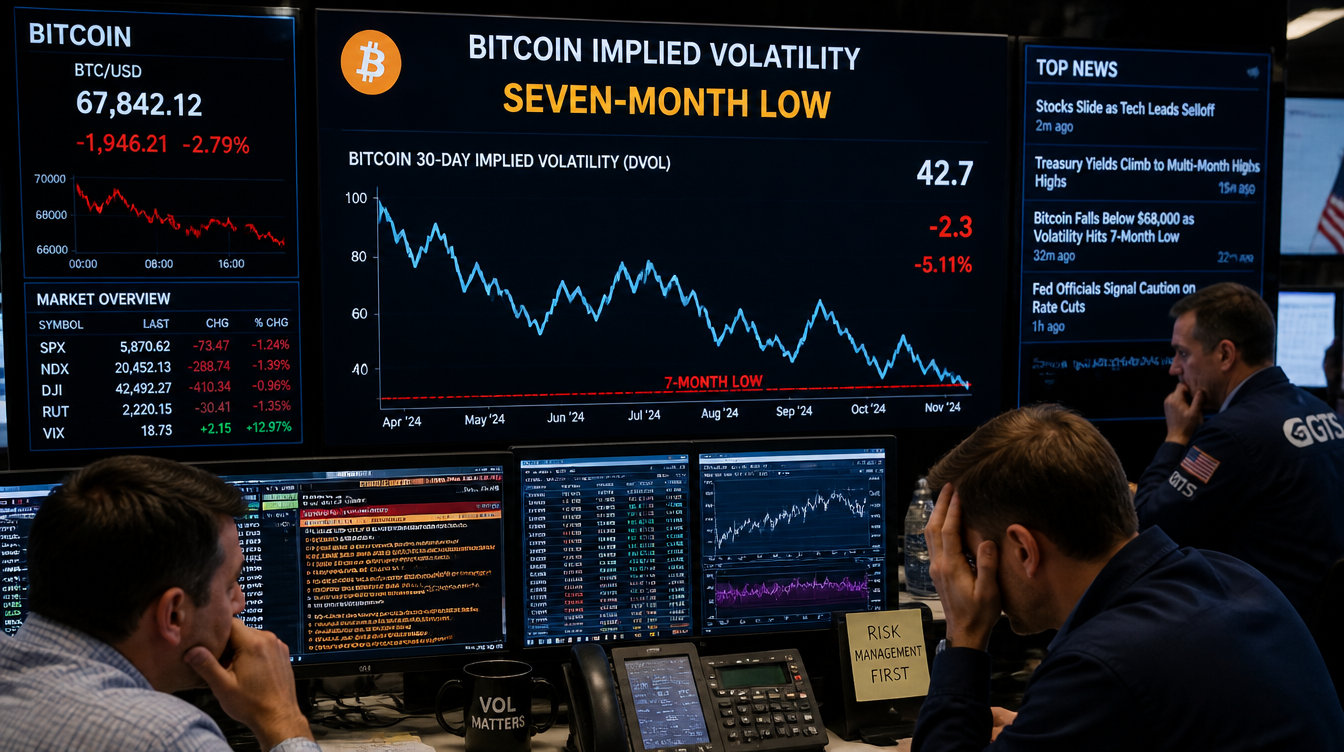
Bitcoin’s implied volatility is signaling a period of relative calm, even as financial markets continue to highlight persistent macroeconomic and geopolitical risks.
Despite ongoing uncertainty around inflation, interest rates, and global tensions, Bitcoin’s BTC $75,432.14 volatility profile suggests traders are bracing for more subdued price swings in the near term.
The 30-day annualized implied volatility index (BVIV) has extended its decline, dropping to 38%—its lowest level since October 2025, according to Volmex data. In options markets, a falling implied volatility reading typically reflects expectations of smaller future price movements.
“Bitcoin volatility has collapsed, and you can see it clearly in BVIV levels, which we track closely to monitor market complacency,” said Shiliang Tang, Managing Partner at Monarq Asset Management.
Tang attributed the low-volatility environment to a mix of easing geopolitical tensions and structural market flows. He noted that risks linked to the Iran conflict appear to be cooling, while ongoing Bitcoin purchases by Strategy (MSTR) and its STRC-linked structure continue to provide a perceived support level for prices.
He also highlighted the growing role of systematic “call overwriters” in suppressing volatility. This strategy involves selling out-of-the-money call options to generate yield on top of spot holdings. With Bitcoin trading near $77,300, these participants typically sell calls above market levels, limiting upside volatility while collecting option premiums.
Institutional funds using such yield-enhancement strategies have become a steady source of options supply, helping compress implied volatility and reducing expectations for large directional price swings.
“Because Bitcoin has underperformed other risk assets on the upside, systematic overwriters are aggressively selling options for yield, keeping a heavy lid on the entire volatility complex,” Tang added.
Bitcoin is currently trading near $77,000, while crude oil—often viewed as a proxy for geopolitical risk—remains relatively stable, with WTI futures staying below the $100-per-barrel mark.
On the demand side, Strategy has accumulated 171,238 BTC in 2026, significantly outpacing the roughly 63,450 BTC mined over the same period. This imbalance continues to underscore strong institutional demand and tightening effective supply.
More broadly, Bitcoin’s declining volatility reflects its ongoing maturation into an institutional asset. As ETF participation, corporate treasuries, and asset manager exposure expand, deeper liquidity and broader ownership are helping to reduce the extreme price swings that characterized earlier stages of the market.