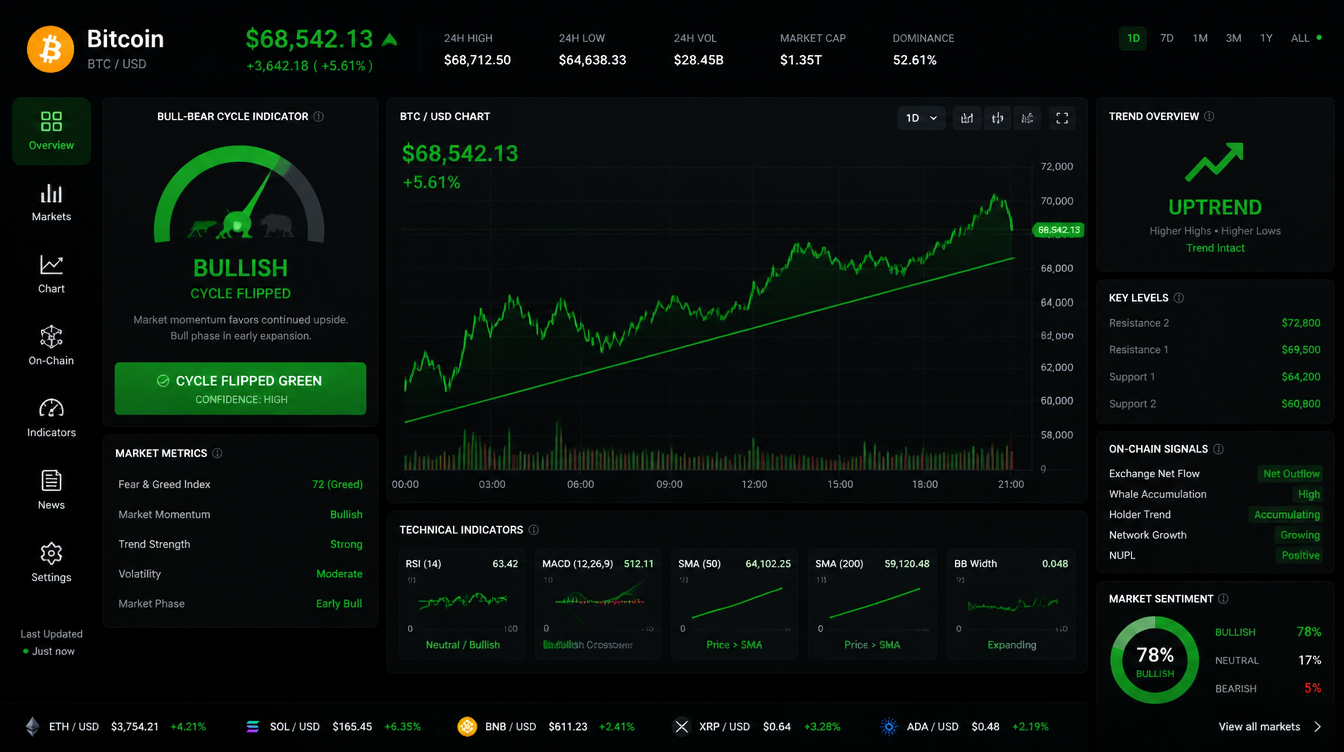
An important on-chain indicator is signaling a potential shift in bitcoin’s market cycle, though analysts remain cautious about reading too much into the move.
CryptoQuant’s bull-bear cycle metric has flipped green for the first time since 2023, a development that suggests improving underlying conditions. According to analyst Julio Moreno, the transition typically indicates that the most severe phase of a downturn may be over, with early signs of recovery beginning to emerge.
Such signals have historically marked key inflection points. When the indicator exits bearish territory, it often reflects strengthening momentum beneath the surface, even if price action has yet to fully confirm the trend.
Still, experts warn against treating the indicator as a predictive tool. Mati Greenspan, founder of Quantum Economics, described it as a measure of market regime rather than a crystal ball. Its strength lies in highlighting when bitcoin stops behaving like a bear-market asset, not in forecasting how far or how fast prices will move.
Greenspan emphasized that confirmation must come from sustained improvements in demand, liquidity, and the market’s ability to hold higher levels. Until then, price action remains the ultimate test.
Past instances — including in 2019 and early 2023 — saw similar signals precede strong bullish phases. However, Moreno pointed to March 2022 as a reminder that false positives can occur, when the indicator briefly turned positive before the market moved lower again.
The current setup reflects a mixed backdrop. While on-chain data points to a constructive shift and momentum is improving, bitcoin continues to struggle with resistance near $82,000. The asset has rebounded about 35% from its February lows around $60,000 but has yet to secure a decisive breakout.
Moreno also highlighted signs of exhaustion in secondary indicators, suggesting the market may need additional time before establishing a sustained uptrend. The environment is further complicated by neutral sentiment readings and a challenging macroeconomic backdrop.
Some market participants share a more optimistic view. Arthur Hayes, CIO of Maelstrom and co-founder of BitMEX, believes bitcoin likely bottomed near $60,000 earlier this year. He identifies $90,000 as a key threshold that could trigger a more aggressive rally toward previous highs around $126,000.
At the same time, analysts stress the importance of interpreting on-chain metrics carefully. Jason Fernandes, co-founder of AdLunam, noted that indicators such as MVRV and NUPL are best used to understand broader market behavior and positioning within the liquidity cycle, rather than as precise trading signals.