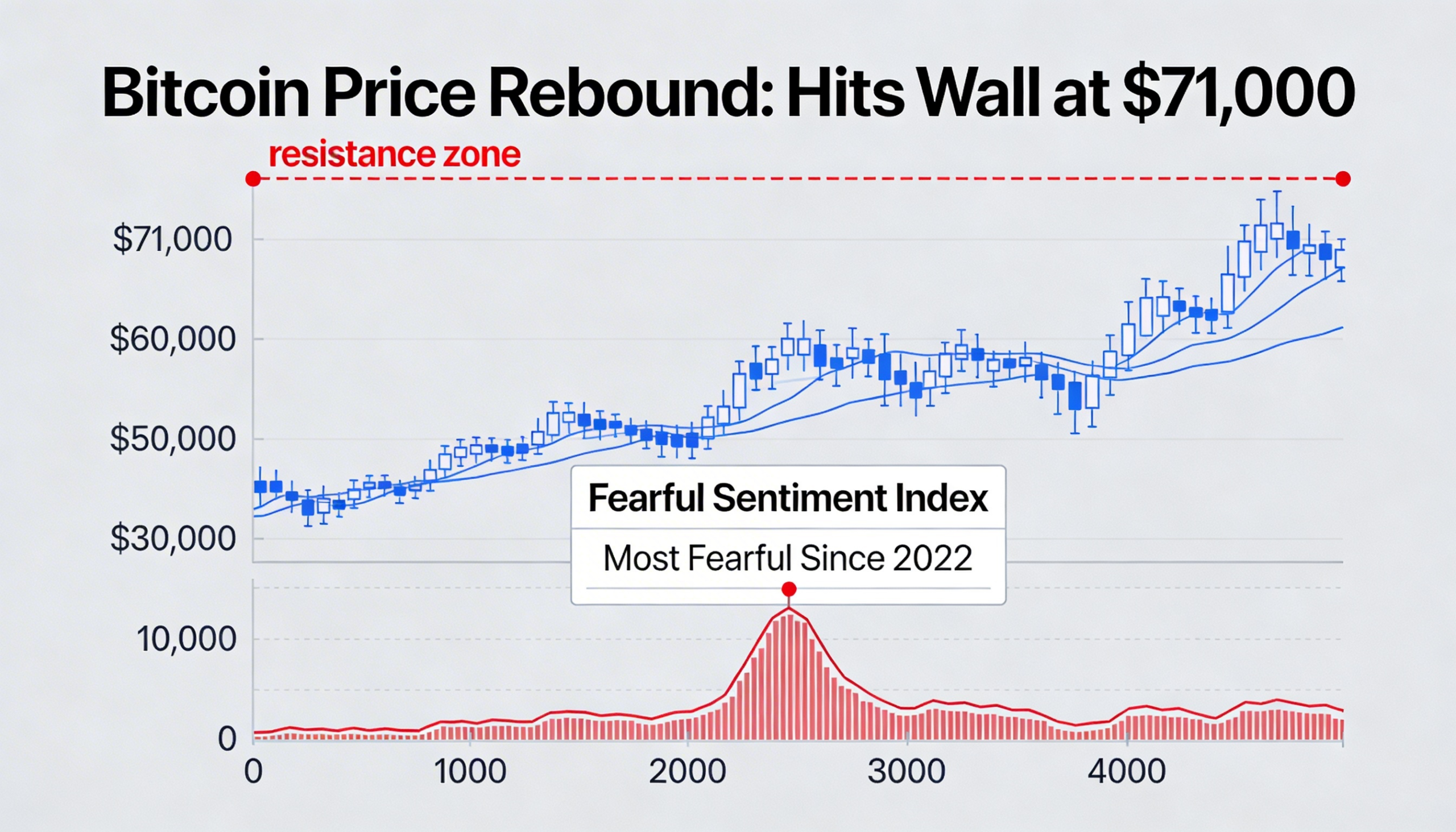
Bitcoin’s recovery effort is losing traction as weakening volumes and thinning liquidity reinforce signs of a broader market pullback.
The largest cryptocurrency rebounded sharply over the weekend after sliding into the low-$60,000 range in a heavy selloff that many traders described as capitulation-like. Prices briefly climbed back toward $70,000, but buying pressure has since faded, leaving the rally vulnerable to renewed downside.
Market participants are increasingly viewing the move as a typical bear-market bounce — a swift rebound that draws in opportunistic buyers before encountering substantial selling from investors looking to reduce exposure at stronger price levels.
“There is still considerable supply from those waiting to exit on strength,” said Alex Kuptsikevich, chief market analyst at FxPro. He cautioned that, under current conditions, bitcoin could soon revisit its 200-week moving average, a long-term technical level closely watched by traders.
Momentum began to stall near the $2.4 trillion total crypto market capitalization threshold, reinforcing skepticism about the durability of the advance. According to Kuptsikevich, the recent move may prove to be only a temporary recovery within a broader corrective phase that has not yet fully played out.
Investor sentiment reflects that uncertainty. The Crypto Fear and Greed Index dropped to 6 over the weekend — a level comparable to the depths of the 2022 FTX-driven downturn — before edging up to 14 by late Monday. Despite the modest rebound, the indicator remains entrenched in extreme fear territory.
Such readings suggest caution remains dominant, with confidence still too fragile to support aggressive buying, analysts say.
At the same time, liquidity conditions are amplifying price swings. Order books across exchanges have thinned, meaning relatively modest sell orders can drive outsized market moves. Those declines can trigger stop-loss orders and forced liquidations, setting off a self-reinforcing cycle of volatility.
This structural fragility helps explain why bitcoin can move thousands of dollars in a single session yet repeatedly fail to clear important resistance zones.
Data from crypto analytics firm Kaiko supports the broader risk-off narrative. In a recent note, the firm said aggregate trading volumes on major centralized exchanges have fallen about 30% since late 2025. Monthly spot volumes have dropped from roughly $1 trillion to around $700 billion.
Although last week saw brief spikes in activity during periods of heightened volatility, Kaiko noted that overall participation has been trending lower. Retail traders, in particular, appear to be gradually stepping back rather than exiting in a single, panic-driven wave.
In markets with reduced liquidity, prices can slide quickly even without heavy selling pressure. The absence of sustained, high-volume capitulation may indicate that a definitive bottom has yet to form.
Kaiko also contextualized the correction within bitcoin’s four-year halving cycle. After reaching a high near $126,000 in late 2025 or early 2026, the cryptocurrency has retraced sharply. The current trading range between $60,000 and $70,000 represents a drawdown of more than 50% from its peak.
Historically, cycle lows have taken time to develop and often involve several failed rallies before a lasting recovery takes shape.
For now, the $60,000 level remains a crucial support area. If buyers can continue to defend that zone, bitcoin may enter a prolonged period of volatile consolidation. A break below it, however, could reignite the same thin-liquidity pressures that intensified the recent selloff — particularly if broader macro sentiment remains tilted toward risk aversion.