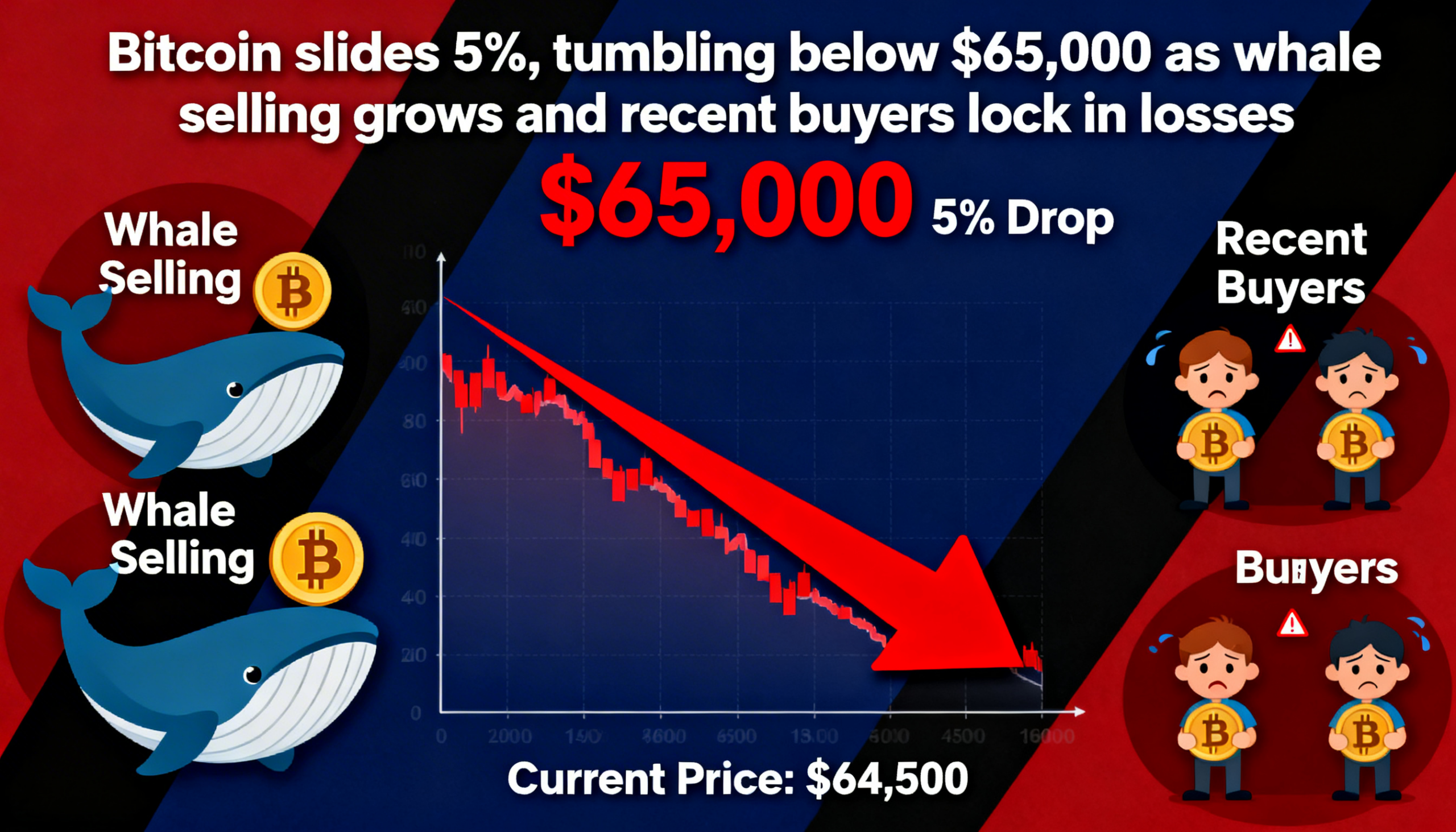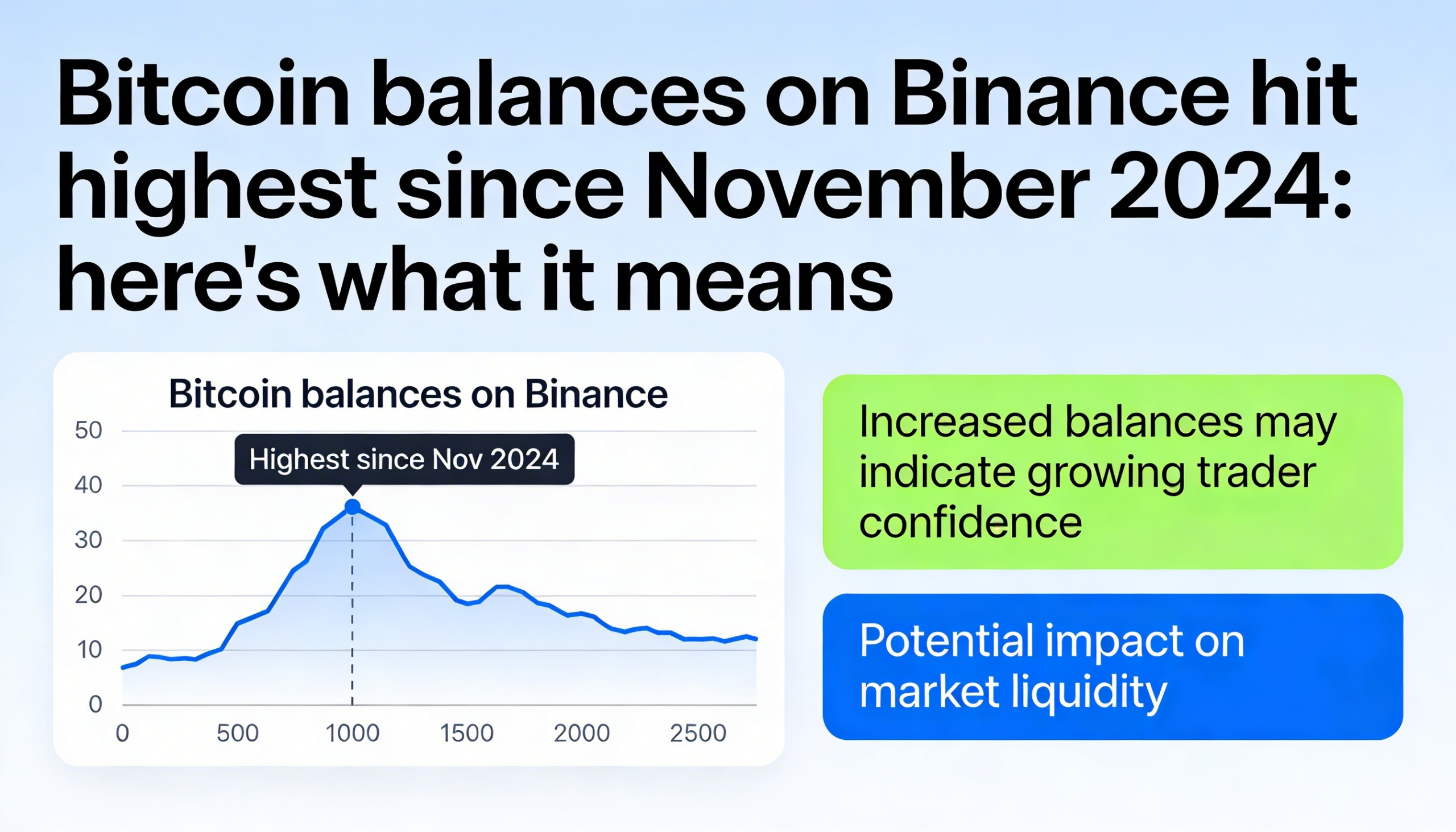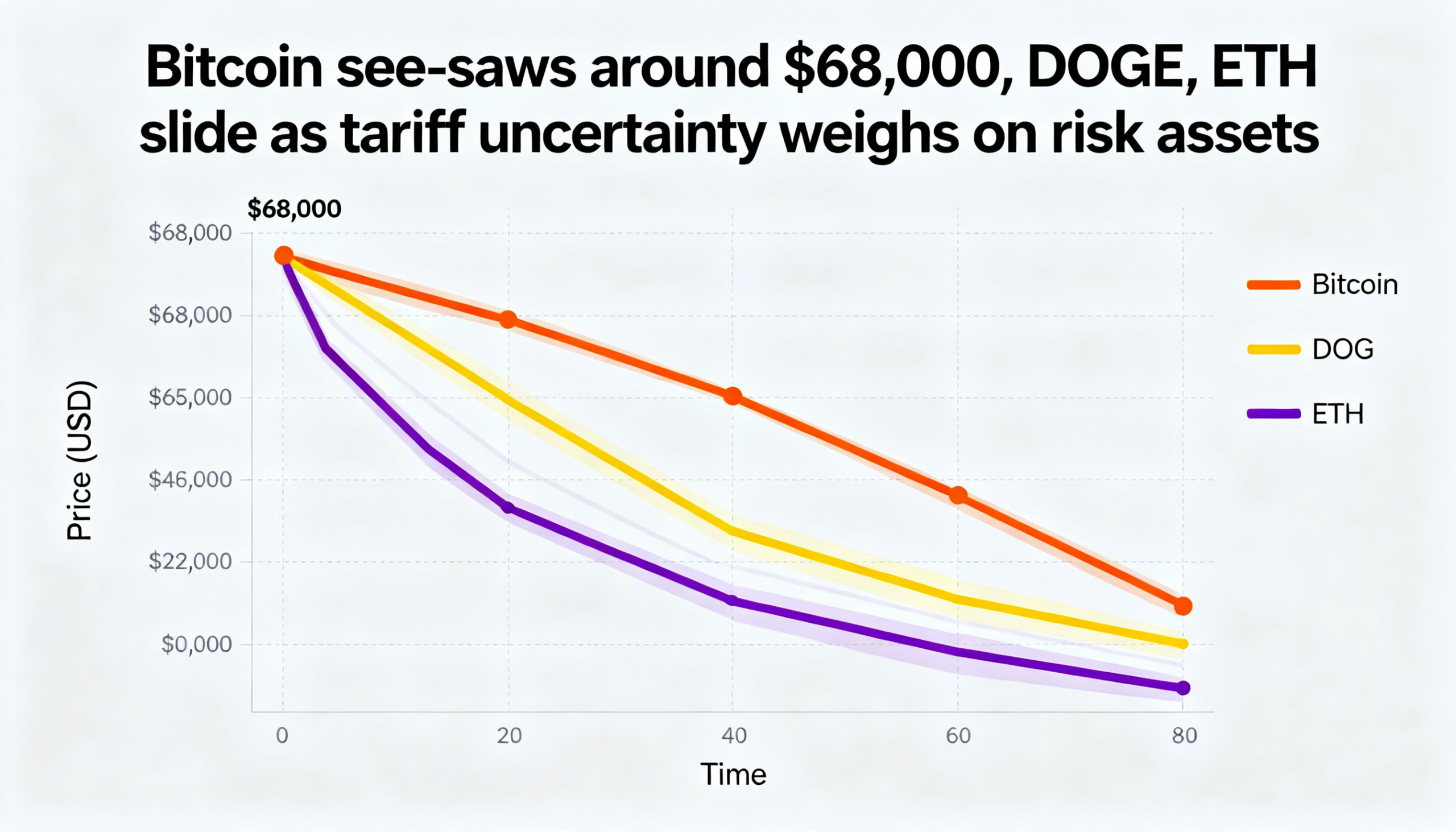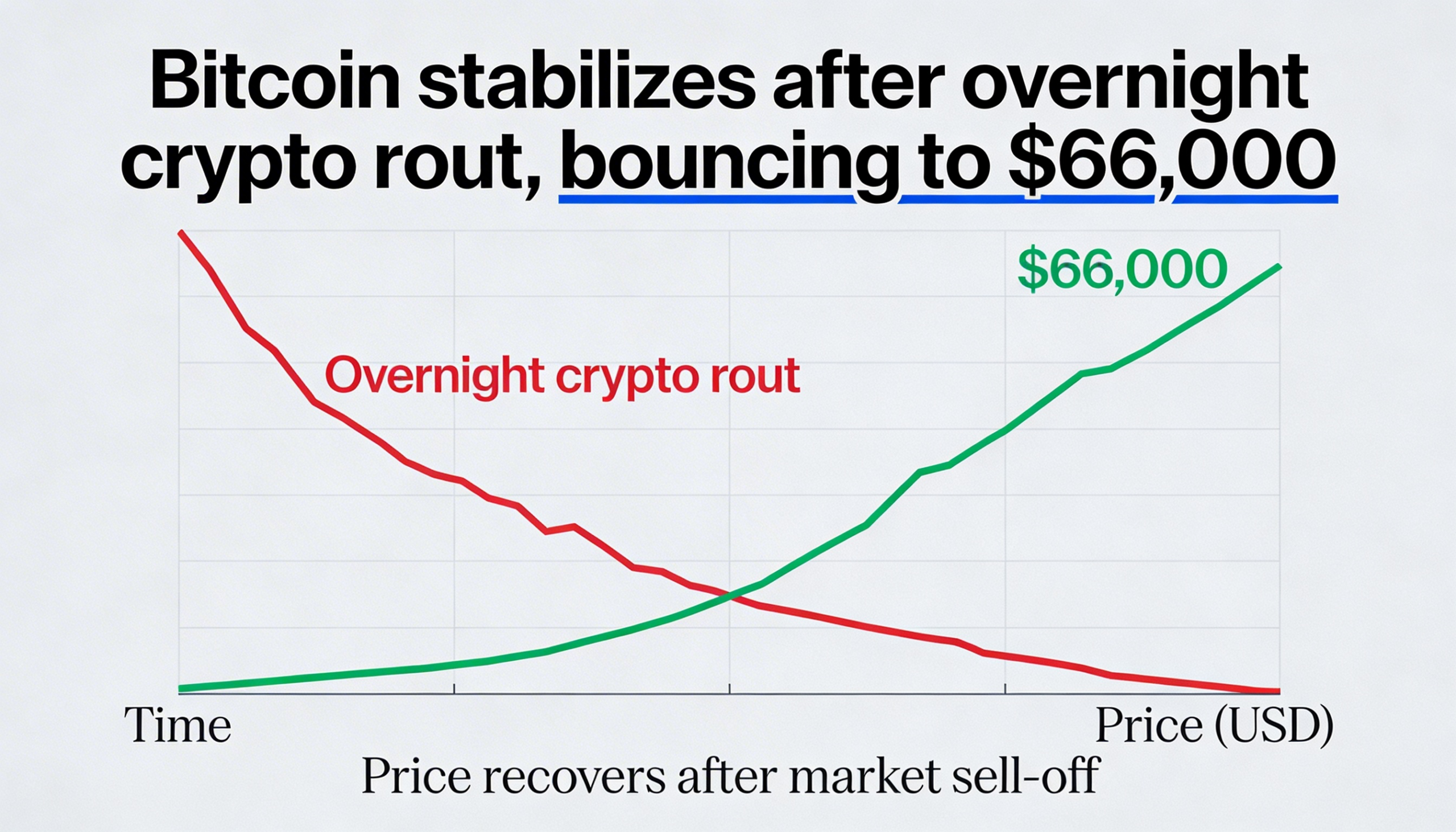
Bitcoin endured a sharp overnight swing during Asian trading on Monday, sliding more than 5% to $64,270 shortly after midnight UTC before rebounding to around $66,300 by late morning. Thin market liquidity amplified the move as investors reacted to renewed U.S. tariff threats and rising geopolitical tensions.
The volatility mirrored action in traditional markets. Futures tied to the S&P 500 dropped 0.84% after Sunday’s open before stabilizing several hours later. Meanwhile, gold futures surged to their highest level since Jan. 30 at the open, then pared gains during European hours. Silver followed a similar path, reflecting a rotation into safe-haven assets.
The divergence came after U.S. President Donald Trump outlined plans to impose new 15% global tariffs on trading partners, while reports of increased U.S. military presence near Iran added to market unease.
Altcoins were hit harder amid the low-liquidity backdrop. Solana (SOL) and SUI each fell between 7% and 8% overnight before recovering during European trading. The sharp moves triggered approximately $270 million in altcoin liquidations, according to CoinGlass.
Derivatives positioning remains cautious
Leverage demand continues to look restrained. Total crypto futures open interest has stayed below $100 billion for more than two weeks, pointing to reduced speculative appetite.
Over the past 24 hours, roughly $500 million in crypto futures positions were liquidated as traders faced margin shortfalls. At the same time, capital appears to be rotating toward products linked to traditional assets. Open interest in Tether Gold (XAUT) futures climbed 14% in 24 hours, even as bitcoin, ether, solana, HYPE and dogecoin saw ongoing outflows.
ZEC and CRO were the only tokens to register a positive 24-hour cumulative volume delta (CVD), suggesting buyer dominance. Bitcoin and other major assets recorded negative CVD readings, signaling stronger selling pressure.
Bitcoin’s 30-day implied volatility index (BVIV) jumped 9% to above 60%, reflecting heightened uncertainty. On Deribit, bitcoin and ether put options traded at a premium to calls across maturities, underscoring persistent demand for downside protection. Traders concentrated activity in puts at $58,000, $60,000 and $62,000 strike levels following the tariff announcement.
Altcoins struggle in thin markets
The broader altcoin market remained under pressure after what appeared to be an exaggerated selloff driven by bitcoin’s weakness and declines in U.S. equities.
Low liquidity intensified losses across smaller tokens. Pump.fun’s PUMP token slid 8.5% before rebounding, while LayerZero’s ZRO dropped 16.5% over 24 hours before stabilizing around 04:00 UTC. A few tokens bucked the trend, including restaking protocol ETHFI, which gained more than 10% from its Monday low.
Telegram-linked toncoin (TON) showed relative resilience, dipping 3.6% overnight before bouncing nearly 5%.
Among sector benchmarks, the CoinDesk DeFi Select Index (DFX) was the strongest performer over the past 24 hours, declining 1.84%. The CoinDesk Smart Contract Platform Select Index and CoinDesk Computing Select Index fell 3.56% and 3.23%, respectively.
Altcoins have largely tracked bitcoin’s movements throughout February, but thin order books have magnified price swings. Should bitcoin establish a local bottom and reclaim levels above $70,000, several altcoins could be positioned for a more sustained recovery after early-month volatility flushed liquidity from the market.