The debate surrounding Bitcoin has moved beyond questions about its survival to a more complex issue: whether the digital asset can ultimately serve as a sovereign reserve asset. As the cryptocurrency matures, critics are increasingly evaluating it using the same standards applied to institutional investments.
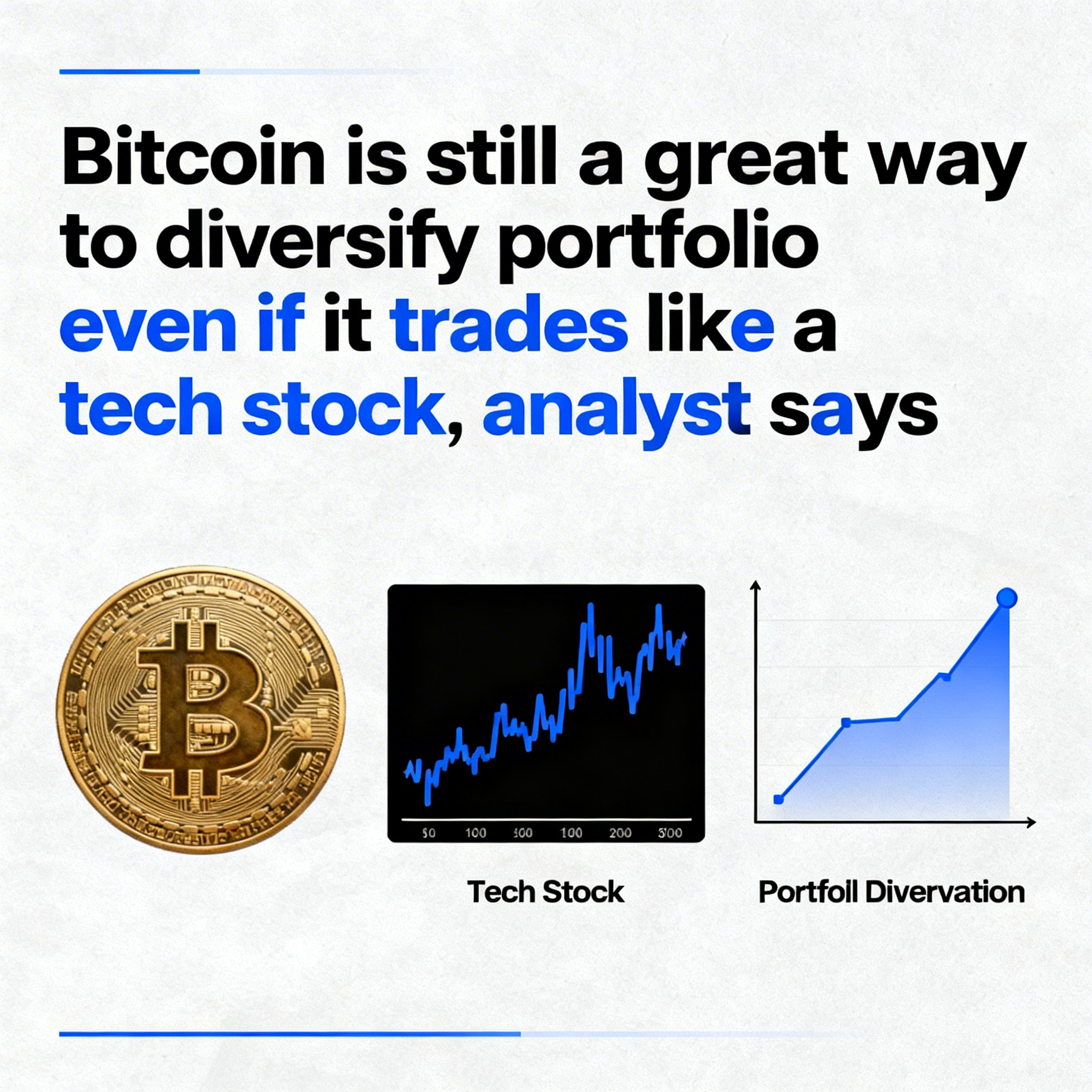
Although bitcoin has recently moved in closer alignment with U.S. equities, that trend does not diminish its usefulness as a portfolio diversifier, according to financial services firm NYDIG. In a weekly market report, the company’s global head of research, Greg Cipolaro, noted that bitcoin’s correlation with major stock indexes such as the S&P 500, the Nasdaq 100, and the software-focused iShares Expanded Tech-Software Sector ETF (IGV) has increased in recent months.
That development has prompted some analysts to argue that bitcoin is effectively trading like a technology stock. Cipolaro, however, rejects that conclusion.
Even when correlations approach 0.5, equities account for only a limited portion of bitcoin’s price movements, he explained. Statistically, that level suggests that about one-quarter of bitcoin’s performance can be attributed to stock market dynamics, while the majority is driven by factors specific to the crypto market.
Those factors include inflows into bitcoin investment funds, changes in derivatives positioning, shifts in network adoption, and regulatory developments.
Cipolaro said the recent synchronization between bitcoin and equities is likely tied to the broader macroeconomic environment rather than a structural link between the two asset classes. Both bitcoin and growth-oriented stocks tend to react to similar conditions, particularly global liquidity and investor appetite for risk.
Even so, the relationship does not undermine bitcoin’s diversification value. While cross-asset correlations with equities are currently elevated, they remain far from determining bitcoin’s overall returns, Cipolaro wrote.
Bitcoin’s evolving narrative
NYDIG’s report also addressed recent remarks from high-profile investors, including Chamath Palihapitiya and Ray Dalio, which have renewed discussion about bitcoin’s long-term role.
Palihapitiya, an early supporter who once described bitcoin as “Gold 2.0” in 2013, recently questioned whether the asset is suitable for sovereign balance sheets. Dalio has voiced similar concerns over the years, pointing to volatility, regulatory risks and potential long-term technological threats such as advances in Quantum Computing.
Cipolaro said such critiques reflect shifting expectations as bitcoin transitions from a retail-driven market to one increasingly shaped by institutional participation. Nevertheless, he argued that bitcoin’s long-term growth does not depend on central bank adoption.
Instead, the asset’s user base has steadily expanded from individual investors to family offices, asset managers and exchange-traded funds—an evolution that differs from many past financial innovations that began with institutional capital.
Central bank ownership could ultimately strengthen the legitimacy of the asset class, Cipolaro noted, but it is not essential for bitcoin’s continued growth.
According to the report, bitcoin’s value ultimately stems from its globally distributed network, political neutrality and technical properties that enable censorship-resistant transfers of value, enforce digital scarcity and allow the system to operate independently of any single government, institution or monetary authority.